
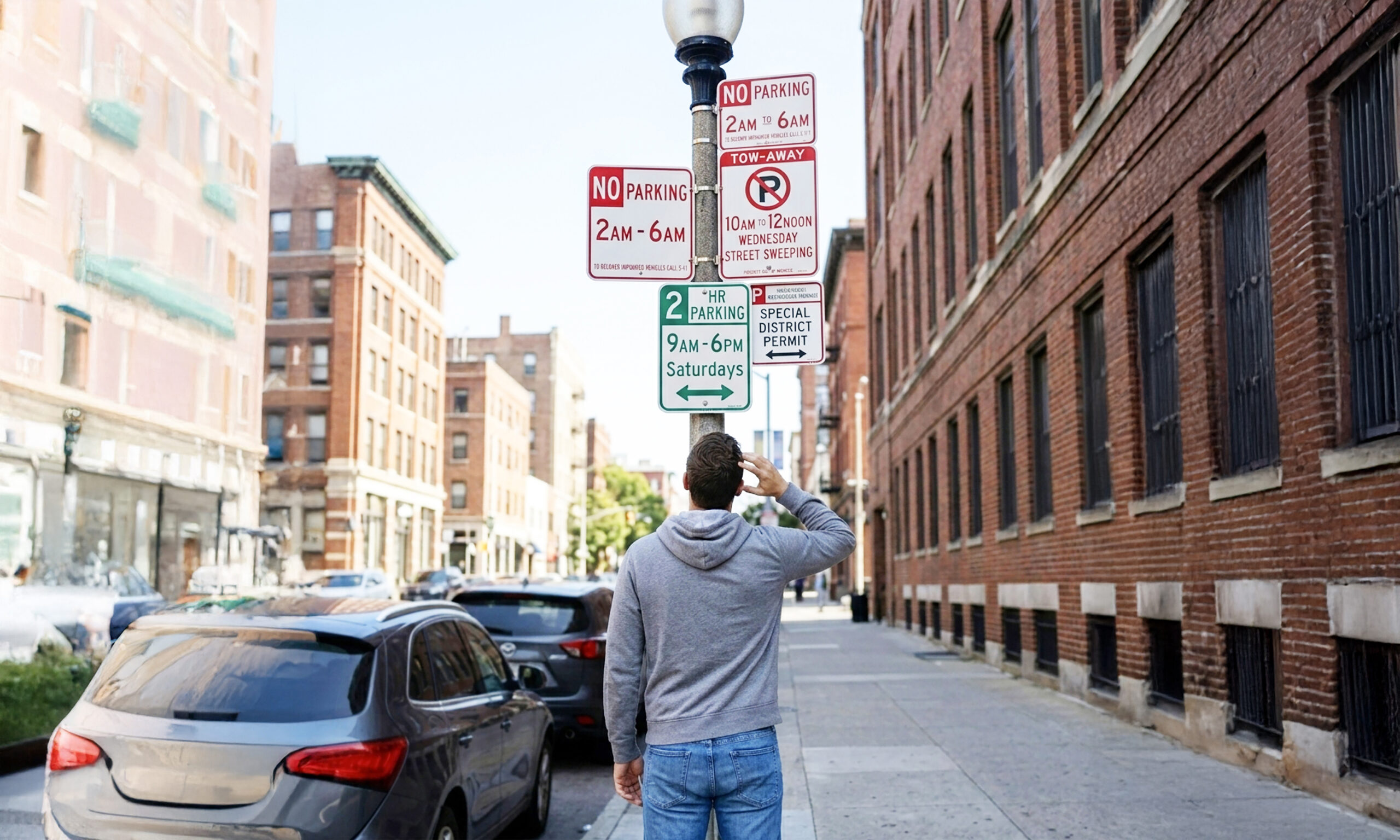
Four signs. Three different time periods. Two arrows. One parking space.
Which rule are you supposed to follow?
If you’ve ever looked up at a pole covered in parking signs and felt like you needed a flowchart just to leave your car, you’re not alone.
One sign says:
2 HOUR PARKING
Another says:
NO PARKING — STREET CLEANING
A third adds:
PERMIT REQUIRED
And somewhere in the stack, an arrow points down the block.
At first glance, the signs can seem contradictory. One appears to allow parking while another tells you not to park at all.
But here’s the key:
The signs may all be correct at the same time.
Multiple parking signs on one pole often represent different rules for different days, times, vehicles, or sections of curb. The challenge isn’t deciding which sign to believe—it’s determining which rules apply to your exact parking space right now.
That’s where drivers get tripped up.
Instead of trying to decode the entire stack at once, there’s a much easier way to approach it:
Separate the rules first. Then put the answer back together.
Here’s how.
Why Are There Multiple Parking Signs on One Pole?
A single stretch of curb can serve different purposes throughout the week.
For example, the same parking space might allow:
2-hour parking during the day
but prohibit parking during:
morning rush hour
and then have another restriction for:
street cleaning on Tuesday
There may also be permit requirements, loading periods, temporary restrictions, or other rules.
Rather than assuming the signs contradict one another, think of each sign as another piece of information about when and how that curb can be used.
Your job is to determine which pieces apply right now.
If you’re new to interpreting street parking restrictions, start with our guide on how to read parking signs for a step-by-step look at days, times, restrictions, arrows, and other important details.
Step 1: Start With Your Exact Parking Location
Before trying to decipher the times and days, determine whether the signs actually apply to your space.
Look at where your vehicle is positioned relative to:
the signpost
directional arrows
intersections
driveways
curb markings
nearby signs
other posted boundaries
Two cars parked on the same block can potentially be subject to different restrictions.
So your first question should always be:
Do these signs apply to where my car is parked?
Once you’ve established that, you can start working through the individual rules.
Step 2: Read Each Parking Sign Separately
One of the biggest mistakes drivers can make is trying to interpret the entire stack as one giant parking sign.
Instead, break it apart.
Imagine a pole with these three signs:
NO PARKING
7 AM–9 AM
MON–FRI
2 HOUR PARKING
9 AM–6 PM
MON–SAT
NO PARKING — STREET CLEANING
TUESDAY
10 AM–12 PM
Don’t try to understand all three at once.
Read each sign as its own rule.
Then compare those rules to your current situation.
Step 3: Identify the Restriction on Each Sign
Start with the main instruction.
Look for language such as:
NO PARKING
NO STOPPING
NO STANDING
2 HOUR PARKING
LOADING ONLY
PERMIT REQUIRED
STREET CLEANING
This tells you what kind of parking rule you’re dealing with.
Some restrictions sound similar but can have important differences. Our guide to No Parking vs. No Standing vs. No Stopping explains what each term commonly means for drivers.
But don’t make your decision yet.
The large words may get your attention, but the smaller details determine when and where that rule applies.
Step 4: Match Each Restriction to Its Day
Next, look at the days listed on each sign.
You might see:
MON–FRI
SATURDAY
TUESDAY
EXCEPT SUNDAYS
or another day-specific condition.
This can immediately eliminate some restrictions from consideration.
For example, if one sign prohibits parking:
TUESDAY 10 AM–12 PM
and you’re parking on Wednesday, that particular time-based restriction may not apply at that moment.
But another sign on the same pole still might.
That’s why you need to evaluate every applicable sign, rather than finding one rule that appears to permit parking and stopping there.
Step 5: Match the Rule to the Current Time
After the day, check the time.
Suppose the signs say:
NO PARKING
7 AM–9 AM
and:
2 HOUR PARKING
9 AM–6 PM
At 8:00 AM, the first rule may be the relevant restriction.
At 11:00 AM, the second rule may become relevant.
The physical parking space hasn’t changed.
The applicable rule has.
This is one reason street parking can be so confusing: whether parking is allowed can depend not only on where you are, but also when you’re there.
If you’re leaving your vehicle overnight, you also need to consider how the rules may change after you park. Our guide to Overnight Parking Rules explains what to check as the day and time change.
Step 6: Pay Attention to Parking Sign Arrows
Now check the arrows.
An arrow can help indicate which section of curb a particular restriction applies to.
One sign might point:
← LEFT
Another might point:
RIGHT →
And another could indicate both directions:
← →
This means two signs attached to the same pole may not necessarily govern exactly the same stretch of curb.
Your car’s position relative to the sign matters.
That’s why parking sign arrows shouldn’t be treated as decoration. They’re part of the information you need to determine whether a particular restriction applies to your space.
If directional signs are the part that trips you up, see what parking sign arrows mean and how left, right, and two-way arrows can affect which section of curb a restriction applies to.
Step 7: Look for Exceptions
Parking signs frequently contain exceptions that modify the general rule.
You might encounter wording such as:
EXCEPT SUNDAYS
EXCEPT HOLIDAYS
EXCEPT WITH PERMIT
or other locally defined exceptions.
An exception can materially change how a restriction applies.
But be careful: an exception on one sign doesn’t necessarily cancel a completely separate restriction on another sign.
Associate each exception with the rule it actually belongs to.
What Happens When Parking Rules Overlap?
This is where stacked parking signs become especially tricky.
Suppose it’s Tuesday at 10:30 AM and the pole says:
2 HOUR PARKING
9 AM–6 PM
but another sign says:
NO PARKING — STREET CLEANING
TUESDAY
10 AM–12 PM
You might look at the first sign and think:
Great. I can park for two hours.
But the street-cleaning restriction may prohibit parking during that specific period.
This illustrates an important principle:
A general parking rule doesn’t necessarily override a more specific restriction that applies at that moment.
You need to consider the applicable rules together.
The Simple Formula for Reading Multiple Parking Signs
When you’re staring at a pole covered with parking regulations, use this sequence:
LOCATION → RULE → DAY → TIME → ARROW → EXCEPTION → OTHER RESTRICTIONS
LOCATION
Does this sign apply to my parking space?
RULE
What does each individual sign permit or prohibit?
DAY
Which rules apply today?
TIME
Which rules apply right now?
ARROW
Which direction or section of curb does each rule cover?
EXCEPTION
Are there exceptions that modify a particular rule?
OTHER RESTRICTIONS
Are there additional signs, curb markings, temporary notices, or local regulations I need to consider?
Then ask the question that actually matters:
Don’t Forget to Look Beyond the Pole
Even after you’ve successfully interpreted every sign, take a quick look around before leaving your vehicle.
Parking restrictions aren’t always contained on one signpost.
Depending on the location, additional restrictions may involve curb markings, temporary signs, construction notices, fire hydrants, driveways, loading areas, accessible parking spaces, permit zones, or other local regulations.
A perfectly interpreted sign doesn’t help if there’s another applicable restriction you didn’t notice.
Why Stacked Parking Signs Feel So Confusing
The problem isn’t necessarily that any individual sign is difficult to read.
It’s the number of variables you’re being asked to process simultaneously.
You may need to determine:
Where am I?
Which signs apply here?
What does each one prohibit or permit?
What day is it?
What time is it?
Which way do the arrows point?
Are there exceptions?
Do any of these rules overlap?
That’s a lot of information to process just to park a car.
And ultimately, drivers don’t really want an interpretation of six different regulations.
They want an answer to one much simpler question:
Can I park here?
Can Technology Help Read Multiple Parking Signs?
This is exactly the type of parking problem ParkClear was created to simplify.
ParkClear uses location-based technology and parking sign analysis to help drivers understand applicable parking information and provide clearer “Yes” or “No” parking guidance.
Learn more about how ParkClear helps read street parking signs and simplifies complicated parking restrictions into clearer guidance for your location.
When several signs contain different restrictions, days, hours, arrows, or exceptions, ParkClear is designed to help simplify that information into a more straightforward parking decision.
Instead of standing on the sidewalk trying to solve:
Sign #1 + Sign #2 + Sign #3 + arrow + Tuesday + 10:30 AM…
the goal is much simpler:
Can I park here?
From a Stack of Signs to a Clearer Parking Decision
The next time you see multiple parking signs on one pole, don’t try to absorb everything at once.
Break the information down.
Remember:
LOCATION → RULE → DAY → TIME → ARROW → EXCEPTION → OTHER RESTRICTIONS
Evaluate each sign individually.
Then put the applicable rules back together.
Because the goal isn’t to become an expert at deciphering parking signs.
It’s to make a more informed parking decision—and get on with your day.
Park with confidence. Save time. Skip the parking-sign headache.
Parking regulations vary by jurisdiction. Always follow posted signs and applicable local laws, and check official local rules when necessary.



33 Comments