
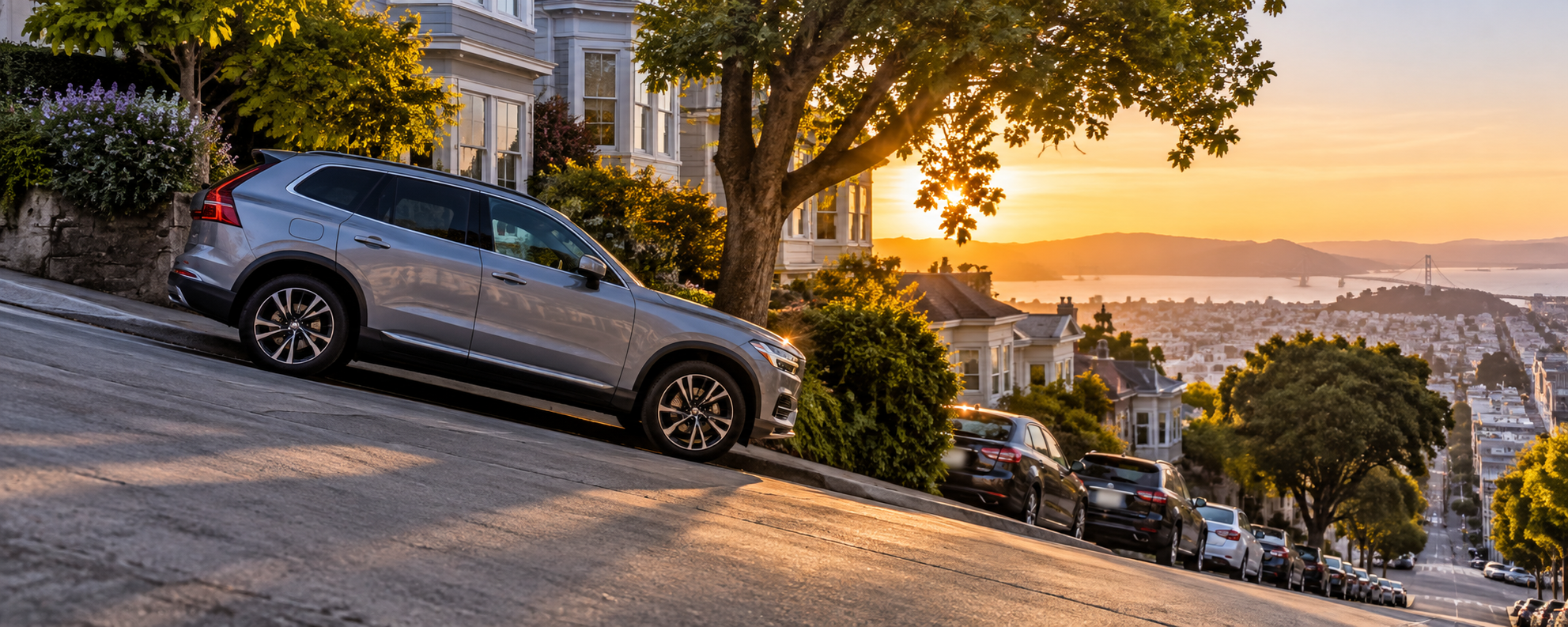
Parking on a hill requires more than simply finding a legal curb space. The direction of the slope, whether a curb is present, and the position of your wheels can all matter.
If you’re wondering how to park on a hill, hill parking rules generally involve positioning your vehicle so that it is less likely to roll into traffic if it begins to move.
You should also remember that parking correctly on a slope does not automatically mean the space itself is legal. Posted parking signs and local restrictions still apply.
How Should You Park on a Hill?
When parking on a hill, secure the vehicle according to its manufacturer instructions and applicable local rules.
One of the most important considerations is the direction your front wheels are facing.
A commonly taught approach is:
- Uphill with a curb: turn the front wheels away from the curb.
- Downhill with a curb: turn the front wheels toward the curb.
- Uphill without a curb: generally turn the wheels toward the edge of the roadway.
The goal is to reduce the chance that an unattended vehicle will roll into traffic.
Because vehicle technology and legal requirements can vary, follow your vehicle owner’s manual and the rules in the jurisdiction where you are parking.
Which Way Do You Turn Your Wheels When Parking Uphill?
When parking uphill beside a curb, drivers are commonly instructed to turn the front wheels away from the curb.
The idea is that if the vehicle rolls backward, a front tire can contact the curb rather than allowing the vehicle to continue freely into the roadway.
After positioning the vehicle, secure it properly before leaving it unattended.
Which Way Do You Turn Your Wheels When Parking Downhill?
When parking downhill beside a curb, the front wheels are commonly turned toward the curb.
If the vehicle begins moving forward, the curb can help prevent it from rolling farther into the roadway.
Again, wheel position is only one part of properly securing a parked vehicle.
How Do You Park Uphill Without a Curb?
Parking uphill without a curb requires different consideration because there is no raised curb to help stop the vehicle.
Drivers are commonly instructed to turn the front wheels toward the edge of the road so that, if the vehicle begins to roll, it moves away from the traveled roadway rather than into traffic.
Be particularly careful about the shoulder, roadway edge, pedestrians, and surrounding conditions.
Should You Use the Parking Brake on a Hill?
Follow your vehicle manufacturer’s instructions for securing the vehicle when parked, including use of the parking brake.
A hill places additional importance on making sure the vehicle cannot move after you leave it.
Do not rely solely on the position of the wheels to secure the vehicle.
Does the Direction Your Car Faces Matter?
Yes, because whether your vehicle is facing uphill or downhill changes the direction it could move if it begins to roll.
Before positioning your wheels, determine whether the front of your vehicle points up the slope or down the slope.
This sounds simple, but on streets with mild grades it may not always be immediately obvious.
Can You Park on a Steep Hill?
A hill being steep does not by itself answer whether parking is allowed.
The parking space may be subject to posted restrictions, local rules, roadway conditions, or other limitations.
Before leaving your vehicle, make sure it is properly secured and check whether parking is permitted at that location.
A legal-looking curb can still be subject to permit parking, street cleaning, time limits, temporary restrictions, or No Parking rules.
What If There Is a No Parking Sign on the Hill?
Hill parking rules tell you how to position and secure a vehicle when parking is permitted. They do not override a No Parking restriction.
If a sign prohibits parking during the current day or time, correctly turning your wheels does not make the parking space legal.
If the restriction operates only during certain hours, our guide to parking in a No Parking zone after hours explains what to check after the restriction ends.
What If There Are Multiple Parking Signs?
A hillside street may have the same overlapping restrictions found anywhere else.
One sign might establish a time limit while another controls street cleaning or permit parking. Directional arrows can also determine which part of the curb a restriction covers.
Read all applicable signs before leaving the vehicle.
Our guide to multiple parking signs explains how to interpret several restrictions posted at the same location.
Do Parking Sign Arrows Still Apply on a Hill?
Yes.
The slope of the street does not change the meaning of a directional parking restriction.
An arrow can indicate where a No Parking zone, time limit, permit restriction, or another rule begins or ends.
See our guide to parking sign arrows if you’re unsure which portion of the curb a sign controls.
What About Street Cleaning on a Hill?
Street cleaning restrictions can apply on hillside streets just as they do elsewhere.
A vehicle may be positioned correctly for the slope but still be parked illegally if a street-cleaning restriction is active.
Always check the scheduled day and hours before leaving your vehicle.
Our guide to street sweeping parking rules explains what drivers should look for.
Can You Park Overnight on a Hill?
Possibly.
Parking overnight on a hill depends on the parking rules for that particular street. The slope itself does not determine whether overnight parking is permitted.
Check for overnight restrictions, permit requirements, street cleaning, temporary signs, and rules that begin the following morning.
See our guide to residential street parking overnight for what to check before leaving a vehicle overnight.
Can You Get a Parking Ticket for Incorrect Hill Parking?
Depending on local law, improper wheel positioning or failure to properly secure a vehicle on a grade may be subject to enforcement.
A separate citation could also result from violating the underlying parking restriction.
This means there can be two different questions when parking on a hill:
Are you allowed to park in this space?
And:
Have you positioned and secured the vehicle correctly for the slope?
Both matter.
What Should You Check Before Parking on a Hill?
First, determine whether the location allows parking.
Read nearby signs, check curb markings, look for temporary notices, and identify any time, permit, street-cleaning, or other restrictions.
Then determine whether you are facing uphill or downhill and secure your vehicle appropriately for the slope.
If the parking signs themselves are confusing, ParkClear’s parking sign scanner is designed to help drivers understand the restrictions that apply to a parking space.
How ParkClear Helps With Hill Parking
ParkClear helps answer the first critical question when parking on a hill: “Can I park here?”
Drivers can scan a parking sign or use their location to help understand confusing street-parking restrictions and get a clear Yes or No answer.
Once you’ve confirmed that you can park there, follow applicable hill parking rules and your vehicle manufacturer’s instructions to position and secure your vehicle appropriately.
The Bottom Line: How Should You Park on a Hill?
When parking on a hill, the direction of the slope and presence of a curb affect how the front wheels should be positioned.
As a general approach, drivers are commonly taught to turn the wheels away from the curb when facing uphill with a curb and toward the curb when facing downhill with a curb. Without a curb, the wheels are commonly positioned toward the edge of the roadway.
Secure the vehicle properly, follow your manufacturer’s instructions, and remember that hill parking technique does not override posted parking restrictions.
Download ParkClear
Confused about whether you can park? Download ParkClear to scan parking signs or use your location to get a clear Yes or No answer to “Can I park here?”
Parking regulations vary by jurisdiction. Always follow posted signs and applicable local laws, check your vehicle manufacturer’s instructions, and check official local rules when necessary.