
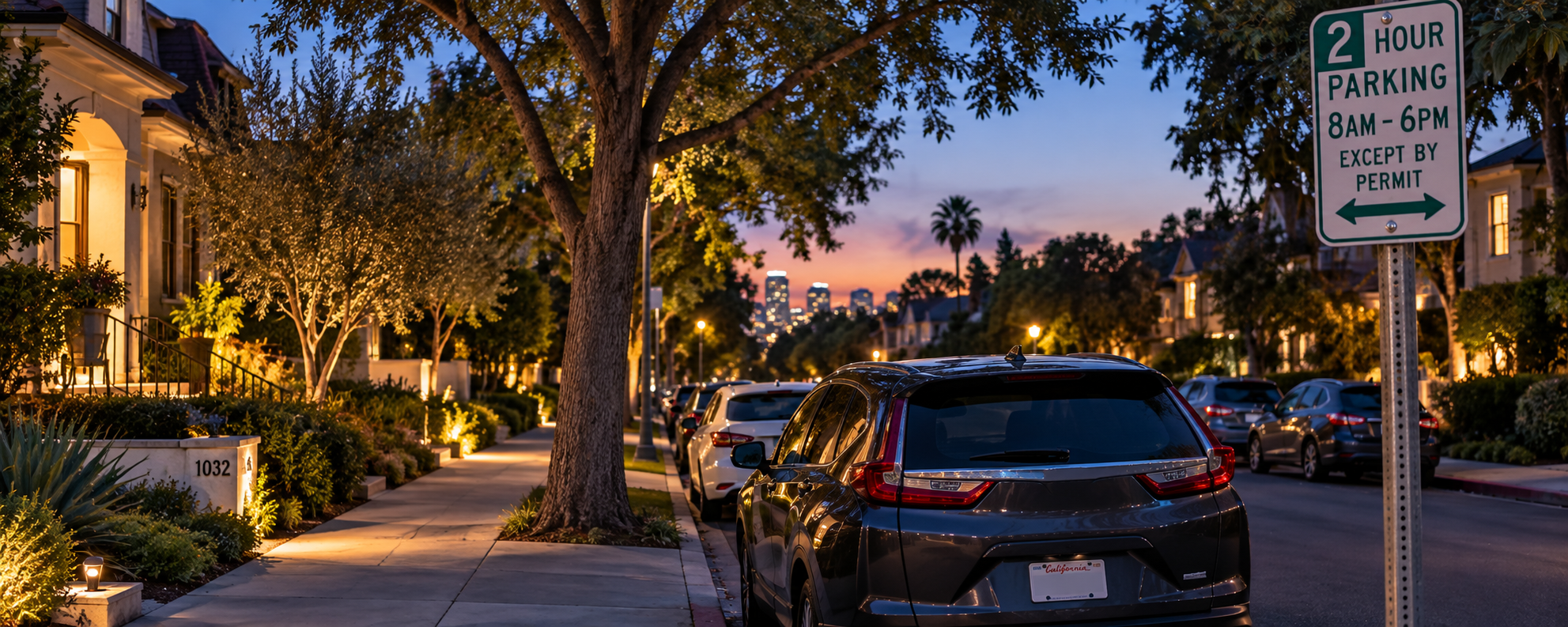
Parking on a residential street overnight may seem straightforward, especially when there are no obvious restrictions. But whether you can legally leave your car overnight can depend on permits, posted signs, street cleaning schedules, time limits, and local parking laws.
If you’re wondering, “Can I leave my car on a residential street overnight?” the answer depends on the residential street parking overnight rules that apply to that particular location.
Even when a street appears unrestricted, it is important to check for rules that may not be immediately obvious.
Can You Park on a Residential Street Overnight?
In many locations, overnight street parking may be allowed unless a specific restriction prohibits it.
However, residential streets can have rules involving:
- Parking permits
- Overnight restrictions
- Street cleaning
- Time limits
- No Parking periods
- Temporary restrictions
- Vehicle-specific restrictions
Some rules appear directly on parking signs, while others may come from local regulations.
Our guide to overnight parking rules explains what drivers should check before leaving a vehicle parked overnight.
What If There Are No Parking Signs?
The absence of a nearby parking sign does not necessarily guarantee that parking is unrestricted.
Some parking rules may apply through local laws rather than a sign directly beside your vehicle. There may also be signs farther along the block that apply to a larger section of curb.
Before assuming a space is unrestricted, look along the street for signs, curb markings, permit notices, temporary postings, and other restrictions.
If you’re unsure which signs apply to your space, our guide to parking sign arrows explains how directional signs can define restricted areas.
Do You Need a Permit to Park Overnight on a Residential Street?
Sometimes.
Certain neighborhoods use residential permit parking programs to limit parking to residents, guests, or authorized vehicles during designated periods.
Permit restrictions may apply throughout the day or only during certain hours.
A street that appears available during the afternoon, for example, could become permit-only overnight.
See our guide to permit parking signs for more information about recognizing and interpreting permit restrictions.
Can You Leave Your Car on a Residential Street for Several Days?
Do not assume that a legal overnight space means you can leave a vehicle there indefinitely.
Some jurisdictions limit how long a vehicle may remain parked on a public street, even when there is no ordinary meter or short-term parking sign.
Other scheduled restrictions may also take effect while the vehicle is unattended.
If you’re leaving a vehicle for several days, check the local rules and look ahead for any restrictions that could become active during that period.
What About Street Cleaning?
Street cleaning is one of the most important things to check when leaving a car parked overnight.
Your parking space may be legal when you arrive at night but become restricted the following morning when scheduled street cleaning begins.
Check nearby signs for the day and hours of enforcement.
Our guide to street sweeping parking rules explains what to look for before leaving your vehicle.
Can Parking Rules Change Overnight?
Yes.
A curb can be legal at one time and restricted several hours later.
For example, overnight parking might be permitted until an early-morning street cleaning restriction, commuter restriction, loading period, or other rule begins.
This is why the relevant question isn’t only “Can I park here right now?”
You should also consider whether the space will remain legal for the entire time you plan to leave your vehicle there.
Can You Park Overnight in a Permit Zone?
Possibly, but it depends on the permit restriction.
Some permit zones operate only during certain days or hours, while others may specifically restrict overnight parking without an appropriate permit.
Read the full sign carefully.
If several signs appear together, our guide to multiple parking signs explains how to work through overlapping restrictions.
Can Guests Park Overnight on a Residential Street?
Guest parking rules vary by location.
Some residential permit programs provide visitor permits or temporary guest parking options. Other streets may allow unrestricted guest parking during certain periods.
Do not assume that being a guest of a resident automatically gives you permission to park in a permit-restricted space.
Check the posted restriction and, when necessary, the applicable local permit program.
Can You Sleep in Your Car on a Residential Street?
Whether a vehicle can legally park overnight and whether someone may legally sleep or remain in that vehicle are separate questions.
Local laws may regulate vehicle habitation, overnight occupancy, camping, or similar activities independently from ordinary parking rules.
A legal parking space therefore does not automatically establish that sleeping in the vehicle is permitted.
Check the applicable local rules if you plan to remain inside the vehicle overnight.
What About Temporary No Parking Signs?
Temporary restrictions can override parking that would normally be permitted.
These signs may appear for construction, moving activity, special events, utility work, filming, road maintenance, or other temporary uses.
Always look for temporary notices before leaving a vehicle overnight or for several days.
Our guide to temporary No Parking signs explains why these restrictions require special attention.
Can You Get a Parking Ticket While Parked Overnight?
Yes.
A vehicle may be legally parked when you leave it but become subject to enforcement when another restriction begins.
Potential issues include an overnight permit requirement, street cleaning, a time limit, temporary restriction, or another parking rule.
Depending on the jurisdiction and circumstances, violating a restriction could result in a citation or potentially towing.
What If a No Parking Restriction Ends at Night?
A timed No Parking restriction may end in the evening, potentially allowing another parking rule to take effect.
But the end of one restriction does not automatically mean the curb becomes unrestricted.
Check whether another sign controls overnight parking.
Our guide to parking in a No Parking zone after hours explains how to evaluate a space after a timed restriction ends.
What Should You Check Before Leaving Your Car Overnight?
Before walking away from your vehicle, determine whether the space will remain legal until you return.
Check the current day and time, then look ahead to any restrictions that will begin overnight or the following morning.
Pay particular attention to permit requirements, street cleaning schedules, time limits, temporary signs, curb markings, and restrictions elsewhere on the block.
If the parking signs are difficult to interpret, ParkClear’s parking sign scanner is designed to help drivers understand confusing parking restrictions.
How ParkClear Helps With Residential Street Parking Overnight
Overnight parking requires thinking beyond whether a space is legal at the exact moment you arrive.
ParkClear helps drivers interpret parking signs and location-based parking rules so they can get a clear Yes or No answer to the question: “Can I park here?”
ParkClear can also help drivers evaluate parking for a future date or time, which can be especially useful when a restriction changes overnight or the following morning.
The Bottom Line: Can You Park on a Residential Street Overnight?
You may be able to park on a residential street overnight, but you should check whether any restrictions will apply before you return to your vehicle.
Look for permit requirements, street cleaning schedules, time limits, temporary signs, overnight restrictions, and other applicable parking rules.
Most importantly, remember that a space that is legal tonight may not still be legal tomorrow morning.
Download ParkClear
Confused about whether you can park? Download ParkClear to scan parking signs or use your location to get a clear Yes or No answer to “Can I park here?”
Parking regulations vary by jurisdiction. Always follow posted signs and applicable local laws, and check official local rules when necessary.