
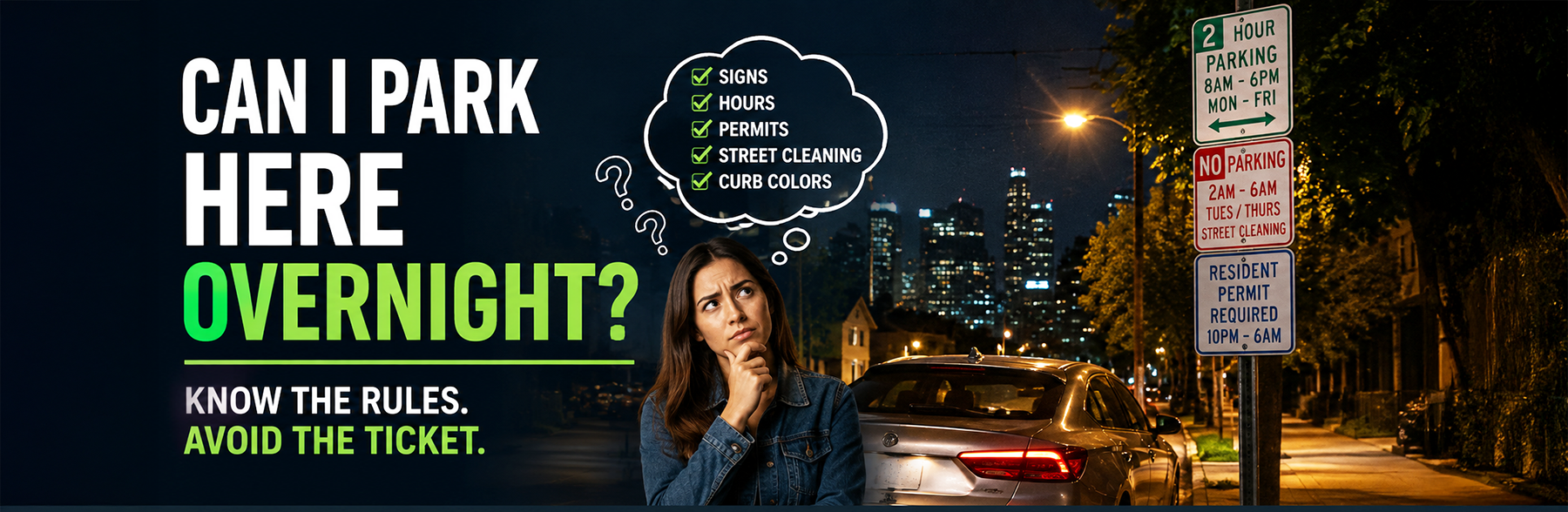
A parking space can be perfectly legal when you leave your car—and prohibited several hours later.
That’s what makes overnight parking rules tricky.
The sign might allow parking at 8:00 PM but prohibit it after midnight. Street cleaning may begin early the next morning. A residential permit restriction could take effect overnight. Or the city itself may have an overnight parking rule that isn’t obvious from the curb in front of you.
So before leaving your car for the night, there’s a more important question than simply:
Can I park here right now?
You also need to ask:
Can I park here overnight?
Possibly—but whether overnight parking is allowed depends on the rules that apply to that specific location.
Depending on the city and street, overnight parking may be affected by:
- Posted parking restrictions
- Overnight parking prohibitions
- Residential permit requirements
- Street-cleaning schedules
- Time-limited parking
- Temporary parking restrictions
- Snow or emergency rules
- Meters and enforcement hours
- Curb markings
- Local ordinances
The key is to determine whether your vehicle will remain legal for the entire time you plan to leave it there, not just at the moment you park.
1. Read Every Parking Sign Near Your Car
Start with the signs controlling the section of curb where you’re parking.
Don’t stop after finding one sign that appears to allow parking.
If you’re unsure how to interpret the information on a parking sign, our guide How to Read Parking Signs breaks down the basics step by step.
Look for restrictions involving:
Hours: Does a restriction begin later tonight?
Days: Will the rules change after midnight?
Permits: Is overnight parking restricted to residents or permit holders?
Time limits: Does a maximum parking duration apply?
Street cleaning: Will parking become prohibited early tomorrow morning?
A sign might say:
2 HOUR PARKING
8 AM – 6 PM
MON – SAT
At first glance, that may appear to mean unrestricted parking after 6:00 PM.
But another applicable sign—or a separate local rule—could still restrict overnight parking.
That’s why you need to consider the entire set of rules affecting the location.
If you’re dealing with several signs at once, see our guide How to Read Multiple Parking Signs on One Pole.
2. Check What Happens After Midnight
Midnight can change more than the date on your phone.
If you’re parking overnight, determine whether crossing into the next calendar day changes any applicable restriction.
For example, imagine parking at 10:00 PM on Monday.
A restriction that begins:
TUESDAY
2 AM – 6 AM
matters to you—even though you’re parking on Monday night.
This is one of the easiest overnight parking details to overlook.
Instead of asking only what rules apply when you arrive, mentally move the clock forward through every hour your vehicle will remain parked.
3. Look for Street-Cleaning Restrictions
Street cleaning is especially important when leaving a vehicle overnight.
You may legally park late at night only to discover that the curb becomes restricted early the next morning.
For example:
You park at 9:00 PM Tuesday.
Street cleaning begins at 7:00 AM Wednesday.
If your vehicle is still there when the restriction takes effect, you could be in violation even though parking was allowed when you originally arrived.
Always check the next morning’s schedule before leaving your car overnight.
For more help interpreting these restrictions, read Street Cleaning Parking Signs Explained.
4. Check for Residential Permit Rules
Some neighborhoods restrict overnight or extended street parking unless a vehicle has the appropriate permit.
Permit rules can apply:
- Only during certain hours
- Overnight
- On specific days
- Within designated residential zones
- To vehicles without a local parking permit
A street may look completely unrestricted until you notice a sign explaining that a permit is required during particular hours.
Don’t assume that an open curb means unrestricted overnight parking.
5. Don’t Forget Time-Limited Parking
A time limit can make overnight parking more complicated.
You might see:
2 HOUR PARKING
8 AM – 6 PM
The important question isn’t simply whether the two-hour restriction ends at 6:00 PM.
You also need to know when enforcement resumes and how the local jurisdiction calculates the parking limit.
Rules can vary considerably between cities.
If your vehicle will still be parked there when the restriction becomes active again, make sure you understand what will be required.
6. Check the Curb Color
The curb itself may provide another clue.
Red, yellow, white, green, blue, or other locally regulated curb markings can indicate special restrictions.
A curb color may relate to:
- Stopping restrictions
- Loading zones
- Passenger loading
- Short-term parking
- Accessible parking
But don’t rely on color alone.
Curb colors and their exact restrictions can vary by jurisdiction, and nearby signs may provide additional rules or enforcement hours.
See What Do Red, Yellow, White, Green, and Blue Curbs Mean? for our complete guide to common curb-color restrictions.
7. Look for No Parking, No Standing, or No Stopping Restrictions
These terms aren’t necessarily interchangeable.
A No Parking restriction can differ from No Standing, while No Stopping is generally more restrictive.
The hours matter too.
A curb may allow ordinary parking during the evening but become a No Parking or No Stopping zone early the next morning.
If you’re unsure about the difference, read No Parking vs. No Standing vs. No Stopping: What’s the Difference?
8. Check Whether the City Has Separate Overnight Parking Rules
This is an important step because not every parking restriction will necessarily be communicated by the sign immediately next to your vehicle.
Some cities or municipalities have broader rules governing overnight street parking.
Depending on the location, there may be restrictions involving:
- Overnight street parking
- Overnight parking permits
- Maximum parking durations
- Certain vehicle types
- Seasonal restrictions
- Snow emergencies
- Temporary parking bans
If you’re unfamiliar with the area, check the official parking rules for that city before leaving your vehicle overnight.
This becomes especially important when you’re traveling or parking somewhere you don’t normally drive.
9. Check for Temporary Restrictions
A parking space that’s normally legal can become temporarily restricted.
Temporary signs may be posted for:
- Construction
- Road work
- Moving activity
- Special events
- Filming
- Utility work
- Emergency restrictions
Look beyond the permanent metal signs.
A temporary notice attached to a pole, tree, barricade, or other approved location may affect whether the space remains legal overnight or the following morning.
10. Look at the Parking Sign Arrows
You found the restriction—but does it actually apply to your vehicle?
Check the arrows.
Parking sign arrows can indicate whether a restriction applies to the curb:
← To the left
→ To the right
↔ In both directions
Your vehicle’s position relative to the sign can therefore matter just as much as the wording itself.
Our guide What Do Parking Sign Arrows Mean? explains how to interpret them.
A Simple Overnight Parking Checklist
Before leaving your vehicle for the night, ask yourself:
Did I read every applicable sign?
Will any restriction begin after I leave?
What happens after midnight?
Is there street cleaning tomorrow morning?
Do I need a residential or overnight permit?
Is there a time limit?
Does the curb color create another restriction?
Are there temporary signs nearby?
Do the arrows on the signs apply to my section of curb?
Does the city have a separate overnight parking rule?
If you can’t confidently answer those questions, it’s worth checking further before leaving your vehicle.
The Biggest Overnight Parking Mistake
One of the easiest mistakes is checking whether parking is legal now instead of whether it will remain legal later.
Think of overnight parking as a timeline.
If you park at 9:00 PM and plan to return at 8:00 AM, the relevant question isn’t:
“Is parking allowed at 9:00 PM?”
It’s:
“Will parking remain allowed from 9:00 PM through 8:00 AM?”
A restriction that begins at any point during that window can change the answer.
ParkClear Helps Simplify the Parking Decision
Overnight parking demonstrates why street parking can become complicated so quickly.
One location can involve multiple signs, changing hours, curb colors, arrows, street-cleaning schedules, permits, and other restrictions.
ParkClear is designed to help simplify confusing street parking information and help drivers make more informed parking decisions.
Because whether you’re parking for ten minutes or leaving your vehicle overnight, the question you ultimately want answered is the same:
Can I park here?
Learn more in Can ParkClear Help Me Read Street Parking Signs?
Download ParkClear
Parking regulations vary by jurisdiction. Always follow posted signs and applicable local laws, and check official local rules when necessary.



17 Comments