
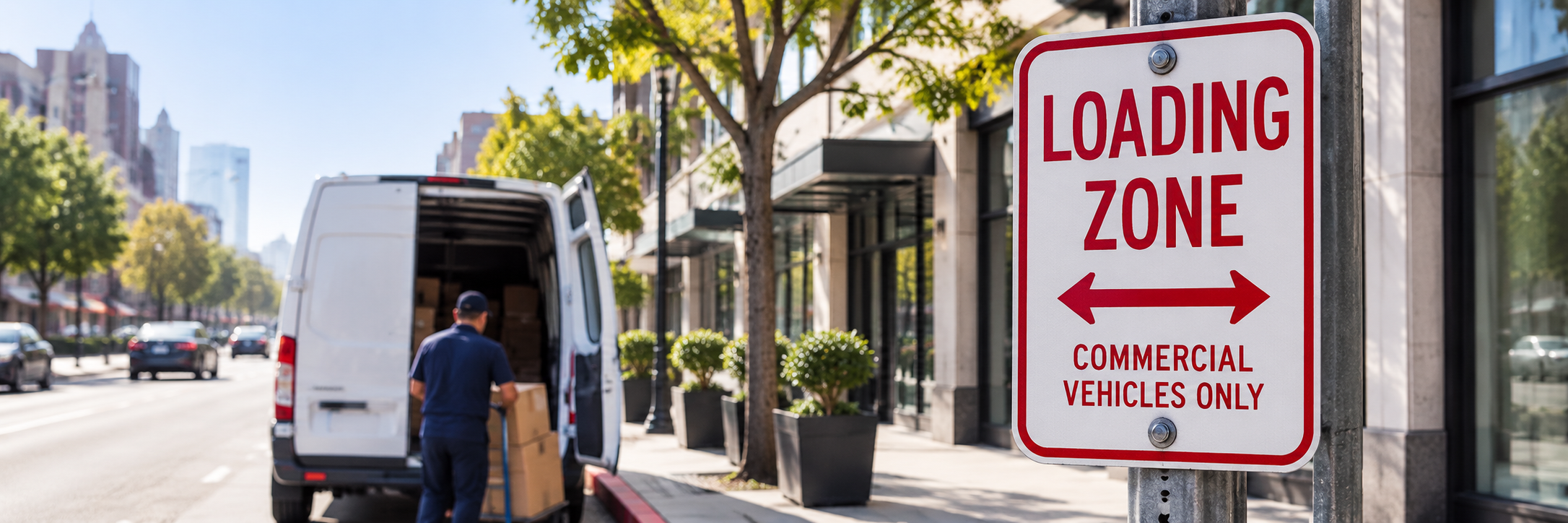
Loading zones provide space for short-term loading and unloading, but the rules can be confusing. Whether you can park in a loading zone depends on the posted signs, curb markings, time restrictions, vehicle type, and local parking regulations.
If you’re wondering, “Can I park in a loading zone?” the safest answer is: check the sign, curb, and applicable time restrictions before leaving your vehicle.
What Is a Loading Zone?
A loading zone provides designated curb space for drivers to quickly load or unload passengers, goods, or deliveries.
Unlike a regular parking space, a loading zone may limit how long you can remain at the curb and what activities are permitted. Some loading zones are restricted to commercial vehicles, while others may allow passenger loading during certain hours.
Because loading zone rules can vary by city and location, always follow the restrictions posted where you are parking.
Can You Park in a Loading Zone?
Sometimes — but not necessarily.
A loading zone may allow a vehicle to stop temporarily for loading or unloading, but that does not automatically mean you can park there and leave the vehicle.
Before using a loading zone, check:
- The posted parking signs
- The hours the loading-zone restriction is active
- Any stated time limit
- Whether the zone is for passengers or commercial loading
- Curb colors or pavement markings
- Whether another parking restriction applies at the same location
A loading zone may become regular parking outside its restricted hours, but only when the posted signs and local rules allow it.
Passenger Loading Zones vs. Commercial Loading Zones
Not all loading zones have the same purpose.
Passenger Loading Zones
Passenger loading zones generally allow drivers to quickly pick up or drop off passengers. Local rules may prohibit or restrict waiting or leaving your vehicle parked.
Commercial Loading Zones
Commercial loading zones generally serve vehicles that are actively loading or unloading goods. Depending on the jurisdiction, eligibility may depend on the vehicle, permits, commercial identification, or other local requirements.
Never assume that a loading zone available to one type of vehicle is available to every vehicle.
How Long Can You Park in a Loading Zone?
There is no single time limit that applies everywhere.
The permitted time may be shown on the parking sign or established by local regulations. Some zones allow only a few minutes, while others have different rules depending on the time of day or type of loading activity.
If a sign gives a specific time limit, treat that limit as part of the parking restriction rather than as ordinary unrestricted parking.
Can You Park in a Loading Zone After Hours?
In some locations, yes.
A loading-zone restriction may only apply during specific hours. Outside those hours, the space may become available for regular parking.
However, don’t rely on the loading-zone hours alone. Another restriction may take effect afterward, such as:
- No Parking
- Street cleaning
- Permit parking
- Metered parking
- Overnight restrictions
- Tow-away restrictions
Read all of the signs that apply to the parking space before deciding whether you can park.
What If There Are Multiple Parking Signs?
Loading zones are often accompanied by several signs containing different restrictions.
For example, one sign might establish loading-zone hours while another controls parking later in the day. Arrows may also indicate where a restriction begins or ends.
When several signs are posted together, they should be interpreted as a complete set of rules for that location.
ParkClear’s guide to multiple parking signs explains how to work through overlapping restrictions.
What Do Loading Zone Curb Colors Mean?
Curb colors can provide additional information about how a curb space may be used, but their meaning can vary by jurisdiction.
A colored curb should therefore be considered together with nearby signs rather than interpreted by color alone.
See our guide to red, yellow, white, green, and blue curb colors for more information.
For example, the Los Angeles Department of Transportation publishes specific rules for colored curb zones, including commercial and passenger loading zones.
Can You Get a Parking Ticket in a Loading Zone?
Yes. Parking or stopping in a loading zone when your vehicle or activity does not qualify can result in a citation and, depending on the location and circumstances, potentially additional enforcement.
Common problems include staying longer than permitted, parking during restricted loading hours, leaving a vehicle where only active loading is allowed, or overlooking another posted restriction.
How ParkClear Helps With Confusing Parking Rules
Street parking often requires interpreting several pieces of information at once.
ParkClear helps drivers understand confusing parking signs and street parking rules. You can scan a parking sign or use your location to get a clear Yes or No answer to the question: “Can I park here?”
ParkClear can also help with parking situations involving time limits, parking sign arrows, street cleaning restrictions, curb colors, and multiple parking signs.
The Bottom Line: Can You Park in a Loading Zone?
You may be able to park in a loading zone, but only when the posted signs and local parking rules permit it.
Check the loading-zone hours, time limits, vehicle requirements, curb markings, and any additional parking signs before leaving your vehicle.
When parking rules are difficult to interpret, ParkClear is designed to make them easier to understand.
Download ParkClear
Confused by parking signs? Download ParkClear to scan parking signs or use your location to get a clear Yes or No answer to “Can I park here?”
Parking regulations vary by jurisdiction. Always follow posted signs and applicable local laws, and check official local rules when necessary.