
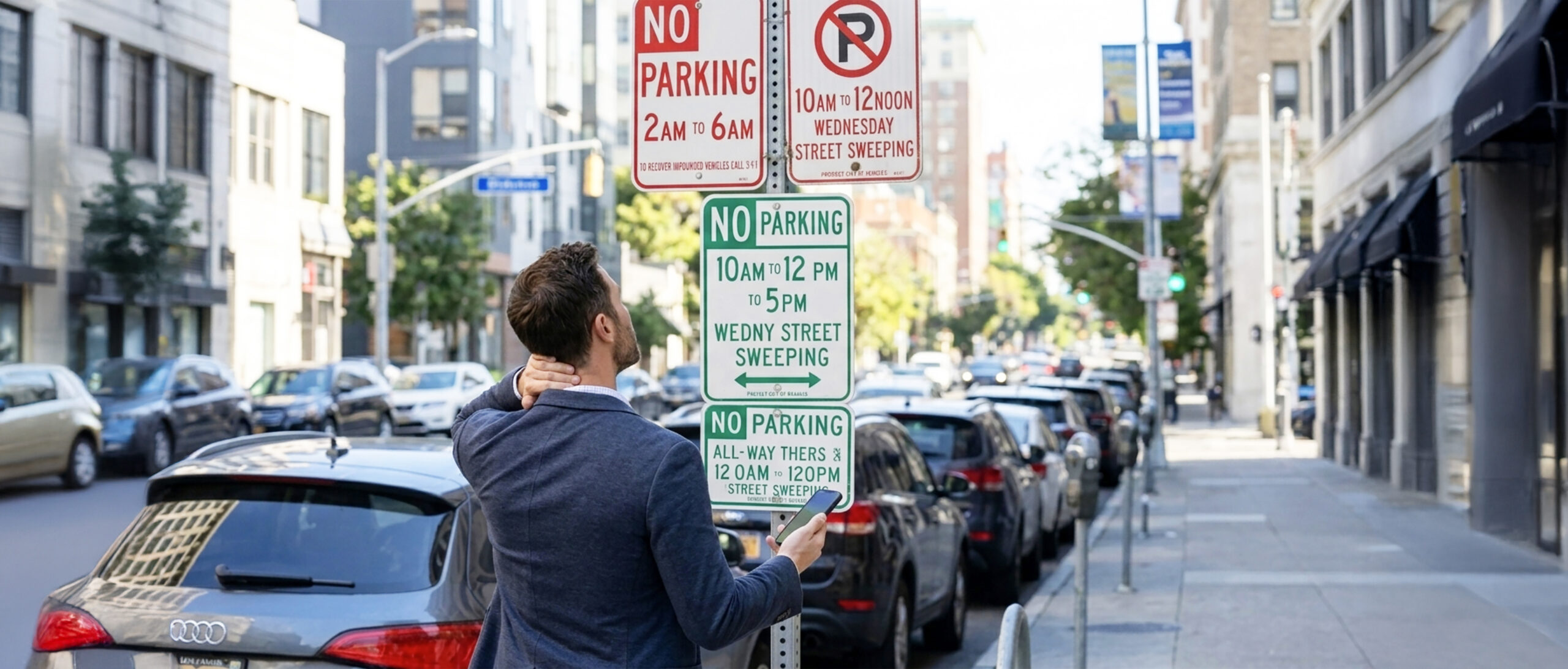
“Can I park here?”
Four simple words.
But on a city street, the answer can depend on a surprising number of things.
Where exactly is your car?
What do the nearby signs say?
Which direction do the arrows point?
What day is it?
What time is it?
Is there a permit restriction?
Is today street-cleaning day?
Does another rule override the one you’re looking at?
A parking space doesn’t simply exist as legal or illegal. The answer can change depending on the location, day, time, posted restrictions, and other parking rules that apply at that moment.
The same curb that allows parking at 2:00 PM might prohibit it at 5:00 PM.
The space that’s perfectly fine on Wednesday might be restricted Thursday morning.
And two cars parked only a short distance apart can potentially face different rules because of a single directional arrow.
That’s what makes the question “Can I park here?” deceptively complicated.
But you don’t need to look at every parking sign as an unsolvable puzzle.
The key is knowing which questions to ask—and in what order.
WHERE → SIGNS → ARROWS → DAY → TIME → OTHER RESTRICTIONS
Work through those pieces systematically, and you can make a much more informed parking decision before walking away from your car.
Let’s start with the most important one.
Start With Your Exact Parking Location
Parking rules can change surprisingly quickly from one section of a street to another.
A sign may apply only in the direction indicated by an arrow. The opposite side of the street may have completely different restrictions. Rules can even change within the same block.
That’s why the first question isn’t simply “What does this sign mean?”
It’s:
“Which parking rules apply to the exact spot where my car is parked?”
Look at nearby signs and pay particular attention to arrows, curb markings, intersections, driveways, loading areas, and other boundaries that may affect where a restriction begins or ends.
Check the Day and Time
Many parking spaces are perfectly legal at one time and prohibited at another.
A space might allow parking during the afternoon but prohibit it during morning rush hour. Another might be restricted for street cleaning for only a few hours on a particular day.
When reading a parking sign, check three things together:
the restriction + the day + the time.
For example, a sign that prohibits parking from 7 AM to 9 AM Monday through Friday doesn’t necessarily mean you can’t park there Saturday afternoon.
The current time matters just as much as the words NO PARKING.
Planning to leave your car overnight? Our guide to Overnight Parking Rules explains what to check before leaving your vehicle until the next day.
Read Every Sign That Applies
One of the biggest sources of parking confusion is a pole containing several signs.
Don’t assume the largest or closest sign tells the whole story.
One sign might establish a two-hour parking limit. Another could prohibit parking during street cleaning. A third might establish permit restrictions during certain hours.
These rules can overlap.
Restrictions can also use similar-sounding terms with different meanings. Learn the difference between No Parking, No Standing, and No Stopping before assuming they mean the same thing.
Instead of reading each sign independently, think of them as layers. Your parking spot needs to satisfy all of the rules that currently apply.
Parking signs can become especially difficult to interpret when several restrictions appear on the same pole. For a step-by-step breakdown, read our How to Read Parking Signs: A Simple Guide to Street Parking Signs.
Pay Attention to Arrows
Those little arrows can make a very big difference.
Parking signs frequently use arrows to indicate where a restriction applies. Depending on the sign and location, an arrow may indicate that a rule applies before the sign, after the sign, or across a particular section of curb.
That means two cars parked only a short distance apart could potentially be subject to different restrictions.
Before leaving your vehicle, make sure you’re interpreting the sign for your space, not simply the nearest sign you happen to see.
Look for Temporary Restrictions
Permanent parking signs aren’t always the final word.
Cities may temporarily restrict parking for construction, road work, special events, filming, moving activities, emergencies, or other purposes. Temporary notices may be posted separately from permanent street signs.
So even if you regularly park on a particular street, take another look before assuming yesterday’s rules still apply today.
Don’t Forget the Curb and Surroundings
Sometimes the clue isn’t on a parking sign at all.
Depending on local rules, curb markings and nearby infrastructure may indicate restrictions around fire hydrants, driveways, crosswalks, bus zones, loading areas, intersections, accessible parking spaces, and other regulated areas.
If the curb is painted, our guide to Curb Colors Meaning explains how red, yellow, white, green, and blue curbs are commonly used—and why you should still check the local rules.
Parking laws vary by jurisdiction, so avoid assuming that a rule you’ve learned in one city works exactly the same way somewhere else.
Why Is Street Parking So Confusing?
The problem isn’t necessarily that any individual parking rule is difficult to understand.
It’s that drivers often have to interpret multiple pieces of information at once.
You may need to determine:
- which signs apply to your exact location;
- what their arrows mean;
- whether the rule applies today;
- whether it applies right now;
- whether another restriction overrides it; and
- whether temporary or curb restrictions also apply.
That’s a lot to process when you’re sitting in traffic with another driver waiting for your space.
And that’s exactly the problem ParkClear was created to simplify.
A Simpler Way to Answer “Can I Park Here?”
Instead of asking drivers to manually interpret every parking rule themselves, ParkClear is designed to make the decision easier.
Using location-based technology and parking sign analysis, ParkClear helps interpret applicable parking information for your location and provides straightforward “Yes” or “No” parking guidance.
The goal is simple:
Turn complicated parking information into a clear answer.
If multiple parking signs or overlapping restrictions are making the answer unclear, learn how ParkClear helps read street parking signs and turns complicated parking rules into simpler parking guidance.
So whether you’re commuting to work, meeting friends, running errands, or exploring an unfamiliar neighborhood, you can spend less time deciphering signs and more time getting where you’re going.
Before You Leave Your Car
Whenever you’re uncertain about a street parking space, remember this simple sequence:
Location → Signs → Arrows → Day → Time → Additional restrictions
If everything checks out, you’ve made a much more informed parking decision.
And when the signs still leave you wondering—
Can I park here?
That’s the question ParkClear was built to help answer.
Take the guesswork out of street parking. Use ParkClear to get clear parking guidance based on your location and the parking rules around you.
Download ParkClear
Parking regulations vary by jurisdiction. Always follow posted signs and applicable local laws, and check official local rules when necessary.



7 Comments