
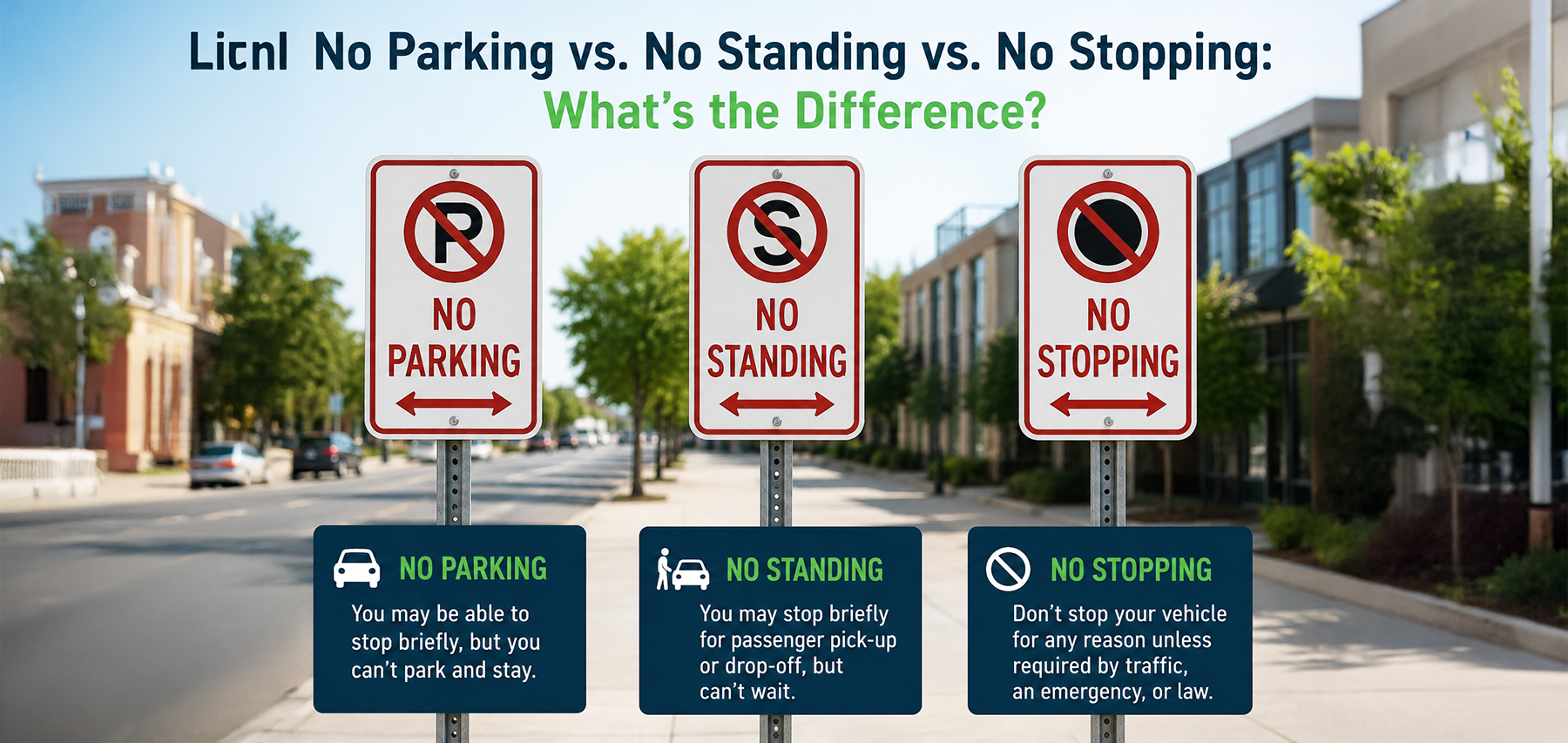
No Parking. No Standing. No Stopping.
They sound like three different ways of saying the same thing—but when it comes to street parking, they can mean very different things.
One sign may allow you to briefly stop to pick someone up. Another may prohibit waiting but allow passengers to get in or out. And another may mean your vehicle shouldn’t stop there at all.
Understanding no parking vs. no standing—and how both differ from no stopping—can help you make quicker decisions, follow posted parking rules, and avoid unnecessary tickets.
If parking signs often leave you second-guessing the rules, start with our guide to How to Read Parking Signs for a simple breakdown of the basics.
Here’s a simple way to understand the difference.
No Parking vs. No Standing vs. No Stopping
Although exact parking laws and terminology can vary by city or state, there’s a simple way to understand these three restrictions: each one generally limits what you can do at the curb a little more.
An Easy Way to Remember All Three
Think of the restrictions as getting progressively stricter:
No Parking → A brief permitted stop may be okay, but don’t park or wait.
No Standing → An immediate passenger pickup or drop-off may be okay, but don’t wait.
No Stopping → Don’t voluntarily stop.
The exact definitions and exceptions can vary by location, so always follow the posted signs and applicable local parking laws.
What Does “No Parking” Mean?
A No Parking sign generally means you cannot leave your vehicle parked or remain in the space simply waiting.
However, depending on local rules, you may be allowed to stop temporarily for an activity such as:
- Picking up or dropping off passengers
- Actively loading or unloading items
- Other brief activities specifically permitted by local law
For example, pulling over to let a passenger out may be permitted even though leaving your vehicle there while you go inside a building would not be.
The important distinction is that stopping briefly isn’t always the same thing as parking.
What Does “No Standing” Mean?
The word standing can be confusing because it doesn’t necessarily mean physically standing outside your car.
In parking regulations, standing generally refers to keeping a vehicle stopped in a location for purposes other than the immediate pickup or drop-off of passengers.
A No Standing restriction is therefore typically stricter than No Parking.
Depending on local law, you may be able to stop long enough for a passenger to immediately enter or exit the vehicle—but you generally cannot sit there waiting for someone.
For example:
Your passenger is already at the curb and gets directly into your car. That may be permitted.
Your passenger texts, “I’ll be down in five minutes,” and you remain at the curb waiting. That may violate a No Standing restriction.
What Does “No Stopping” Mean?
No Stopping is generally the strictest of the three restrictions.
Where stopping is prohibited, you generally cannot voluntarily stop your vehicle—even if you remain behind the wheel or intend to stop for only a few seconds.
That means you typically should not stop there to:
- Wait for someone
- Pick up or drop off a passenger
- Load or unload belongings
- Check your phone
- Sit with your hazard lights on
Of course, circumstances such as traffic, emergencies, law-enforcement directions, or other legally required stops can be exceptions.
But as a parking restriction, No Stopping generally means the curb is not available for a voluntary stop.
Restrictions may also be communicated through painted curbs. Our guide to Curb Colors Meaning explains how red, yellow, white, green, and blue curbs are commonly used for different parking and stopping restrictions.
Does Putting on Your Hazard Lights Make It Okay?
No.
Turning on your hazard lights doesn’t automatically make an otherwise prohibited stop, stand, or parking action legal.
Hazard lights communicate that your vehicle is stopped or may present a hazard. They don’t override a No Parking, No Standing, or No Stopping restriction.
The same principle applies if you stay inside the vehicle.
Being behind the wheel does not necessarily mean you aren’t parked or standing under local law.
What If the Sign Only Applies During Certain Hours?
This is where parking signs can become much more complicated.
You might see something like:
NO STOPPING
7 AM – 9 AM
MON – FRI
Outside those posted hours, the No Stopping restriction may no longer apply—but that doesn’t necessarily mean parking is automatically legal.
Another sign on the same pole could impose a different restriction.
For example, the same curb might have:
No Stopping during morning rush hour
2-hour parking during the day
Street cleaning on a particular weekday
Permit requirements at night
That’s why it’s important to read every applicable parking sign, not just the largest or closest one.
If several signs are posted together, see our guide on How to Read Multiple Parking Signs on One Pole.
Do Parking Sign Arrows Matter?
Absolutely.
A No Parking, No Standing, or No Stopping restriction may only apply in the direction indicated by an arrow.
An arrow pointing left may regulate the curb to the left of the sign, while an arrow pointing right may regulate the curb to the right. Signs with arrows pointing in both directions can indicate that the restriction applies on both sides of the sign.
See our guide What Do Parking Sign Arrows Mean? for a more detailed explanation.
Why These Signs Are Easy to Misunderstand
Drivers often use the words parking, waiting, and stopping interchangeably in everyday conversation.
Parking regulations don’t necessarily treat them that way.
The difference can come down to:
- Why your vehicle stopped
- How long it remains stopped
- Whether passengers are actively entering or exiting
- Whether loading or unloading is taking place
- The time and day
- Additional posted restrictions
- Local parking laws
That’s why two signs that sound nearly identical can create very different rules.
A Simple Way to Remember the Difference
When you’re trying to remember No Parking vs. No Standing vs. No Stopping, think of them as three increasing levels of restriction:
No Parking
Brief permitted activity may be allowed, but don’t park or wait there.
No Standing
Generally, only an immediate passenger pickup or drop-off may be allowed.
No Stopping
Don’t voluntarily stop there.
And remember: the exact legal definitions and exceptions vary by location, so the posted signs and local parking laws ultimately control.
Confusing Parking Signs? ParkClear Can Help.
A single parking sign can be confusing enough.
Add time restrictions, arrows, street-cleaning schedules, permit rules, and several signs on the same pole, and figuring out whether you can legally park can quickly become complicated.
ParkClear helps simplify street parking decisions by interpreting parking restrictions and giving drivers an easy-to-understand answer based on the parking information available.
Instead of trying to decode every rule yourself, ParkClear is designed to help answer the question that matters most:
Can I park here?
Learn more in our guide Can ParkClear Help Me Read Street Parking Signs?
Download ParkClear
Parking regulations vary by jurisdiction. Always follow posted signs and applicable local laws.



14 Comments