
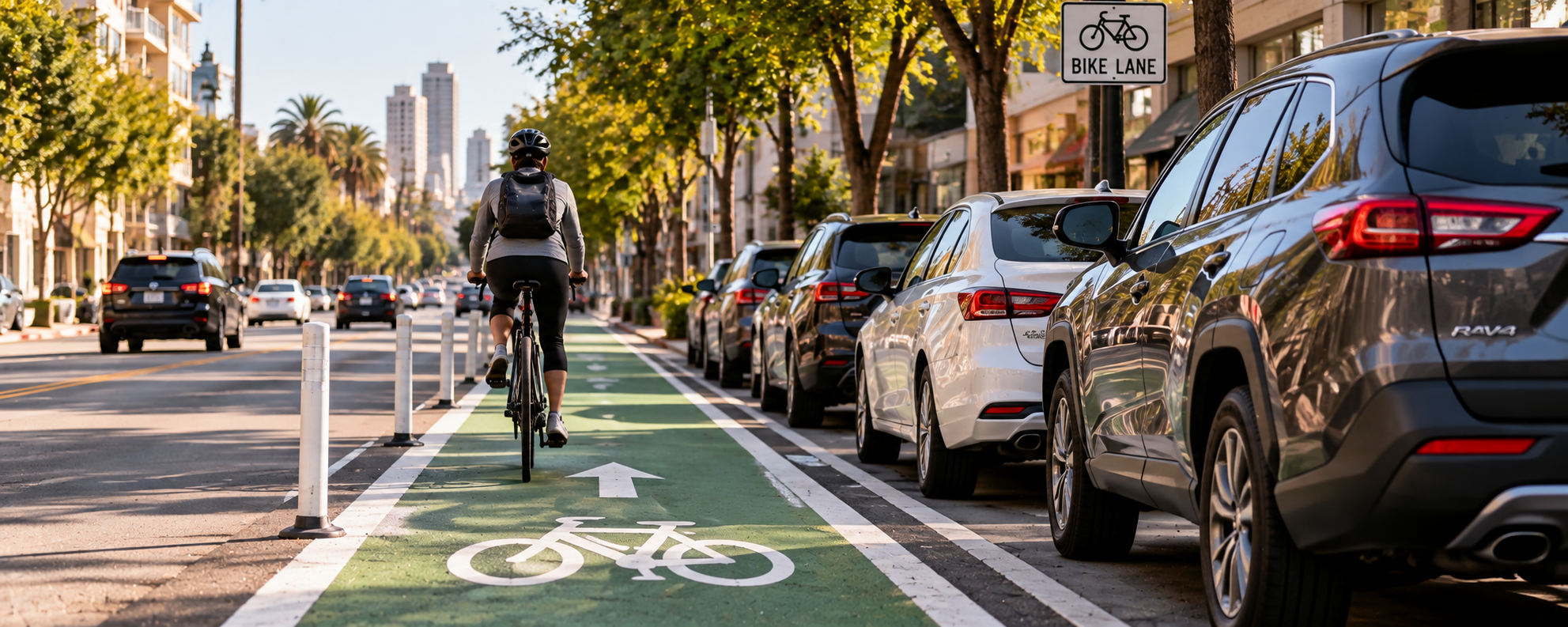
You find an open stretch of curb, but there’s a bike lane running alongside it. There may even be other cars parked nearby. So where are you actually supposed to park—and can you park there at all?
Parking in a bike lane depends on the street design, posted restrictions, and local law. In many situations, drivers cannot simply stop or park inside a lane designated for bicycle travel. But some streets are designed with legal parking next to a bike lane, and others have restrictions that change depending on the time of day.
The important thing is to identify where the actual parking area ends and the bike lane begins before leaving your vehicle.
Can You Park in a Bike Lane?
Don’t assume that an open section of pavement inside a bike lane is an available parking space.
Bike lanes generally exist to provide cyclists with a designated area of the roadway. Parking a vehicle within that travel area can obstruct cyclists and force them into vehicle traffic.
However, street designs vary significantly.
Some streets have a bike lane immediately beside the curb. Others provide a designated parking lane next to the bike lane. Protected bike lanes can place parked vehicles between moving traffic and cyclists.
That means the presence of a bike lane doesn’t necessarily mean there is no parking on that street. It means you need to identify exactly where vehicles are permitted to park.
How Can You Tell Where the Bike Lane Is?
Start with the pavement.
Bike lanes may be identified by:
- Bicycle symbols
- Painted lane lines
- Green pavement
- Signs
- Flexible posts or bollards
- Raised barriers
- Curbs or medians
- Buffer zones
Don’t use color alone to make your decision. Bike-lane designs and markings can differ between cities.
Look at the entire street configuration and any nearby parking signs before choosing a space.
What If Cars Are Already Parked Next to the Bike Lane?
This is where bike-lane parking can become confusing.
On some streets, parked vehicles are intentionally positioned between the moving traffic lane and the bike lane. The bicycle lane then runs between the parked vehicles and the sidewalk.
This is often associated with a protected or parking-protected bike lane.
In that configuration, the parked cars aren’t necessarily blocking the bike lane. They may be occupying a designated parking lane beside it.
Look for pavement markings and signs that show where the parking area actually begins.
Never assume that another parked vehicle proves the space is legal. Other drivers can misunderstand the rules too.
Can You Cross a Bike Lane to Park?
Street layouts sometimes require a driver to cross a bike lane to reach a legal parking space.
When local rules and the street design allow this, drivers should watch carefully for cyclists and other road users before crossing the bicycle lane.
The key distinction is between crossing a bike lane to reach a designated parking area and leaving your vehicle parked within the bicycle travel lane itself.
If the layout isn’t clear, check the pavement markings, signs, and applicable local rules.
What About a Protected Bike Lane?
Protected bike lanes physically separate cyclists from moving motor-vehicle traffic using features such as posts, barriers, curbs, medians, or parked vehicles.
These designs can make parking rules look unfamiliar.
For example, you may encounter:
Curb → bike lane → buffer → parked cars → traffic lane
rather than the more traditional:
Curb → parked cars → traffic lane
If parking spaces or a parking lane are clearly marked outside the protected bicycle area, drivers may be able to park there subject to the other restrictions on the street.
The important point is not to treat the protected bicycle area itself as parking space.
Can You Stop in a Bike Lane for a Few Minutes?
Don’t assume that a short stop is automatically allowed.
Parking, standing, and stopping can have different legal meanings, and a restriction may prohibit one or more of them.
A driver waiting for a passenger, making a delivery, or sitting inside the vehicle may still be subject to restrictions even though the vehicle is only there briefly.
This distinction is similar to the differences we explain in our guide to No Parking, No Standing, and No Stopping signs.
What If You’re Picking Someone Up?
A quick passenger pickup does not automatically override a bike-lane restriction.
Look for designated passenger loading areas or other places where local rules permit vehicles to stop.
Some streets intentionally provide loading areas next to bicycle infrastructure. Others may prohibit stopping in the bike lane entirely.
Our guide to passenger loading zones explains what drivers should check when picking up or dropping off passengers.
What About Deliveries and Loading?
Loading doesn’t automatically make a restricted space legal either.
Commercial streets can be particularly complicated because bike lanes, loading zones, parking meters, bus zones, and time-based restrictions may all exist along the same block.
A designated loading area may interrupt or sit alongside bicycle infrastructure, but its permitted use depends on the signs and local regulations.
If you see a loading restriction, our guide to loading zone parking rules can help you interpret what applies.
Can Bike Lane Parking Rules Change by Time of Day?
They can.
A curbside area may serve different purposes at different times.
For example, a location might permit parking during certain hours but restrict it during another period for traffic movement, loading, transit operations, or another designated use.
This is why the street layout alone may not give you the complete answer.
Always read the nearby parking signs and pay attention to:
- Days of the week
- Hours
- Arrows
- Exceptions
- Permit requirements
- Temporary restrictions
If several signs are mounted on the same pole, use our guide to reading multiple parking signs to work through them together.
Do Parking Sign Arrows Matter Near Bike Lanes?
Yes.
A parking restriction may apply only to a particular section of curb.
The sign itself might stand several feet away from where you want to park, while an arrow indicates that the restriction continues toward your vehicle.
Before assuming an open area is unrestricted, determine where the sign’s restriction begins and ends.
Our guide to parking sign arrows explains how directional signs can affect the curb around you.
What If the Bike Lane Is Green?
Green pavement commonly helps identify areas intended for bicycle movement or locations where bicycles and motor vehicles may interact, but don’t treat pavement color as a universal parking rule.
Street markings and their use can vary by jurisdiction and roadway design.
A green section of pavement should prompt you to look more carefully at the street configuration, bicycle symbols, lane lines, signs, and local regulations before parking.
Can You Park There If There Is No Sign?
The absence of a No Parking sign doesn’t necessarily establish that you can park inside a bike lane.
Some restrictions arise from local traffic laws or roadway design rather than a parking sign placed directly beside every prohibited location.
This is the same reason drivers need to be cautious around intersections, crosswalks, driveways, and other regulated areas even when there isn’t a sign immediately beside the vehicle.
When the pavement clearly designates an area for bicycle travel, don’t assume it doubles as an unmarked parking space.
What If Temporary Signs Conflict With the Normal Parking Setup?
Temporary restrictions can change how a normally available curb space may be used.
Construction, street work, special events, utility work, or other temporary conditions can affect parking even when permanent markings suggest that parking is normally allowed.
Check temporary signs before relying on the usual street configuration.
Our guide to temporary No Parking signs explains what drivers should look for.
A Quick Way to Read a Bike-Lane Street
When you arrive at a street with bicycle infrastructure, evaluate it in this order:
First, find the bike lane. Look for bicycle symbols, lane lines, barriers, green pavement, or signs.
Next, find the parking area. Determine whether there is a separate parking lane or marked parking spaces.
Then, read the signs. Check hours, days, arrows, loading restrictions, permits, and other limitations.
Finally, look for temporary changes. Construction signs or temporary notices may override the normal curb use.
If you still can’t tell whether the space is intended for vehicles, don’t assume that an empty section of pavement is a legal parking space.
Where ParkClear Fits In
Bike-lane streets show why parking decisions increasingly involve more than simply reading one sign.
Drivers may need to understand the sign, curb, street layout, time, location, and overlapping restrictions before determining whether a space is available.
ParkClear helps drivers interpret confusing parking signs and location-based parking rules to provide a clear Yes or No answer to “Can I park here?”
If the posted rules are difficult to interpret, you can use ParkClear’s parking sign scanner to help understand the restriction.
When parking legality depends on a local rule that isn’t communicated on the sign, drivers should also verify the applicable official local regulation.
Before You Park Beside a Bike Lane
Seeing other cars parked beside a bike lane doesn’t tell you everything you need to know.
Those vehicles might be in a designated parking lane—or they might simply be parked incorrectly.
Instead, identify the bicycle travel area, locate the intended parking area, read the signs, and check for time-based or temporary restrictions.
The goal is simple: park in the space intended for vehicles without obstructing the space intended for cyclists.
Download ParkClear
Confused about whether you can park? Download ParkClear to scan parking signs or use your location to get a clear Yes or No answer to “Can I park here?”
Parking regulations vary by jurisdiction. Always follow posted signs and applicable local laws, and check official local rules when necessary.