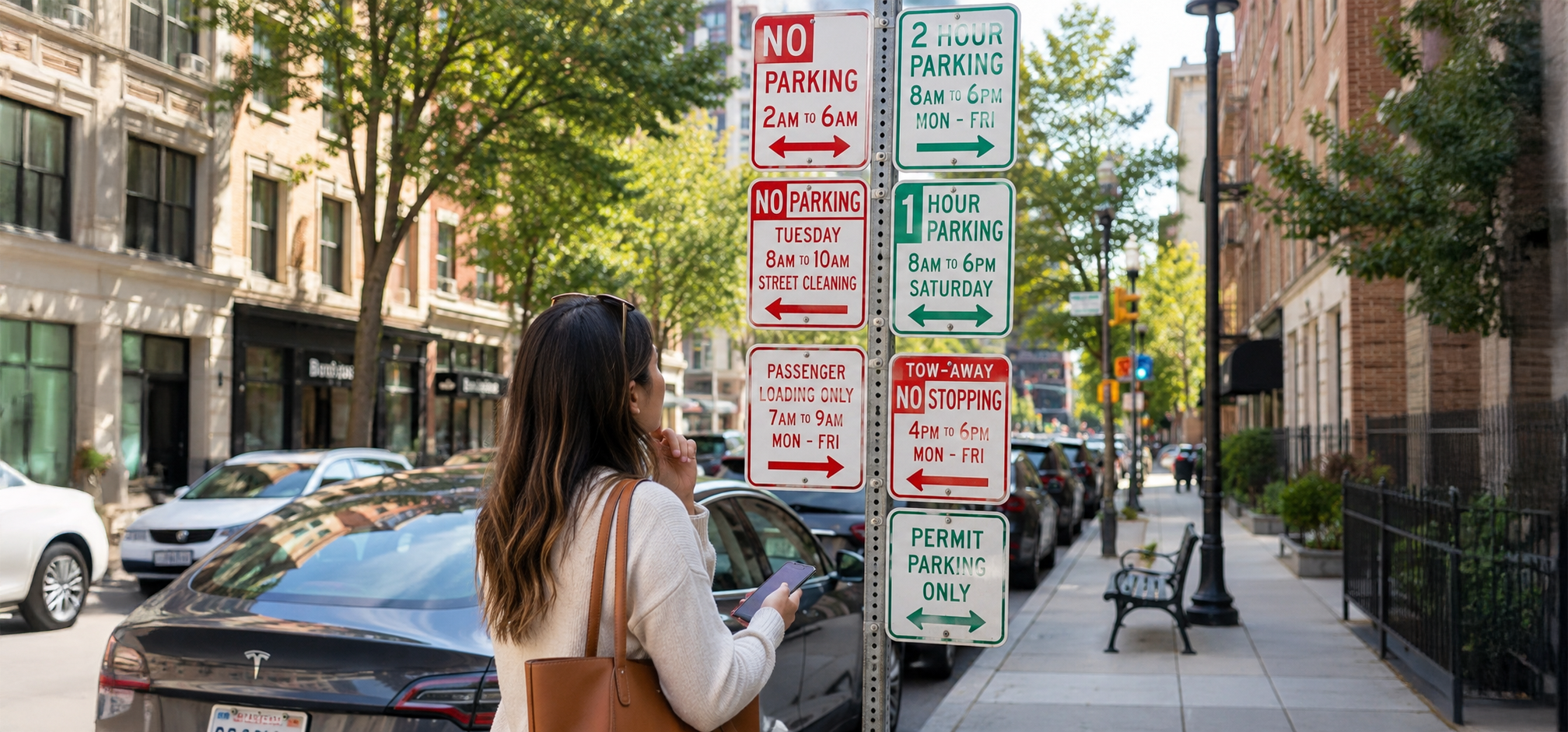
What do parking sign arrows mean? Arrows indicate the direction along the curb where a posted parking restriction applies. They help drivers determine whether a rule affects the space to the left, right, or on both sides of a sign.
Here’s the general meaning:
- ← Left arrow: The restriction applies in the direction to the left of the sign.
- → Right arrow: The restriction applies in the direction to the right of the sign.
- ← → Double arrow: The restriction extends in both directions from the sign.
These arrows help identify where a parking rule applies, but they don’t tell you everything about whether parking is permitted.
For example, you might correctly read a NO PARKING, 2 HOUR PARKING, or STREET CLEANING sign but still misunderstand whether the restriction applies to your vehicle.
The posted hours might be correct. The day might match. But the arrow could point away from your parking space.
And when several signs share the same pole, different restrictions may apply to different portions of the curb.
The key is to connect three things: the sign, the arrow, and your vehicle’s location.
Always consider the wording, posted times, nearby signs, and applicable local regulations before deciding whether you can park.
Let’s look at how each arrow works.
Why Do Parking Signs Have Arrows?
Parking restrictions often apply only to a particular section of curb rather than an entire street.
Arrows help communicate where a parking rule applies.
A sign may establish a restriction, while the arrow helps define the area affected by that restriction. That means reading the words NO PARKING, 2 HOUR PARKING, or PERMIT PARKING isn’t always enough.
If the signs themselves are difficult to decipher, our guide to how to read parking signs breaks down the days, times, restrictions, arrows, and other information drivers should check.
You also need to ask:
Where does this rule apply?
That’s where the arrow becomes important.
What Does a Left Arrow on a Parking Sign Mean?
A left-pointing arrow generally indicates that the posted regulation applies in the direction the arrow is pointing.
For example, if a NO PARKING sign has an arrow pointing left, the restriction may apply along the curb extending to the left of that sign.
But don’t interpret the arrow in isolation.
Another sign, intersection, curb marking, or local parking regulation may determine where that restriction begins or ends.
If the restriction itself is confusing, our guide to No Parking vs. No Standing vs. No Stopping explains how these similar-sounding parking rules can mean different things.
Always consider the sign’s wording, its position, and the surrounding street conditions together.
What Does a Right Arrow on a Parking Sign Mean?
Similarly, a right-pointing arrow generally indicates that the posted rule applies in the direction of the arrow.
If your vehicle is parked to the right of the sign, that restriction may therefore apply to your space.
But again, the arrow only tells you part of the story.
You still need to determine:
What is the restriction?
Does it apply today?
Does it apply at this time?
Are there exceptions?
Are there other signs nearby?
A directional arrow can tell you where to look—but the rest of the sign tells you what rule you’re dealing with.
What Do Arrows Pointing Both Directions Mean?
Some parking signs use arrows pointing in both directions.
This generally indicates that the regulation extends along the curb in both directions from the sign, subject to other posted boundaries or restrictions.
This is especially important when you’re parked close to the sign itself.
Your vehicle may be on one side of the pole, but a bidirectional arrow can indicate that the same rule applies on both sides.
That’s why assuming “I’m parked on the other side of the sign, so I’m okay” can be a costly mistake.
What If a Parking Sign Has No Arrow?
Not every parking sign uses arrows.
When there is no directional arrow, you still need to determine the area governed by the sign according to the signage, curb layout, nearby signs, and applicable local rules.
Don’t assume that the absence of an arrow automatically means a restriction applies everywhere—or nowhere.
Parking regulations and signage conventions can vary between jurisdictions, so the safest approach is to evaluate the entire parking environment.
What If Several Parking Signs Have Different Arrows?
Now things get interesting.
Imagine a pole containing:
NO PARKING — STREET CLEANING
TUESDAY 8 AM–10 AM →
and:
2 HOUR PARKING
8 AM–6 PM ←
and perhaps another permit restriction beneath them.
Suddenly, you’re not interpreting one arrow.
You’re determining which rule applies to which section of curb—and whether that rule applies right now.
When multiple signs, arrows, time limits, and restrictions appear together, see how ParkClear helps read street parking signs and simplify the information into clearer parking guidance.
This is where drivers should slow down and evaluate each sign separately.
For every applicable sign, ask:
What does it regulate?
Which direction does it apply?
What days does it apply?
What hours does it apply?
Does an exception change the rule?
Then consider those rules together.
Your Car’s Position Matters
One of the easiest mistakes to make is reading the closest sign without considering where your vehicle sits relative to it.
Imagine two cars:
CAR A ← PARKING SIGN → CAR B
A directional restriction could potentially apply to Car A but not Car B—or vice versa.
The cars may be only a short distance apart, yet different rules can apply depending on the signs, arrows, curb boundaries, and local regulations.
So instead of asking:
“What does that parking sign mean?”
ask:
“What does that parking sign mean for the exact space where my car is parked?”
That is a much better parking question.
Don’t Let the Arrow Distract You From the Time and Day
Understanding the arrow doesn’t automatically tell you whether parking is allowed.
Suppose the arrow confirms that a NO PARKING restriction applies to your section of curb.
That sounds definitive.
But then the rest of the sign says:
MON–FRI
7 AM–9 AM
If it’s Saturday afternoon, that particular time-based restriction may not currently apply.
Parking signs often require drivers to combine several pieces of information:
LOCATION + RESTRICTION + DIRECTION + DAY + TIME + EXCEPTIONS
Miss one piece and you may reach the wrong conclusion.
This becomes especially important when leaving a vehicle for several hours. Our guide to Overnight Parking Rules explains how to check whether parking will remain allowed as the day, time, or restrictions change.
Look for Other Parking Restrictions Nearby
An arrow shouldn’t be interpreted as permission to ignore everything else.
Even if one parking restriction doesn’t extend to your space, another one might.
Check for other signs, curb markings, temporary notices, loading zones, permit restrictions, street-cleaning rules, construction notices, and other applicable parking regulations.
The question isn’t simply whether one particular sign allows you to park.
The real question is whether all applicable rules allow you to park there at that time.
A Simple Way to Read Parking Sign Arrows
When you see an arrow on a parking sign, use this sequence:
SIGN → ARROW → LOCATION → DAY → TIME → OTHER RULES
SIGN: What does the sign prohibit, permit, or restrict?
ARROW: Which direction does the sign indicate?
LOCATION: Is your vehicle within the area affected by that restriction?
DAY: Does the restriction apply today?
TIME: Does it apply right now?
OTHER RULES: Are there additional signs or restrictions affecting the same parking space?
This gives you a much better framework than simply looking at an arrow and guessing.
Why Parking Sign Arrows Become So Confusing
A single arrow isn’t necessarily complicated.
The difficulty comes from combining the arrow with everything else.
You may be trying to interpret:
three signs, two arrows, different hours, different days, a permit exception, and a street-cleaning restriction—all on one pole.
And ultimately, you aren’t trying to become an expert in parking signage.
You’re trying to answer one question:
That’s why parking-sign interpretation is such a natural problem for technology to help simplify.
How ParkClear Helps Simplify Confusing Parking Signs
ParkClear is designed to help drivers understand parking rules without manually deciphering every piece of information on their own.
Using location-based technology and parking sign analysis, ParkClear helps interpret applicable parking information and turn complicated restrictions into clearer “Yes” or “No” parking guidance.
When parking signs contain arrows, different times, multiple restrictions, or overlapping rules, the goal is to help drivers get from:
“What does all of this mean?”
to:
“Can I park here?”
faster and with greater confidence.
The Next Time You See a Parking Sign Arrow
Don’t panic over the arrow—and don’t ignore it.
Remember:
What does the sign say?
Which way does the arrow point?
Where is my car?
Does the restriction apply today?
Does it apply right now?
Are there other rules I need to consider?
Once you work through those questions, parking sign arrows become much easier to understand.
And when multiple signs, arrows, times, and restrictions turn a simple parking space into a puzzle, ParkClear was built to help make the answer clearer.
Park with confidence. Save time. Skip the parking-sign headache.
Parking regulations vary by jurisdiction. Always follow posted signs and applicable local laws, and check official local rules when necessary.


17 Comments