
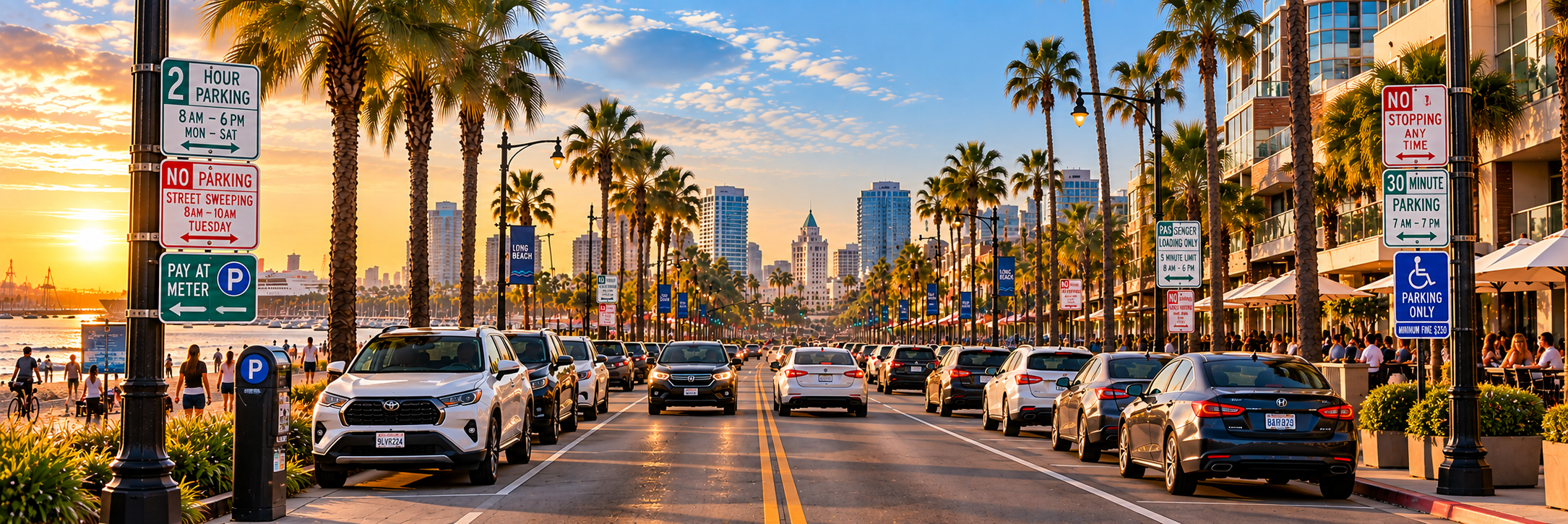
Long Beach has one of Southern California’s most varied parking environments.
Downtown streets, waterfront attractions, Belmont Shore, Retro Row, residential neighborhoods and beach areas can all operate differently—and parking conditions can change within just a few blocks.
Drivers may need to consider meters, time limits, preferential parking districts, street sweeping, colored curbs, loading zones and temporary restrictions.
Finding an empty curb isn’t enough.
Here’s what to check before parking in Long Beach.
How Does Street Parking Work in Long Beach?
Long Beach is its own city with its own parking regulations and enforcement.
Before leaving your vehicle, check:
- Every parking sign affecting the space.
- Parking meter or pay-station instructions.
- Time limits.
- Directional arrows.
- Street-sweeping restrictions.
- Preferential parking restrictions.
- Curb colors.
- Loading zones.
- Temporary No Parking signs.
- Restrictions beginning later during your stay.
The most important question isn’t simply whether parking is legal when you arrive.
You need to know whether it will remain legal until you return.
What About Parking in Downtown Long Beach?
Downtown Long Beach combines offices, restaurants, entertainment, residential buildings and waterfront destinations.
Metered street parking is available in parts of Downtown, but rules differ depending on exactly where you park.
The city distinguishes between its Downtown Core and other Downtown metered areas, with different rates and enforcement schedules.
That makes checking the individual meter particularly important.
Before leaving your vehicle, confirm:
- Meter operating hours.
- Maximum parking duration.
- Required payment.
- Nearby parking signs.
- Curb restrictions.
- Loading restrictions.
Don’t assume the meter rules from one Downtown block apply to the next.
How Do Long Beach Parking Meters Work?
Long Beach uses both single-space meters and multi-space pay stations.
Metered parking can be found in areas including:
- Downtown Long Beach.
- The Pike.
- Second Street in Belmont Shore.
- Fourth Street in Retro Row.
- Select beach parking lots.
Rates, hours and maximum parking durations vary by district.
For example, Long Beach currently establishes different meter schedules for Downtown Core, Downtown, The Pike, Belmont Shore and Retro Row.
That means there isn’t one universal “Long Beach parking meter rule.”
Read the meter or pay station where you actually park.
And remember:
Paying a meter doesn’t override another parking restriction.
A No Parking sign, loading restriction or other applicable rule can still prohibit parking even if the meter accepts payment.
Our guide to parking meter rules after hours explains why meter payment and permission to park are separate questions.
What About Parking in Belmont Shore?
Belmont Shore creates a very different parking environment from Downtown.
Second Street is a busy commercial corridor lined with restaurants, shops and businesses, while surrounding residential streets can have different parking conditions.
Long Beach currently operates metered parking along portions of Second Street.
If you’re visiting Belmont Shore, check:
- Meter hours.
- Maximum parking duration.
- Nearby curb markings.
- Residential restrictions on surrounding streets.
- Street sweeping.
- Loading zones.
Moving one or two blocks away from Second Street doesn’t necessarily mean you’ve found unrestricted parking.
Always read the signs on the residential block where you actually stop.
What About Parking Near the Beach?
Long Beach offers multiple types of parking near its waterfront, including beach lots and other public parking facilities.
Some beach parking locations use meters or mobile payment.
But don’t assume rules at a beach lot are identical to street-parking rules nearby.
If you’re parking on the street rather than inside a designated lot, follow the regulations governing that curb.
Similarly, paying for a beach parking facility doesn’t authorize parking elsewhere.
Check the signs, meter or pay station at your exact location.
What About Parking Around The Pike?
The Pike and surrounding waterfront attractions generate significant parking demand.
Metered parking is available in The Pike area, and public parking structures provide another option.
If you’re using street parking, pay attention to:
- Meter hours.
- Maximum duration.
- Loading restrictions.
- Temporary restrictions.
- Other signs affecting the curb.
If you’re planning to stay for dinner, entertainment or an event, consider whether your parking time limit will expire before you’re ready to leave.
What About Retro Row Parking?
Fourth Street’s Retro Row is another Long Beach commercial district with its own metered parking environment.
Restaurants, independent shops and other businesses create steady curb demand.
Long Beach currently operates meters along portions of Fourth Street in this district.
Don’t assume those meters operate on the same schedule as Downtown or Belmont Shore.
Read the meter at the space where you park.
Nearby residential streets may also have different regulations, so check again if you move away from the commercial corridor.
Does Long Beach Have Residential Permit Parking?
Yes.
Long Beach has Preferential Parking Districts in designated parking-impacted residential areas.
These districts are intended to address neighborhoods where outside parking demand creates significant pressure on available curb space.
Posted restrictions may limit how long vehicles without the applicable permit can remain parked.
Long Beach offers residential, guest and temporary preferential parking permits for qualifying residents.
Permits are specific to the district for which they’re issued.
If you’re visiting a residential neighborhood, don’t assume an unmetered curb means unrestricted parking.
Read the posted signs.
Our guide to permit parking signs explains what drivers should look for.
Can Visitors Use Guest Parking Permits?
Qualifying residents within Long Beach Preferential Parking Districts can obtain guest permits, and temporary preferential parking permits are also available for eligible guests.
But a guest permit doesn’t transform the street into unrestricted parking.
Other regulations may still apply.
Always check for:
- Street sweeping.
- Colored curbs.
- Temporary No Parking signs.
- Driveways.
- Other posted restrictions.
A permit generally addresses a particular permit restriction—not every parking rule on the street.
How Does Street Sweeping Work in Long Beach?
Street sweeping is particularly important in Long Beach.
The city posts street-sweeping restrictions with specific days and times.
Different sides of a street may be swept on different days.
That means drivers need to read the signs for the side where they’re actually parked.
Don’t rely on memory from the opposite curb.
And don’t assume you can remain parked because the sweeper has already passed.
Follow the full restriction printed on the sign.
Our guide to parking during street sweeping explains why the posted time window matters.
Is Street Sweeping Enforced on Holidays?
Long Beach suspends street-sweeping violations on designated city-observed holidays.
However, this does not mean all parking rules are suspended.
In fact, Long Beach generally continues enforcing citywide parking violations—including meters and pay stations—on holidays unless a sign specifically states “Except on Holidays.”
That’s an important distinction.
Never assume:
Holiday = free parking everywhere.
Check the exact sign or meter before leaving your vehicle.
What Do Long Beach Curb Colors Mean?
Long Beach uses colored curbs to communicate different parking, stopping and loading restrictions.
Understanding these colors can help drivers avoid parking violations, especially in busy commercial districts and residential neighborhoods.
Here are the general meanings:
- Red curb: No stopping, standing or parking, except where specifically authorized by law.
- White curb: Generally reserved for passenger loading and unloading. Posted signs may specify additional restrictions.
- Green curb: Short-term parking, typically with a posted time limit. Check nearby signs for the permitted duration and applicable hours.
- Yellow curb: Generally designates a loading zone, often for commercial loading and unloading. Restrictions and permitted uses may vary by location and time.
- Blue curb: Designates accessible parking for vehicles displaying the required disability parking placard or license plates.
Important: Curb colors are only part of the parking rules. Nearby signs may establish specific hours, time limits or additional restrictions.
For example, a green curb may permit short-term parking during designated hours, while another restriction applies at a different time.
Always check both the curb marking and applicable parking signs before leaving your vehicle.
Our guide to parking curb colors explains what drivers should look for.
Watch for Loading Zones
Long Beach’s commercial and waterfront districts contain restaurants, hotels, stores and businesses that require curb access.
That means drivers may encounter commercial loading and passenger-loading zones.
An empty loading zone isn’t automatically available for ordinary parking.
Check:
- Curb color.
- Posted hours.
- Type of loading permitted.
- Maximum duration.
- Other restrictions.
See our guides to loading zone parking rules and passenger loading zones for more information.
Can You Park in an Alley in Long Beach?
No.
Long Beach specifically prohibits parking in alleys.
Alleys need to remain available for emergency access, including fire trucks and ambulances.
This is a useful rule to remember in dense neighborhoods where ordinary street parking can be difficult to find.
Don’t treat an open section of alley as overflow parking simply because other curb spaces are occupied.
Our broader guide to alley parking rules explains why alley parking is commonly restricted.
Can You Leave Your Car Parked for Several Days?
Don’t assume that a curb without a posted time limit allows indefinite vehicle storage.
California cities commonly regulate vehicles left standing for extended periods, and Long Beach city materials identify vehicles left in the same public-street location for more than 72 hours as long-term storage in its parking policies.
If you’re planning to leave a vehicle on a Long Beach street for several days, check the applicable city regulations rather than relying only on the signs immediately beside the car.
Our guide to how long a car can be parked on the street explains why extended street parking requires extra attention.
How Do You Read Multiple Parking Signs?
Long Beach can present several restrictions on the same section of curb.
Imagine seeing:
2 HOUR PARKING
NO PARKING — STREET SWEEPING
PERMIT EXEMPT
PASSENGER LOADING — CERTAIN HOURS
These instructions may appear contradictory.
But each rule can apply during a different time or under different circumstances.
A permit might exempt one vehicle from a time limit without overriding street sweeping.
A loading zone might operate during certain hours and convert to another use later.
Directional arrows can further determine which portion of curb each rule controls.
Our guides to multiple parking signs and parking sign arrows explain how to work through stacked restrictions.
Watch for Temporary No Parking Signs
Normal parking conditions can change.
Construction, moving activity, special events, maintenance and other temporary uses may require curb restrictions.
Before parking, look for temporary notices and check:
- Effective date.
- Start time.
- End time.
- Directional arrows.
- Portion of curb affected.
Don’t assume a familiar street is legal today simply because you parked there previously.
Read our guide to temporary No Parking signs for more information.
What About Parking During Major Long Beach Events?
Long Beach hosts major events throughout the year, particularly around Downtown and the waterfront.
Events can bring temporary street closures, parking restrictions and changes to normal traffic patterns.
If you’re attending a major event, check current city information before arriving and pay close attention to temporary signs once you’re there.
A street that normally permits parking may operate differently during an event.
Our special event parking guide explains what drivers should check.
Be Careful Around Driveways, Intersections and Crosswalks
An empty section of curb isn’t necessarily a legal parking space.
Before squeezing into a short space, make sure your vehicle isn’t interfering with:
- Driveway access.
- Crosswalk visibility.
- Intersections.
- Fire hydrants.
- Red curbs.
- Other restricted areas.
Some parking restrictions apply because of state or local law even when there isn’t a traditional parking sign directly beside your vehicle.
Read our guides to driveway parking rules, crosswalk parking rules and intersection parking rules for more information.
How Does Parking Enforcement Work in Long Beach?
Long Beach enforces parking regulations covering meters, posted time limits, street sweeping, loading zones, residential parking restrictions and other prohibited parking locations.
Enforcement depends on the applicable rule, location, day and time. A vehicle may receive a parking citation even when no parking meter is present, because restrictions can also come from posted signs, curb markings and local laws.
For current enforcement policies, holiday exceptions and citation information, consult the City of Long Beach’s official parking resources.
What if You Get a Parking Ticket in Long Beach?
Long Beach operates its own parking citation system.
If you receive a citation, read it carefully and note:
- The violation.
- Date and time.
- Location.
- Payment instructions.
- Contest instructions.
- Applicable deadline.
If you believe the citation was issued incorrectly, document the parking environment promptly.
Take photographs showing:
- Your vehicle’s position.
- Every relevant sign.
- Directional arrows.
- Curb markings.
- Meter or pay-station information.
- The surrounding block.
Then follow the City of Long Beach procedures provided with the citation.
Long Beach Street Parking Checklist
Before walking away from your vehicle:
- Read every applicable sign. Don’t stop after finding one favorable rule.
- Check directional arrows. Determine which portion of curb each restriction controls.
- Check the meter. Long Beach meter rules vary by district.
- Inspect the curb. Look for colored restrictions.
- Check residential permits. Some neighborhoods have Preferential Parking Districts.
- Check street sweeping. Pay attention to the specific side of the street.
- Look for loading zones. Commercial and waterfront areas can have specialized curb uses.
- Look for temporary restrictions. Normal parking conditions can change.
- Don’t park in an alley.
- Check your return time. Make sure another restriction doesn’t begin before you return.
The key question isn’t simply:
Can I park here now?
It’s:
Can I legally remain here until I return?
How ParkClear Helps With Long Beach Street Parking
Long Beach demonstrates why parking rules can change dramatically within the same city.
A driver may need to interpret multiple signs, understand a meter, recognize a preferential parking restriction, account for street sweeping and determine whether another rule will begin before returning.
ParkClear helps drivers interpret municipal street-parking regulations using parking-sign scanning and location-based information.
The goal is to provide a clear Yes or No answer to:
Can I park here?
Future date and time checks can help drivers evaluate whether parking will be permitted later, while parking-expiration reminders can help track when permitted parking ends.
ParkClear doesn’t locate vacant parking spaces, provide live parking occupancy or offer turn-by-turn navigation.
Its focus is helping drivers understand the rules governing the curb where they want to park.
Learn more about the ParkClear parking sign scanner.
Make Long Beach Parking Easier to Understand
Whether you’re parking Downtown, visiting The Pike, heading to the beach, shopping on Second Street in Belmont Shore or exploring Retro Row, don’t judge a parking space simply because the curb is empty.
Read every sign. Check the meter. Inspect the curb. Look for street-sweeping and permit restrictions.
And remember that parking conditions can differ significantly from one Long Beach district to another.
Most importantly, check whether the rules will change before you plan to return.
Confused about whether you can park? Download ParkClear to scan parking signs or use your location to get a clear Yes or No answer to “Can I park here?”
Parking regulations vary by jurisdiction. Always follow posted signs and applicable local laws, and check official local rules when necessary.