
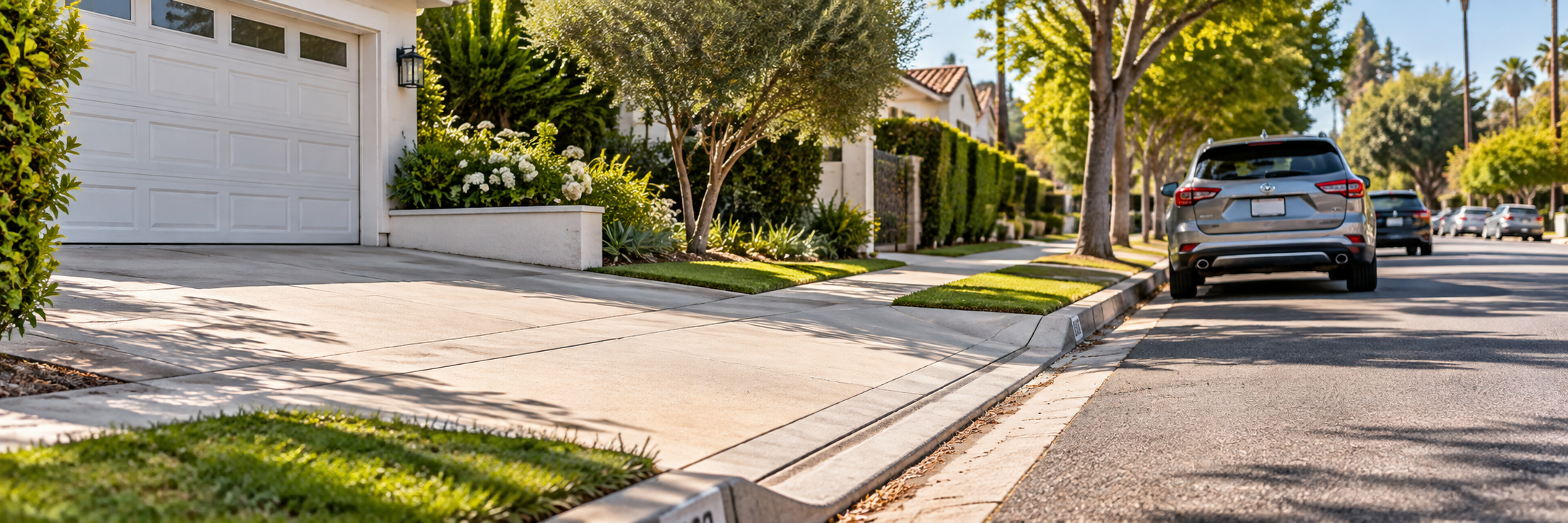
Parking near a driveway can be confusing when the curb looks like an ordinary available parking space.
If you’re wondering, “Can I park in front of a driveway?” the answer depends on local parking laws, the position of your vehicle, and whether you block or interfere with access to the driveway.
A lack of No Parking signs or painted curbs does not automatically mean the space is legal.
Can You Park in Front of a Driveway?
Generally, parking in a way that blocks a driveway is prohibited.
Driveways need to remain accessible so vehicles can enter and exit the property. However, the exact rules governing how close you may park to a driveway can vary by jurisdiction.
Before leaving your vehicle, make sure no part of it unlawfully obstructs the driveway and check applicable local parking rules.
How Close Can You Park to a Driveway?
There is no single distance that drivers should assume applies everywhere.
Local laws can determine whether a specific minimum clearance applies and how authorities measure that clearance.
Rather than relying on a distance you remember from another city, check the rules for the jurisdiction where you are parking.
What Counts as Blocking a Driveway?
Blocking a driveway can involve more than parking directly across its center.
Depending on local law and the circumstances, a vehicle that extends into the driveway opening may interfere with safe access even if most of the driveway remains clear.
When choosing a space, consider the position of your entire vehicle—not just its wheels or bumper relative to the driveway.
Can You Partially Block a Driveway?
Do not assume that leaving most of a driveway open makes the parking space legal.
A vehicle can still interfere with entry or exit when only part of it extends across the driveway opening.
If the available curb space is too short to keep your vehicle clearly outside the restricted area, choosing another space is the safer option.
Can You Park in Front of Your Own Driveway?
This is a common question, and the answer depends on local law.
Some jurisdictions may prohibit blocking a driveway regardless of who owns or occupies the adjoining property, while others may have different rules or exceptions.
Property ownership alone should not be treated as automatic permission to disregard street-parking regulations.
Check the applicable local rules before parking across your own driveway.
Does a Driveway Need a No Parking Sign?
Not necessarily.
Many parking restrictions come directly from traffic or municipal laws and do not require a separate sign at every location.
A driveway can therefore have parking protections even when there is no No Parking sign nearby.
This is similar to other location-based restrictions where drivers need to consider both posted signs and general parking laws.
Does the Curb Need to Be Painted?
Not necessarily.
Cities use curb colors differently, and some driveway areas may have no painted curb at all.
Never assume that an unpainted curb makes it legal to block a driveway.
See ParkClear’s guide to curb colors and their meanings for more information about interpreting painted curbs.
What If There Is a Parking Meter Near the Driveway?
A nearby parking meter does not automatically make every portion of the curb legal for parking.
Drivers still need to comply with driveway-clearance requirements and other parking restrictions.
Before paying the meter, make sure the space itself is legal.
See our guide to parking meter rules for more information about meters and overlapping parking restrictions.
What If Parking Signs Are Near the Driveway?
Parking signs can establish additional restrictions for the same curb.
A space near a driveway could also have time limits, permit requirements, street-cleaning restrictions, temporary parking rules, or other limitations.
Read every applicable sign before deciding whether you can park.
Our guide to multiple parking signs explains how to evaluate several restrictions affecting the same parking space.
Can You Get a Parking Ticket for Blocking a Driveway?
Yes.
Parking in violation of driveway restrictions can result in a citation, with enforcement rules and penalties depending on the jurisdiction.
A driver should not rely solely on whether the property owner appears to be using the driveway at that moment.
The applicable parking rule controls whether the vehicle may remain there.
Can Your Car Be Towed for Blocking a Driveway?
Potentially.
Local laws determine when authorities may tow a vehicle that blocks or interferes with driveway access.
Because towing can be a possible consequence, avoid leaving your vehicle where its position relative to a driveway is uncertain.
See our guide to tow-away zone signs for more information about towing-related parking restrictions.
How ParkClear Helps With Street Parking Rules
Determining whether a curb space is legal can require more than finding an open spot.
ParkClear helps drivers understand confusing parking signs and street parking rules.
Scan a parking sign or use your location to get a clear Yes or No answer to the question: “Can I park here?”
ParkClear can also help drivers interpret curb colors, multiple parking signs, parking meters, tow-away restrictions, and other street-parking rules.
The Bottom Line: Can You Park in Front of a Driveway?
Do not park where your vehicle unlawfully blocks or interferes with a driveway.
The exact clearance requirements vary by jurisdiction, so check applicable local rules rather than assuming a universal distance.
Remember that a driveway may still have parking restrictions even when there is no painted curb or No Parking sign.
When street-parking rules are difficult to interpret, ParkClear is designed to make parking decisions clearer.
Download ParkClear
Confused about whether you can park? Download ParkClear to scan parking signs or use your location to get a clear Yes or No answer to “Can I park here?”
Parking regulations vary by jurisdiction. Always follow posted signs and applicable local laws, and check official local rules when necessary.