
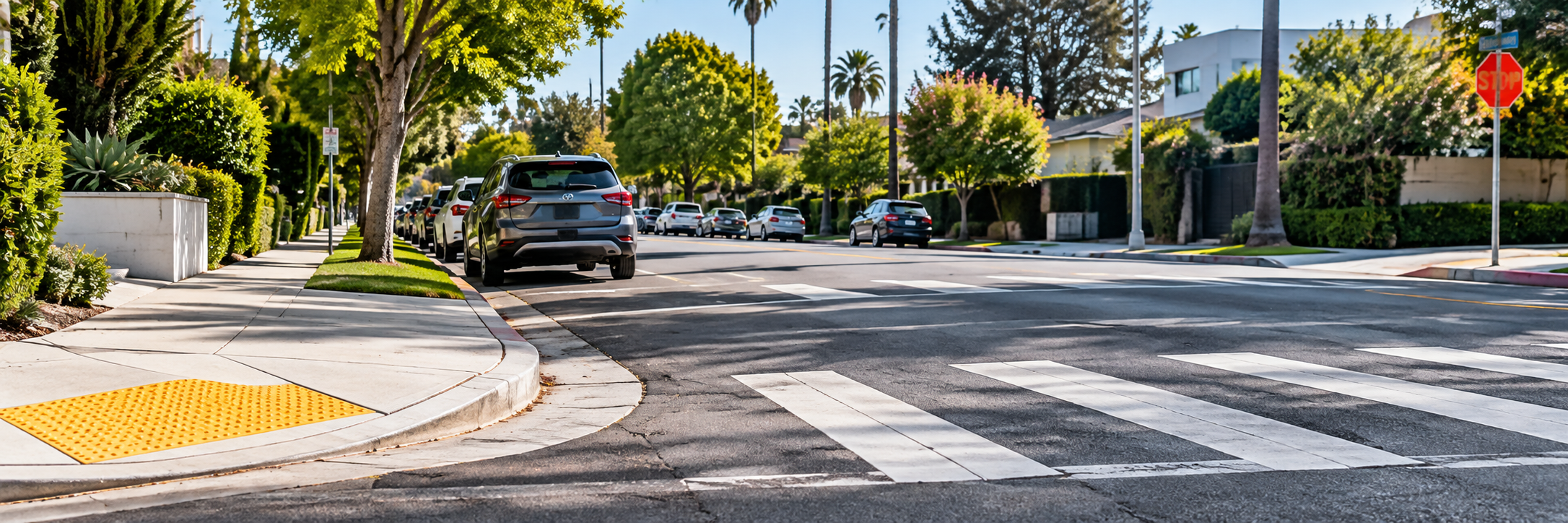
Parking near an intersection can be confusing because an open stretch of curb does not necessarily mean the space is legal.
If you’re wondering, “Can I park near an intersection?” the answer depends on local parking laws, your distance from the intersection or crosswalk, posted signs, curb markings, and other restrictions.
Before leaving your vehicle, check the entire area rather than relying only on whether you see a No Parking sign.
Can You Park Near an Intersection?
Sometimes—but you generally cannot park where local law requires the area near an intersection to remain clear.
Cities and states may establish restrictions around intersections, crosswalks, traffic signals, stop signs, or other roadway features.
Because these requirements vary by jurisdiction, drivers should not assume that one distance applies everywhere.
How Close Can You Park to an Intersection?
The required distance depends on the applicable local law and the features present at the intersection.
For example, rules may differ depending on whether the intersection has a marked crosswalk, stop sign, traffic signal, or other traffic-control device.
Instead of relying on a distance you remember from another city, check the official parking rules where you’re actually parking.
Can You Park Near a Crosswalk?
Parking too close to a crosswalk may be prohibited.
Keeping the area around a crosswalk clear can help maintain visibility between drivers and pedestrians.
A crosswalk may also exist even when its markings are not immediately obvious, depending on local law and the type of intersection.
When parking near a corner, consider both the intersection and any applicable crosswalk restrictions.
Can You Park Near a Stop Sign?
Restrictions may apply near stop signs even when the curb itself appears available.
The required clearance can vary by jurisdiction, so avoid assuming that an open curb directly beside a stop sign is automatically a legal parking space.
Check local requirements before leaving your vehicle.
Can You Park Near a Traffic Light?
Local laws may also restrict parking near traffic signals or signalized intersections.
A parking space that interferes with visibility, traffic movement, pedestrian access, or another regulated clearance area may not be legal even when there is no individual No Parking sign beside it.
Look at the entire intersection before deciding where to park.
Does There Have to Be a No Parking Sign?
Not necessarily.
Some parking restrictions come directly from traffic laws rather than from a sign posted at each individual location.
That means the absence of a No Parking sign does not automatically make a curb space legal.
This is particularly important around intersections, driveways, fire hydrants, crosswalks, and other regulated areas.
Does the Curb Have to Be Painted Red?
Not necessarily.
Curb markings vary by jurisdiction, and a legal parking restriction may exist even when the curb has no paint.
Never use an unpainted curb as your only indication that parking is permitted.
See ParkClear’s guide to curb colors and their meanings for more information about interpreting curb markings.
What If There Are Parking Signs Near the Intersection?
Read every sign that applies to the space.
Parking signs may establish additional restrictions involving time limits, street cleaning, permit parking, loading zones, meters, or tow-away periods.
A driver may need to satisfy both the general intersection rule and the posted parking restrictions.
See our guide to multiple parking signs for help interpreting several rules at the same location.
Can You Park at a Meter Near an Intersection?
The presence of a parking meter does not automatically override another parking restriction.
Before paying a meter, make sure your vehicle is positioned in a legal parking space and does not violate an intersection, crosswalk, or other clearance requirement.
Our guide to parking meter rules explains why paying a meter does not necessarily mean every other parking restriction disappears.
What If There Is a Temporary No Parking Sign?
Temporary restrictions can change the normal parking rules near an intersection.
Construction, street work, events, utility work, or other temporary activities may restrict curb space that drivers normally use.
Always check the dates, hours, arrows, and affected area on temporary signs.
See our guide to temporary no parking signs for more information.
Can You Get a Ticket for Parking Too Close to an Intersection?
Yes.
Parking in an area where local law prohibits vehicles near an intersection, crosswalk, traffic-control device, or another restricted location can result in enforcement.
Penalties and enforcement practices vary by jurisdiction.
The safest approach is to verify that the location itself is legal, rather than relying solely on the absence of a parking sign.
Can Your Vehicle Be Towed?
Potentially.
Depending on the jurisdiction and circumstances, some parking violations can result in towing as well as a citation.
This is particularly important where a vehicle creates a safety issue, obstructs traffic, or violates a posted tow-away restriction.
See our guide to tow-away zone signs for more information about towing-related parking restrictions.
How ParkClear Helps With Street Parking Rules
Street parking decisions sometimes require more than interpreting a single parking sign.
ParkClear helps drivers understand confusing parking signs and street parking rules.
Scan a parking sign or use your location to get a clear Yes or No answer to the question: “Can I park here?”
ParkClear can also help drivers understand multiple parking signs, curb colors, parking meters, temporary restrictions, and other street-parking rules.
The Bottom Line: Can You Park Near an Intersection?
You may be able to park near an intersection, but only when your vehicle complies with applicable clearance requirements and other parking restrictions.
Because intersection and crosswalk rules vary by jurisdiction, don’t assume a universal distance.
Check the location, nearby signs, curb markings, crosswalks, traffic-control devices, and applicable local parking laws before leaving your vehicle.
When street-parking rules are difficult to interpret, ParkClear is designed to make parking decisions clearer.
Download ParkClear
Confused about whether you can park? Download ParkClear to scan parking signs or use your location to get a clear Yes or No answer to “Can I park here?”
Parking regulations vary by jurisdiction. Always follow posted signs and applicable local laws, and check official local rules when necessary.

One Comment