
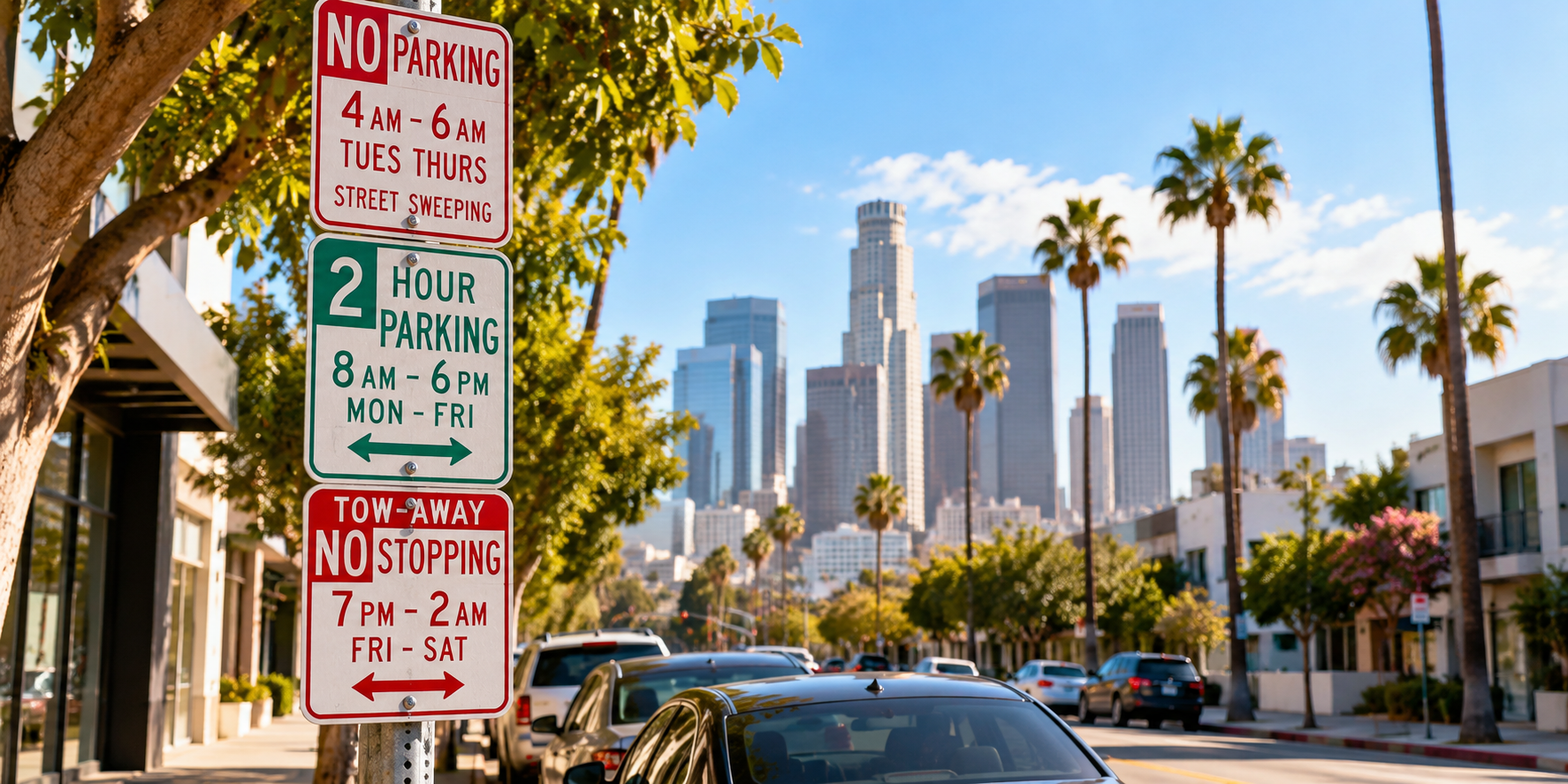
Street parking in Los Angeles can be surprisingly complicated.
You may find an open curb space only to discover several parking signs on the same pole. One rule applies in the morning, another in the evening, street sweeping happens on a particular day, and a residential permit restriction may apply overnight.
Add parking meters, colored curbs, loading zones, temporary restrictions and neighborhood-specific rules, and answering a seemingly simple question can become difficult:
Can I park here?
This Los Angeles street parking guide brings the most important rules together in one place. Use it as a starting point for understanding parking signs, meters, curb colors, street sweeping, permits, overnight parking and other regulations before leaving your vehicle.
How Do You Know if You Can Park on a Los Angeles Street?
Start with the exact location where you intend to park.
Don’t assume that an empty curb means parking is legal. Instead, check:
- Every parking sign affecting the space.
- The days and hours listed on those signs.
- Directional arrows showing where restrictions apply.
- The curb color.
- Meter requirements and operating hours.
- Residential permit restrictions.
- Street-sweeping schedules.
- Temporary No Parking or tow-away notices.
You also need to consider how long you intend to stay.
A space that’s legal at 2 PM may become restricted at 4 PM. Parking legally therefore requires understanding both your location and your intended parking period.
For a step-by-step introduction, start with our guide to how to read parking signs.
How Do You Read Multiple Los Angeles Parking Signs?
Los Angeles streets frequently have more than one parking regulation posted on the same pole.
For example, you might see:
2 HOUR PARKING
followed by a street-cleaning restriction
and then a permit-parking restriction covering different hours.
These signs don’t necessarily contradict one another.
They may describe different rules that apply at different times.
The key is determining which restrictions apply to your vehicle, day and time—and whether another restriction will begin before you plan to leave.
Don’t simply choose the sign that appears most favorable.
Our detailed guide to multiple parking signs explains how to interpret overlapping regulations.
What Do the Arrows on Los Angeles Parking Signs Mean?
Directional arrows help identify the section of curb controlled by a parking restriction.
An arrow pointing in one direction generally indicates that the restriction applies toward that side of the sign. Other arrow configurations may indicate that a restriction continues in multiple directions or identify boundaries between parking zones.
This becomes especially important when several parking signs are installed along the same block.
Your vehicle’s position relative to the sign can determine whether a restriction applies.
See our complete guide to parking sign arrows before guessing which portion of a curb is regulated.
What Do Los Angeles Curb Colors Mean?
Los Angeles uses colored curbs to designate different curbside uses and restrictions.
Depending on the location, you may encounter red, yellow, white, green and blue curbs.
These colors can identify areas associated with prohibited stopping or parking, loading activity, short-term parking or accessible parking.
But curb regulations shouldn’t be interpreted by color alone.
Nearby signs may establish additional conditions or hours that affect how the curb can be used.
Our complete guide to parking curb colors explains the different colors and what drivers should check before parking.
How Does Metered Street Parking Work in Los Angeles?
Metered parking is common throughout Los Angeles commercial districts and busy neighborhoods.
Before paying, check:
- The meter’s operating hours.
- The current rate.
- Maximum parking duration.
- Applicable parking signs.
- Restrictions that begin later.
A common mistake is assuming that paying a meter automatically makes the space legal.
It doesn’t.
A separate parking regulation can still prohibit parking during a particular period.
Similarly, when a meter stops requiring payment, that doesn’t necessarily mean the curb becomes unrestricted.
Our guide to parking meter rules after hours explains this distinction.
Is Street Parking Free in Los Angeles on Sundays?
Sometimes—but not everywhere.
There is no universal rule that makes all Los Angeles street parking free on Sundays.
Meter schedules vary by location, and separate parking restrictions may continue to apply regardless of whether meter payment is required.
Check the individual meter and all nearby signs before assuming Sunday parking is free.
We’ve covered this question in detail in our guide to Sunday parking in Los Angeles.
Is Parking Free in Los Angeles After 6 PM?
Again, it depends on the location.
Some parking meters stop requiring payment in the evening, while others operate later.
And meter hours are only one part of the parking decision.
A curb may become subject to another restriction after the meter stops operating.
If you’re parking for dinner, a concert or another evening activity, check whether your space remains legal for the entire time you intend to stay.
Read our guide to Los Angeles parking after 6 PM for a more detailed explanation.
What Are the Street-Sweeping Parking Rules in Los Angeles?
Street-cleaning restrictions prohibit parking on designated streets during posted days and hours.
The restriction may apply even though the street appears clean or the sweeper has already passed.
The safest approach is to follow the posted enforcement period rather than trying to determine whether cleaning has already occurred.
Street sweeping becomes particularly important when parking overnight because a vehicle that’s legal in the evening may become restricted the following morning.
Our guide to parking during street sweeping explains what drivers should check.
Do You Need a Parking Permit in Los Angeles?
Some Los Angeles neighborhoods have preferential or permit-parking restrictions.
These programs can limit parking by vehicles without an appropriate permit during specified days and hours.
Don’t assume a residential street is unrestricted simply because there are no meters.
Check posted signs to determine whether a permit is required during your intended parking period.
Permit regulations can also vary between districts.
For a deeper explanation, read our Los Angeles parking permit guide.
Can You Park Overnight on a Los Angeles Street?
Overnight street parking is possible in many locations, but the rules depend on the specific street.
Before leaving a vehicle overnight, check for:
- Residential permit restrictions.
- Street-cleaning schedules.
- Posted overnight prohibitions.
- Early-morning restrictions.
- Time limits.
- Temporary notices.
Think beyond the moment you park.
If you leave your vehicle at 10 PM, you need to know what happens at midnight, 2 AM, 6 AM and the following morning—not merely whether parking is permitted at 10 PM.
Our overnight parking guide explains how to evaluate the full parking period.
What Are Los Angeles Loading Zones?
Loading zones reserve curb space for particular activities rather than ordinary long-term parking.
Commercial loading zones and passenger loading areas can have different rules and operating periods.
An empty loading zone shouldn’t automatically be treated as an available parking space.
Check the curb marking and all accompanying signs to determine the applicable restriction.
For more detail, see our guides to loading zone parking rules and passenger loading zones.
What Does a Tow-Away Zone Mean?
A tow-away designation deserves particular attention.
Parking where an active tow-away restriction applies can result in more than a parking citation—your vehicle may be removed.
Tow-away restrictions may be permanent or associated with specific days and times.
They may also appear temporarily for construction, special events, street work or other activities.
Always check when the restriction takes effect.
Our guide to tow-away zone signs explains what to look for.
What About Temporary No Parking Signs?
Temporary signs can change the normal parking conditions on a street.
They may be installed for construction, filming, moving activity, street maintenance, special events or other temporary uses.
This is particularly important if you’re familiar with a neighborhood.
Just because you’ve legally parked on a street many times before doesn’t mean the same curb is legal today.
Look for temporary notices before walking away from your vehicle and check their effective dates and times.
Read our guide to temporary No Parking signs for more information.
How Close Can You Park to Intersections, Driveways and Other Restricted Areas?
Parking legality isn’t determined only by signs and meters.
Your vehicle’s position relative to certain street features can also matter.
Drivers should be particularly careful around intersections, driveways, crosswalks, fire hydrants, bus zones and other restricted areas.
If you’re uncertain about a particular situation, we’ve created dedicated guides covering:
- Parking near intersections
- Parking in front of driveways
- Parking near crosswalks
- Parking near stop signs
- Bus zone parking
These rules are important even when there isn’t a parking meter immediately beside your vehicle.
Are Parking Rules the Same Everywhere in Los Angeles?
No.
Even within the City of Los Angeles, parking conditions vary considerably by neighborhood.
Downtown Los Angeles has dense commercial activity, loading zones, meters and event-related restrictions.
Venice combines beach traffic, residential neighborhoods, meters and permit restrictions.
Other neighborhoods may have different combinations of residential permits, street cleaning and commercial parking.
Our Downtown Los Angeles parking guide and Venice Beach parking guide provide more localized information.
And remember that neighboring Santa Monica is a separate city, not part of the City of Los Angeles.
If you’re parking there, use our Santa Monica parking guide and follow Santa Monica’s local regulations.
What Happens if You Get a Parking Ticket in Los Angeles?
If you receive a parking citation, read it carefully.
Identify the alleged violation, payment deadline and instructions for requesting a review if you believe the citation was issued incorrectly.
If you plan to contest a citation, documenting the parking location can be helpful. Photographs of your vehicle, curb markings and applicable signs may help establish what conditions existed when the citation was issued.
For a detailed overview, read our guide to Los Angeles parking tickets.
You can also review our broader guide on how to avoid parking tickets.
Los Angeles Street Parking Checklist
Before walking away from your vehicle, run through this quick check:
- Look at the curb. Is it marked with a color or designated use?
- Find the parking signs. Read every sign that could apply to your space.
- Check the arrows. Confirm that the restriction actually covers your location.
- Check the day. Weekday, weekend and Sunday rules can differ.
- Check the time. Determine what’s in effect now.
- Check your return time. Make sure another restriction doesn’t begin before you return.
- Check the meter. Confirm payment hours and maximum duration.
- Look for permit restrictions. Especially on residential streets.
- Check street sweeping. Particularly if parking overnight.
- Look for temporary signs. Construction and events can override normal conditions.
The important principle is simple:
Don’t ask only whether you can park there now. Ask whether you can remain parked there until you return.
Explore Parking by LA Neighborhood
Parking restrictions can change significantly between Los Angeles neighborhoods. Explore our local guides for more specific parking considerations:
- Hollywood Parking Guide — Meters, entertainment districts, residential permits and event restrictions.
- Koreatown Parking Guide — Busy commercial corridors, residential streets and street sweeping.
- Silver Lake Parking Guide — Hillside parking, narrow streets, driveways and local restrictions.
- Echo Park Parking Guide — Residential parking, Echo Park Lake and Dodger Stadium events.
- Highland Park Parking Guide — York Boulevard, North Figueroa Street and neighborhood parking rules.
- Studio City Parking Guide — Ventura Boulevard, parking meters and residential restrictions.
- Westwood Parking Guide — UCLA-area parking, Westwood Village meters and permit zones.
Each guide explains what drivers should check before parking in that area.
How ParkClear Helps You Park in LA
ParkClear was built around the complexity drivers encounter on streets like these.
Using parking-sign scanning and location-based parking information, ParkClear helps drivers interpret municipal street-parking regulations and answer:
Can I park here?
Instead of requiring you to decipher multiple restrictions independently, ParkClear is designed to provide a clear Yes or No answer based on the applicable parking rules.
Future date and time checks can help you evaluate parking for later, while parking-expiration reminders help you keep track of when your permitted parking period ends.
ParkClear doesn’t locate vacant parking spaces, provide live parking occupancy or offer turn-by-turn navigation.
Its focus is simpler:
Helping you understand whether you’re allowed to park where you already are.
You can also use the ParkClear parking sign scanner when you’re facing a confusing parking sign.
Make Los Angeles Street Parking Easier to Understand
Los Angeles street parking doesn’t have one universal set of conditions that applies to every curb.
Parking legality can depend on your exact location, the day, the time, your vehicle, curb markings and several overlapping regulations.
That’s why reading the entire parking environment matters.
Read the signs. Inspect the curb. Confirm the meter hours. Most importantly, check whether the rules will change before you plan to leave.
Confused about whether you can park? Download ParkClear to scan parking signs or use your location to get a clear Yes or No answer to “Can I park here?”
Parking regulations vary by jurisdiction. Always follow posted signs and applicable local laws, and check official local rules when necessary.



7 Comments