
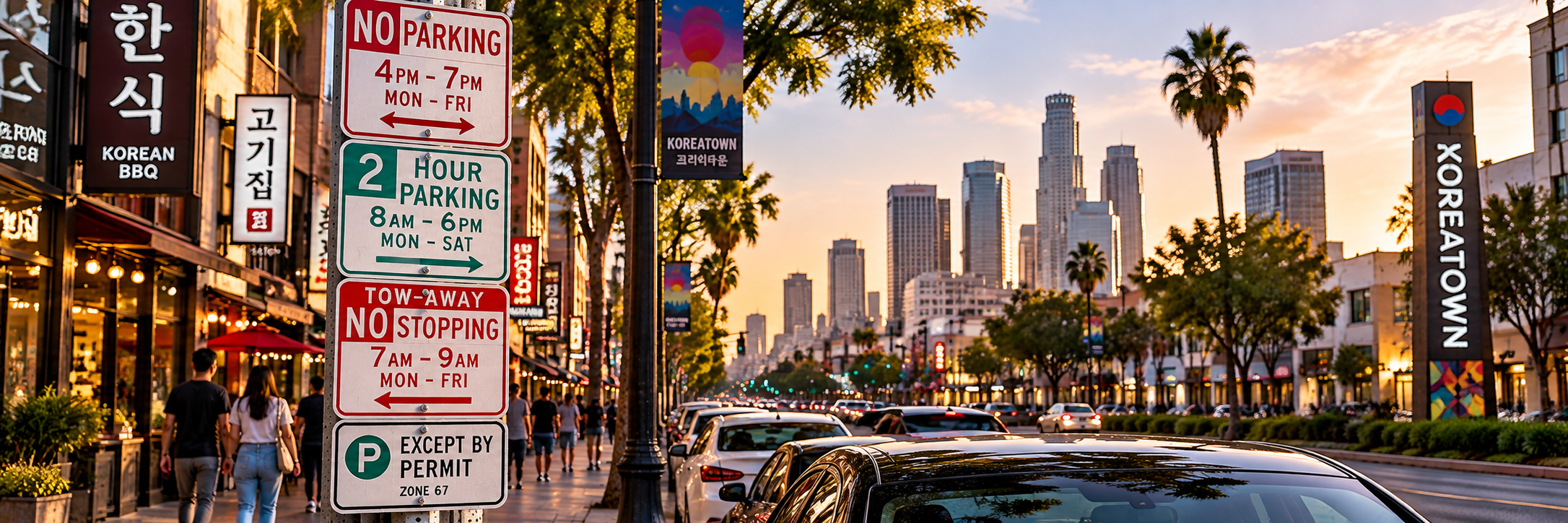
Koreatown is one of Los Angeles’ busiest neighborhoods, known for its restaurants, nightlife, apartments, and bustling commercial streets. Finding parking in Koreatown can be challenging, especially during evenings and weekends.
Where can you park in Koreatown?
Drivers can look for metered street parking along commercial corridors such as Wilshire Boulevard and Sixth Street, time-limited parking on nearby streets, and public or private parking garages and lots. Availability and restrictions vary by location.
Residential streets may also offer parking, but some have permit requirements, street-sweeping schedules, overnight restrictions, or posted time limits.
Before parking, check every applicable sign. A space that looks available may not be legal for your entire visit.
This Koreatown parking guide explains where to look for parking, how to understand local street-parking restrictions, and what to check before leaving your vehicle.
How Does Street Parking Work in Koreatown?
Koreatown is within the City of Los Angeles, so Los Angeles municipal parking regulations apply.
However, parking rules can change from one block to another.
Before leaving your vehicle, check:
- Every parking sign affecting the space.
- Meter hours and time limits.
- Directional arrows.
- Curb colors.
- Residential permit restrictions.
- Street-sweeping schedules.
- Loading zones.
- Temporary No Parking notices.
- Restrictions beginning later in the day.
The last point is particularly important.
You aren’t simply asking whether parking is legal when you arrive. You need to know whether it will remain legal until you return.
For the broader citywide rules, start with our Los Angeles Street Parking Guide.
Why Can Koreatown Parking Be So Confusing?
Koreatown combines busy commercial corridors with densely populated residential streets.
That means different curb uses can exist very close together.
You might drive past metered commercial parking, turn onto a residential street with permit restrictions and then encounter street-sweeping or time-limit signs on the next block.
The appearance of an empty space doesn’t tell you whether you can legally use it.
The signs do.
And sometimes more than one sign applies.
Our guide to how to read multiple parking signs can help when several restrictions appear on the same pole.
How Do Parking Meters Work in Koreatown?
Koreatown has metered parking on various commercial streets.
Don’t assume every meter follows the same rate, operating schedule or maximum parking duration.
Instead, check the meter at the exact space where you park.
Look for:
- Current operating hours.
- Parking rate.
- Maximum time allowed.
- Payment instructions.
- Nearby parking signs.
Most importantly, paying the meter does not override another parking restriction.
A meter and a parking sign can govern different aspects of the same space.
If a sign prohibits parking during a particular period, adding time to a meter doesn’t make parking legal during that restriction.
Read our guide to parking meter rules after hours for more information.
What About Parking Along Wilshire Boulevard?
Wilshire Boulevard runs directly through Koreatown and is one of the neighborhood’s major commercial corridors.
If you’re parking on or near Wilshire, don’t assume the rules on one block continue onto another.
Check the signs at your exact location.
Busy corridors can have restrictions designed around traffic flow, loading and different times of day.
A space that appears usable during one period may become restricted later.
This matters especially if you’re parking for dinner, an appointment or an activity that could last several hours.
What About Street Parking Around 6th Street?
Sixth Street is another major Koreatown corridor lined with restaurants, businesses and destinations.
Parking conditions can vary as you move between commercial and residential blocks.
If you find street parking nearby, check both sides of the street carefully.
One side may have different regulations from the other, and signs farther along the block may still apply to your space.
LADOT advises drivers to look for parking signs when entering a block and to check for additional signs on longer blocks.
Don’t assume the closest sign is necessarily the only one that matters.
Is Koreatown Street Parking Free After 6 PM?
There is no universal rule that Koreatown street parking becomes free or unrestricted after 6 PM.
Meter operating hours vary by location.
Even if payment is no longer required at a particular meter, another restriction may still apply.
For example, a space could be affected by a time limit, permit requirement, loading restriction or another posted regulation.
If you’re parking in Koreatown for dinner or nightlife, check what happens during your entire expected stay.
Our guide to Los Angeles parking after 6 PM explains this in greater detail.
Is Parking Free in Koreatown on Sundays?
Don’t assume Sunday means unrestricted parking.
Whether meter payment is required depends on the posted operating schedule for that particular location.
Other parking restrictions can also remain in effect.
Always check the meter and surrounding signs rather than relying on a general Sunday rule.
Read our guide to Sunday parking in Los Angeles before assuming a space is free.
Are There Residential Permit Parking Areas in Koreatown?
Some Los Angeles residential areas use Preferential Parking District restrictions to reduce non-resident parking.
Where such restrictions apply, they are identified by posted signs.
This is important in a neighborhood like Koreatown, where drivers may leave a busy commercial street and search surrounding residential blocks for parking.
Don’t assume an unmetered residential space is unrestricted.
Look for signs indicating whether a permit is required or whether vehicles without permits are subject to a shorter time limit or parking prohibition.
And remember: a parking permit doesn’t cancel other restrictions.
Street sweeping, colored curbs and other posted regulations still apply.
Our Los Angeles parking permit guide explains permit parking in more detail.
Watch for Street Sweeping in Koreatown
Street-sweeping restrictions are easy to overlook, especially if you park at night and plan to leave your vehicle until the next morning.
Check the posted cleaning day and hours before walking away.
A space that’s completely legal when you park in the evening could become restricted the following morning.
Also, don’t assume you can park immediately after a street sweeper passes.
The posted restriction—not the sweeper’s location—determines when parking is permitted.
Read our guide to parking during street sweeping for more information.
Can You Park Overnight in Koreatown?
Overnight parking depends on the specific street and posted regulations.
Before leaving your vehicle overnight, check for:
- Permit requirements.
- Street-sweeping restrictions.
- Posted overnight restrictions.
- Early-morning restrictions.
- Time limits.
- Temporary No Parking signs.
Think beyond the moment you park.
If you arrive at 10 PM and plan to retrieve your car at 8 AM, you need to determine whether the vehicle can legally remain there throughout that entire period.
Our overnight parking rules guide explains what to check.
Understand Koreatown Loading Zones
Koreatown’s restaurants, shops, apartment buildings and businesses create considerable demand for curbside loading.
That can mean passenger loading areas, commercial loading zones and other restricted curb spaces.
An empty loading zone should not automatically be treated as an available parking space.
Check the curb color and accompanying signs to determine:
- What type of loading is permitted.
- Whether parking is allowed at other times.
- What hours the restriction applies.
- Whether another regulation also affects the space.
See our guides to loading zone parking rules and passenger loading zones.
What Do Colored Curbs Mean in Koreatown?
Like the rest of Los Angeles, Koreatown uses colored curbs to communicate particular parking and curb-use restrictions.
You may encounter red, yellow, white, green or blue curbs.
Don’t rely solely on the paint.
Signs near the curb may provide additional information about when or how a restriction applies.
If the curb paint is difficult to see, inspect the surrounding area carefully before parking.
Our guide to parking curb colors explains the different colors.
Why Do Some Koreatown Parking Signs Seem to Contradict Each Other?
They may not actually contradict each other.
Several restrictions can govern the same curb at different times.
Imagine a pole displaying:
2 HOUR PARKING
NO PARKING — STREET CLEANING
PERMIT PARKING ONLY DURING CERTAIN HOURS
and another restriction applying during part of the day.
Each sign can be valid.
The challenge is determining which rule applies to your vehicle at the particular day and time you’re parking.
Directional arrows can make things even more complicated because they determine which portion of the curb a restriction controls.
When you encounter stacked signs, evaluate them together.
Our guides to multiple parking signs and parking sign arrows explain how to work through them.
Watch for Temporary No Parking Signs
Temporary restrictions can appear because of construction, street work, moving activity, filming or other temporary uses of the curb.
A street you have parked on many times before may operate differently today.
Always scan the block for temporary notices before leaving your vehicle.
Pay particular attention to:
- Effective dates.
- Start and end times.
- Directional arrows.
- The section of curb affected.
A temporary restriction can change what would otherwise be legal parking.
Read our guide to temporary No Parking signs for more information.
Be Careful Near Driveways, Intersections and Crosswalks
In a dense neighborhood, drivers sometimes try to fit into any available curb space.
But your entire vehicle needs to fit legally.
Don’t allow part of your vehicle to extend into a driveway, crosswalk, colored curb or other restricted area.
This is especially worth checking when squeezing into a short space between two vehicles.
For more information, read our guides to driveway parking rules, crosswalk parking rules and intersection parking rules.
What if You Get a Parking Ticket in Koreatown?
Koreatown is within the City of Los Angeles, so City of Los Angeles procedures generally apply to municipal parking citations issued there.
Read the citation carefully and note the violation, instructions and applicable deadlines.
If you believe the citation was issued incorrectly, document the location promptly.
Useful documentation may include photographs showing:
- Your vehicle’s position.
- Nearby parking signs.
- Curb markings.
- Meter information.
- The surrounding block.
Our Los Angeles parking ticket guide provides more information.
Koreatown Street Parking Checklist
Before leaving your vehicle:
- Read every applicable sign. There may be more than one.
- Check the arrows. Make sure you know which section of curb each sign controls.
- Check the meter. Review operating hours, payment and maximum duration.
- Look at the curb. Don’t overlook a colored restriction.
- Check for permits. Especially when moving from commercial streets into residential areas.
- Check street sweeping. Think about the entire time your car will remain parked.
- Look for temporary notices. Today’s rules may differ from the usual rules.
- Check your return time. A different restriction may begin before you return.
The important question isn’t simply:
Can I park here now?
It’s:
Can I legally remain parked here until I plan to leave?
How ParkClear Helps With Koreatown Street Parking
Koreatown illustrates why understanding street parking can become difficult.
A driver may need to interpret several signs, check a meter, recognize a curb restriction and determine whether the rules change later—all before walking away from the vehicle.
ParkClear helps drivers interpret municipal street-parking regulations using parking-sign scanning and location-based information.
The goal is to provide a clear Yes or No answer to:
Can I park here?
Future date and time checks can help drivers evaluate parking rules for a later period, while parking-expiration reminders can help track when permitted parking ends.
ParkClear doesn’t locate vacant spaces, provide live parking occupancy or navigate drivers to available parking.
Its purpose is to help drivers understand the regulations governing the curb where they want to park.
Learn more about the ParkClear parking sign scanner.
Make Koreatown Parking Easier to Understand
Koreatown’s density is part of what makes the neighborhood vibrant—but it can also make street parking rules feel complicated.
Don’t judge a space only by whether another car is parked there.
Read the signs. Check the meter. Inspect the curb. Look for permits and temporary restrictions.
Most importantly, make sure the rules won’t change before you plan to return.
Understanding Parking Rules Across Los Angeles
Hollywood follows City of Los Angeles parking regulations, but individual streets can have different meter hours, permit restrictions, street sweeping schedules, and temporary parking rules.
For a broader explanation, explore our Los Angeles Street Parking Guide, which covers parking signs, curb colors, meters, residential permits, and other common restrictions throughout the city.
Confused about whether you can park? Download ParkClear to scan parking signs or use your location to get a clear Yes or No answer to “Can I park here?”
Parking regulations vary by jurisdiction. Always follow posted signs and applicable local laws, and check official local rules when necessary.

One Comment