
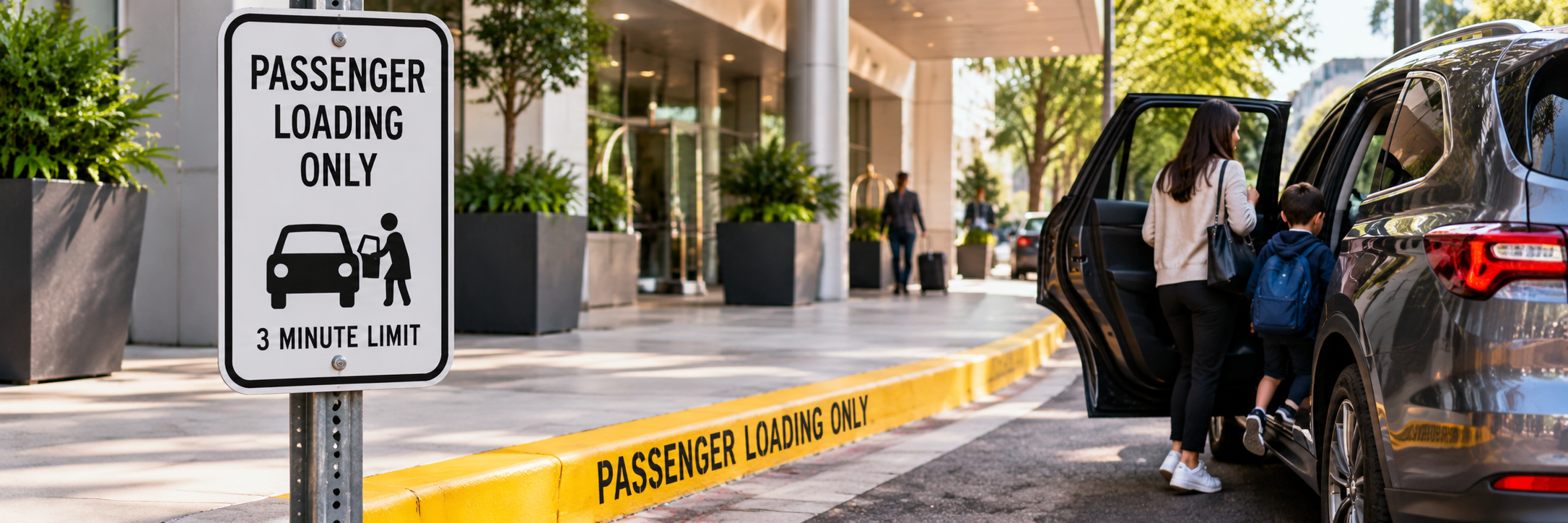
Passenger loading zones help people enter or exit vehicles quickly, but they are not the same as ordinary parking spaces.
If you’re wondering, “Can I park in a passenger loading zone?” the answer depends on the posted signs, curb markings, time restrictions, and local parking laws. In many locations, drivers may use these spaces only for active passenger pickup and drop-off rather than regular parking.
What Is a Passenger Loading Zone?
A passenger loading zone provides designated curb space for drivers to pick up or drop off passengers.
You commonly find these zones near schools, hotels, apartment buildings, hospitals, transit areas, businesses, and other places where passengers frequently enter or exit vehicles.
The amount of time you may remain in the zone and whether the driver can leave the vehicle varies by jurisdiction.
Can You Park in a Passenger Loading Zone?
Generally, drivers should not treat a passenger loading zone like a regular parking space.
The zone may allow you to stop briefly while a passenger enters or exits your vehicle, but remaining there after the loading or unloading activity is complete may violate local parking rules.
Before stopping, check the posted parking signs, applicable hours, curb markings, time limits, and any additional restrictions.
If several restrictions are posted together, see our guide to multiple parking signs to understand how overlapping rules may apply.
Can You Leave Your Car in a Passenger Loading Zone?
Do not assume that you can leave your vehicle unattended.
Some jurisdictions require the driver to remain with the vehicle or limit the stop to the amount of time reasonably necessary for passengers to enter or exit.
Local rules may consider even a short absence to be parking rather than active passenger loading.
How Long Can You Stay in a Passenger Loading Zone?
There is no single time limit that applies everywhere.
Some passenger loading zones display a specific time limit, while local rules may set additional restrictions that do not appear on the sign.
If the sign displays a time limit, follow it carefully. A maximum time does not necessarily mean you can use the space for ordinary parking during that entire period.
Can You Wait for Someone in a Passenger Loading Zone?
This depends on the local rules and the restriction posted at that particular location.
Waiting several minutes for someone who has not yet arrived may be treated differently from actively picking up a passenger who is ready to enter your vehicle.
If you’re uncertain whether waiting is permitted, don’t assume that remaining inside the vehicle automatically makes the stop legal.
Our guide to No Parking vs. No Standing vs. No Stopping explains why the difference between parking, waiting, and briefly stopping can matter.
What Do Passenger Loading Zone Curb Colors Mean?
Some cities use curb colors to identify passenger loading areas, but curb-color meanings are not universal.
A particular curb color may indicate passenger loading in one jurisdiction and have a different meaning elsewhere.
Always interpret the curb together with nearby signs and applicable local rules. See our guide to curb colors and their meanings for more information.
Can You Park in a Passenger Loading Zone After Hours?
Possibly.
Some passenger loading restrictions apply only during certain days or hours. Outside those periods, another parking rule may apply—or the space may become available for ordinary parking.
For example, a passenger loading restriction could end and be replaced by metered parking, permit parking, street cleaning, or another restriction.
Our guide to parking after restricted hours explains what to check when a posted restriction is no longer active.
Is a Passenger Loading Zone the Same as a Commercial Loading Zone?
No. The two can serve different purposes.
Passenger loading zones are generally intended for people entering or exiting vehicles.
Commercial loading zones are generally intended for loading or unloading goods and may have vehicle, permit, or commercial-use requirements.
Our broader guide to loading zone parking rules explains the differences and other restrictions drivers may encounter.
Can You Get a Parking Ticket in a Passenger Loading Zone?
Yes.
A citation may be issued when a vehicle remains in a passenger loading zone in violation of the posted or local restrictions.
Potential problems include staying too long, leaving the vehicle when prohibited, using the space without actively loading or unloading passengers, or overlooking another restriction that applies at the same location.
What If the Passenger Loading Sign Is Confusing?
Read the entire sign rather than focusing only on the words Passenger Loading.
Check the days, hours, arrows, time limits, curb markings, and any additional signs on the same pole or nearby.
Parking-sign arrows can also determine exactly where a restriction applies. Our parking sign arrows guide explains how those directional restrictions work.
You can also use ParkClear’s parking sign scanner when you’re trying to understand confusing posted parking restrictions.
The Bottom Line: Can You Park in a Passenger Loading Zone?
A passenger loading zone should generally be treated as a place for active passenger pickup or drop-off, not as an ordinary parking space.
Exactly what is permitted depends on the signs, hours, curb markings, and laws where you’re parking.
Before leaving your vehicle—or waiting longer than necessary—make sure you understand all restrictions that apply to the space.
Download ParkClear
Confused about whether you can park? Download ParkClear to scan parking signs or use your location to get a clear Yes or No answer to “Can I park here?”
Parking regulations vary by jurisdiction. Always follow posted signs and applicable local laws, and check official local rules when necessary.