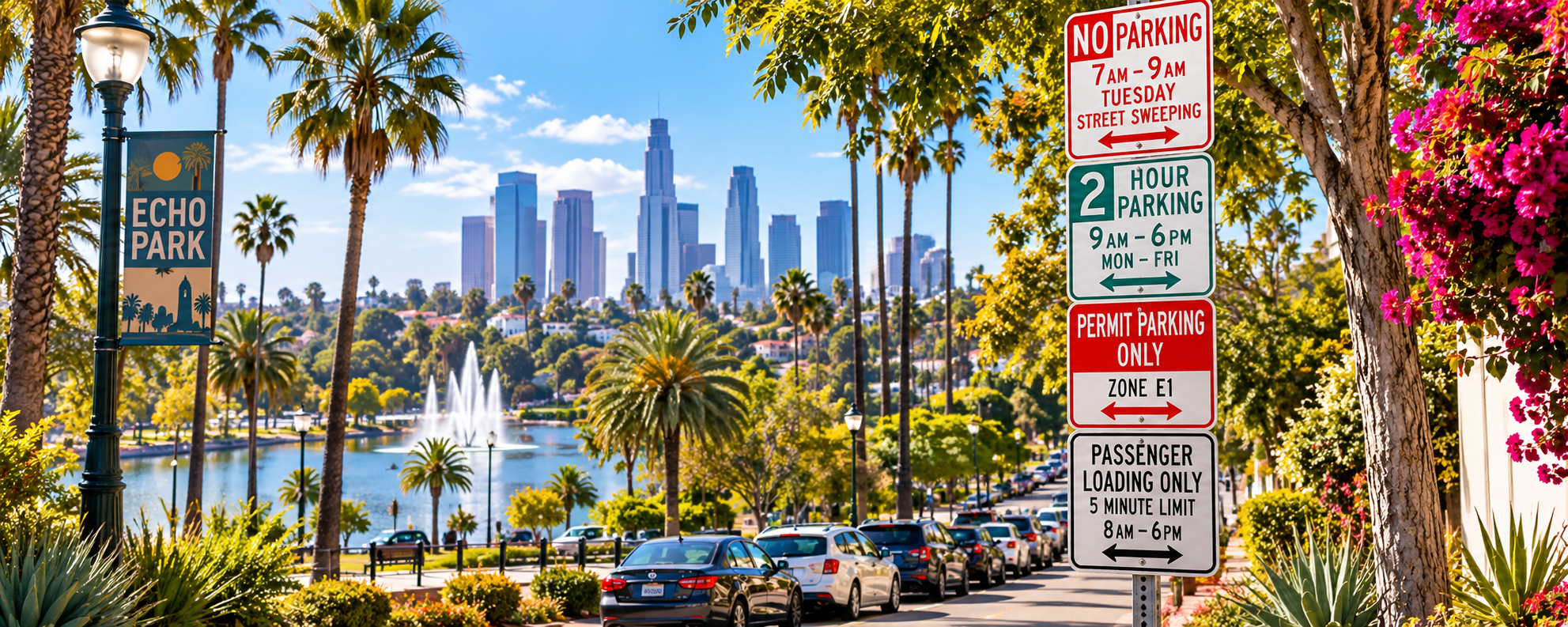
Echo Park combines some of Los Angeles’ busiest corridors with steep hills, narrow residential streets, restaurants, nightlife, Echo Park Lake and the enormous traffic generated by nearby Dodger Stadium.
That mix can make street parking surprisingly complicated.
A space that looks open may be controlled by residential permit restrictions, street sweeping, a time limit, a colored curb, a temporary No Parking sign or another rule that doesn’t immediately stand out.
And during Dodger games and major events, parking pressure can spread well beyond the stadium itself.
Here’s what to check before parking in Echo Park.
How Does Street Parking Work in Echo Park?
Echo Park is part of the City of Los Angeles, so its public streets follow Los Angeles parking laws and LADOT parking regulations.
Before leaving your vehicle, check:
- Every parking sign affecting the space.
- Posted time limits.
- Directional arrows.
- Residential permit restrictions.
- Street-sweeping restrictions.
- Colored curbs.
- Loading zones.
- Temporary No Parking signs.
- Driveways and intersections.
- Restrictions that begin later during your stay.
Don’t assume a space is legal simply because another vehicle is parked there.
That vehicle may have a permit, may have arrived under different restrictions or may simply be parked illegally.
What About Parking Around Echo Park Lake?
Echo Park Lake is one of the neighborhood’s major destinations, attracting visitors for recreation, events and nearby restaurants and businesses.
Parking conditions around the lake can vary by block.
Some surrounding streets may have time limits or other posted restrictions, while nearby residential streets can introduce an entirely different set of rules.
If you move away from the lake looking for parking, start your evaluation over.
Read the signs on the exact block where you intend to leave your vehicle rather than assuming the rules from the previous street continue.
What About Parking on Sunset Boulevard?
Sunset Boulevard is one of Echo Park’s busiest commercial corridors.
Restaurants, cafés, shops, nightlife and other businesses create significant demand for curb space throughout the day and evening.
Drivers should pay particular attention to:
- Time-limited parking.
- Meters where present.
- Passenger loading.
- Commercial loading.
- No Stopping restrictions.
- Tow-away periods.
- Temporary signs.
Some Los Angeles streets use curb lanes differently depending on the time of day.
A space that permits parking during one period can become restricted later.
That’s why the important question isn’t only whether you can park when you arrive.
It’s whether the vehicle can legally remain there until you return.
Does Echo Park Have Residential Permit Parking?
Some Los Angeles residential areas operate within Preferential Parking Districts, or PPDs.
Where a PPD restriction is posted, vehicles without the appropriate permit may face time limits or be prohibited from parking during specified periods.
These programs are designed to reduce the impact of outside parking on residential neighborhoods.
That’s particularly relevant in areas affected by major destinations and events.
If you leave a busy commercial area looking for parking on a residential street, don’t assume the absence of a meter means unrestricted parking.
Look for permit signs first.
Our guide to permit parking signs explains what drivers should check.
What About Parking Near Dodger Stadium?
Dodger Stadium can dramatically increase parking demand in and around Echo Park, Elysian Park and Chavez Ravine.
During home games and major events, drivers searching for alternatives to stadium parking may move into surrounding neighborhoods.
But a residential street near the stadium isn’t automatically available for event parking.
In 2026, Los Angeles established a new Preferential Parking District in Chavez Ravine in response to stadium visitors parking on residential streets.
That means drivers heading to a Dodgers game should pay particularly close attention to permit restrictions in surrounding neighborhoods.
If a sign requires the appropriate residential parking permit, don’t assume you can leave your vehicle there simply because spaces are available.
Does a Residential Permit Override Other Parking Rules?
No.
A Los Angeles parking permit provides an exemption from the particular permit restriction for which it was issued.
Other parking regulations remain in effect.
For example, a permitted vehicle may still need to comply with:
- Street sweeping.
- Red curbs.
- Temporary No Parking signs.
- Driveway restrictions.
- Other No Parking or No Stopping rules.
A permit solves one restriction, not every restriction affecting the curb.
That becomes particularly important when several signs appear together.
Can Dodger Games Change Nearby Street Parking?
Yes.
Major events can affect traffic and parking conditions around the stadium and neighboring communities.
Los Angeles may use traffic management, temporary parking restrictions and other measures during special events.
That means a street you’ve parked on previously may not operate exactly the same way during a particular event.
Before leaving your vehicle on a game day:
- Read every permanent parking sign.
- Look for temporary No Parking or No Stopping signs.
- Check residential permit restrictions.
- Inspect the curb.
- Confirm whether the restriction changes later.
- Never assume other fans parking nearby means the space is legal.
Our guide to special event parking explains what to check when parking near major events.
Watch for Temporary No Parking Signs
Temporary restrictions deserve particular attention in Echo Park.
Events, construction, utility work, moving activity, filming and other temporary uses can change normal parking conditions.
A curb that’s ordinarily legal can temporarily become restricted.
Check temporary signs for:
- Effective date.
- Start time.
- End time.
- Directional arrows.
- Portion of curb affected.
Don’t rely on previous experience with the street.
The fact that you parked there yesterday doesn’t guarantee you can park there today.
Our guide to temporary No Parking signs explains what drivers should look for.
How Does Street Sweeping Work in Echo Park?
Los Angeles restricts parking during designated street-cleaning periods where posted.
Check the exact day and time on the sign.
Schedules can differ between streets and between opposite sides of the same street.
And seeing the sweeper pass doesn’t automatically mean you can immediately move your vehicle back.
Follow the complete posted restriction.
Our guide to parking during street sweeping explains why the entire posted time window matters.
What About Echo Park’s Hills?
Echo Park’s hills create a parking issue that flatter neighborhoods don’t emphasize as much.
When parking on a slope, drivers need to secure the vehicle correctly and follow applicable hill-parking requirements.
The direction your wheels should face depends on the slope and whether a curb is present.
Before leaving your vehicle:
- Set the parking brake.
- Position the wheels correctly.
- Make sure the vehicle is secure.
- Check all surrounding parking signs.
Our guide to hill parking rules explains how to position a vehicle when parking uphill or downhill.
Be Careful on Narrow Residential Streets
Some Echo Park residential streets are narrow, hilly or tightly lined with parked vehicles.
That can make a space appear usable even when parking there would interfere with access or violate another restriction.
Don’t squeeze into a location simply because your vehicle physically fits.
Consider whether you’re:
- Blocking a driveway.
- Too close to an intersection.
- Interfering with traffic.
- Parked against a restricted curb.
- Violating a posted sign.
Parking legally requires more than fitting between two vehicles.
Watch the Driveways
Driveways are particularly important on dense residential streets.
A vehicle can violate driveway rules even if only part of it extends into the driveway opening.
Don’t judge clearance from the driver’s seat alone.
If the space is tight, get out and look at the front and rear of your vehicle before walking away.
Our guide to driveway parking rules explains what drivers should consider.
What Do Echo Park Curb Colors Mean?
Colored curbs can establish additional restrictions even when the surrounding street otherwise permits parking.
Drivers may encounter curb markings associated with:
- No Parking or No Stopping.
- Passenger loading.
- Commercial loading.
- Short-term parking.
- Accessible parking.
Nearby signs may provide hours or additional conditions.
Don’t evaluate the sign and curb separately.
They work together to determine whether you can legally use the space.
Our guide to parking curb colors explains common curb restrictions.
Watch for Loading Zones on Commercial Streets
Echo Park’s restaurants and businesses require curb access for deliveries and passenger pickup.
That creates loading zones along commercial corridors.
An empty loading space isn’t automatically available for ordinary parking.
Check:
- Type of loading permitted.
- Operating hours.
- Maximum duration.
- Curb markings.
- Nearby signs.
A loading restriction may apply only during certain hours, with another parking rule taking effect later.
Our guides to loading zone parking rules and passenger loading zones explain the differences.
How Do You Read Multiple Parking Signs in Echo Park?
Several parking rules can apply to one section of curb.
Imagine finding:
2 HOUR PARKING
EXCEPT BY PERMIT
NO PARKING — STREET CLEANING
NO STOPPING — EVENT DAYS
Those signs may control different days, times or vehicles.
They don’t necessarily contradict one another.
The challenge is determining which rule applies to you at the time you intend to park.
Directional arrows can also establish where a restriction begins and ends.
Our guides to multiple parking signs and parking sign arrows explain how to work through stacked restrictions.
Can You Leave a Car Parked on an Echo Park Street for Several Days?
Los Angeles prohibits leaving a vehicle continuously parked in the same location on a public street for more than 72 hours.
That matters even when a street doesn’t appear to have a shorter posted time limit.
So an unrestricted-looking residential curb shouldn’t be treated as long-term vehicle storage.
If you’re planning to leave town, consider the 72-hour rule along with street sweeping, permit restrictions and temporary signs.
Our guide to how long a car can be parked on the street explains this issue in more detail.
Be Careful Near Intersections and Crosswalks
An open curb near an intersection isn’t automatically a legal parking space.
Los Angeles and California parking laws include restrictions designed to protect visibility and pedestrian safety.
Check carefully around:
- Intersections.
- Crosswalks.
- Corners.
- Fire hydrants.
- Driveways.
- Red curbs.
Some restrictions apply because of law even when there isn’t a traditional parking sign immediately beside the vehicle.
Read our guides to intersection parking rules, crosswalk parking rules and how close you can park to a corner for more information.
What About Overnight Parking in Echo Park?
Don’t assume every Echo Park street follows one universal overnight rule.
Los Angeles establishes Overnight Parking Districts in designated areas, with restrictions indicated by posted signs.
Other streets may instead have preferential permit restrictions, street sweeping or different time-specific rules.
If you’re leaving your vehicle overnight, check the exact block for:
- Overnight Parking District signs.
- Preferential parking restrictions.
- Street sweeping the following morning.
- Temporary restrictions.
- Other No Parking periods.
Our guide to overnight parking rules explains what drivers should check before leaving a vehicle overnight.
What About Sundays and Holidays?
Sunday or a holiday doesn’t automatically mean every parking rule disappears.
Los Angeles relaxes enforcement of certain regulations on designated holidays unless otherwise posted, including some time limits, meters and street-sweeping restrictions.
However, important safety restrictions and other rules remain enforceable.
Preferential Parking District restrictions also remain enforceable on national holidays.
So don’t assume a residential permit sign can be ignored simply because it’s a holiday.
Always read the signs controlling your actual parking space.
What if You Get a Parking Ticket in Echo Park?
Echo Park parking citations are handled through the City of Los Angeles.
If you receive a citation, check:
- Violation.
- Date and time.
- Location.
- Payment instructions.
- Contest instructions.
- Deadline.
If you believe the citation was issued incorrectly, document the parking environment promptly.
Photograph:
- Your vehicle’s position.
- Every relevant sign.
- Directional arrows.
- Curb markings.
- Temporary signs.
- The surrounding block.
Then follow the City of Los Angeles citation review process.
Echo Park Street Parking Checklist
Before walking away from your vehicle:
- Read every applicable sign. Don’t stop after finding one that allows parking.
- Check directional arrows. Determine which portion of curb each sign controls.
- Look for residential permit restrictions. This is especially important near Dodger Stadium.
- Check street sweeping. Make sure another restriction won’t begin before you return.
- Look for temporary signs. Event and temporary restrictions can change normal parking conditions.
- Inspect the curb. Colored curbs can add another restriction.
- Check the slope. Park correctly on Echo Park’s hills.
- Check driveways, intersections and crosswalks.
- Remember the 72-hour rule if you’re leaving the vehicle for an extended period.
- Check your return time. Make sure the space remains legal throughout your stay.
The important question isn’t simply:
Can I park here right now?
It’s:
Can I legally remain here until I return?
How ParkClear Helps With Echo Park Street Parking
Echo Park demonstrates why understanding street parking often requires more than reading one sign.
A driver may need to interpret stacked restrictions, recognize a permit district, account for street sweeping, check a temporary event sign and determine whether another rule begins later.
ParkClear helps drivers interpret municipal street-parking regulations using parking-sign scanning and location-based information.
The goal is to provide a clear Yes or No answer to:
Can I park here?
Future date and time checks can help drivers evaluate whether parking will be permitted later, while parking-expiration reminders can help track when permitted parking ends.
ParkClear doesn’t locate vacant parking spaces, provide live parking occupancy or offer turn-by-turn navigation.
Its focus is helping drivers understand the rules governing the curb where they want to park.
Learn more about the ParkClear parking sign scanner.
Make Echo Park Parking Easier to Understand
Whether you’re visiting Echo Park Lake, parking along Sunset Boulevard, heading toward Dodger Stadium or leaving your vehicle on a hillside residential street, don’t judge a space simply because the curb is empty.
Read every sign. Inspect the curb. Look for permits, street sweeping and temporary restrictions.
Most importantly, check whether the rules will change before you plan to return.
Understanding Parking Rules Across Los Angeles
Hollywood follows City of Los Angeles parking regulations, but individual streets can have different meter hours, permit restrictions, street sweeping schedules, and temporary parking rules.
For a broader explanation, explore our Los Angeles Street Parking Guide, which covers parking signs, curb colors, meters, residential permits, and other common restrictions throughout the city.
Confused about whether you can park? Download ParkClear to scan parking signs or use your location to get a clear Yes or No answer to “Can I park here?”
Parking regulations vary by jurisdiction. Always follow posted signs and applicable local laws, and check official local rules when necessary.