
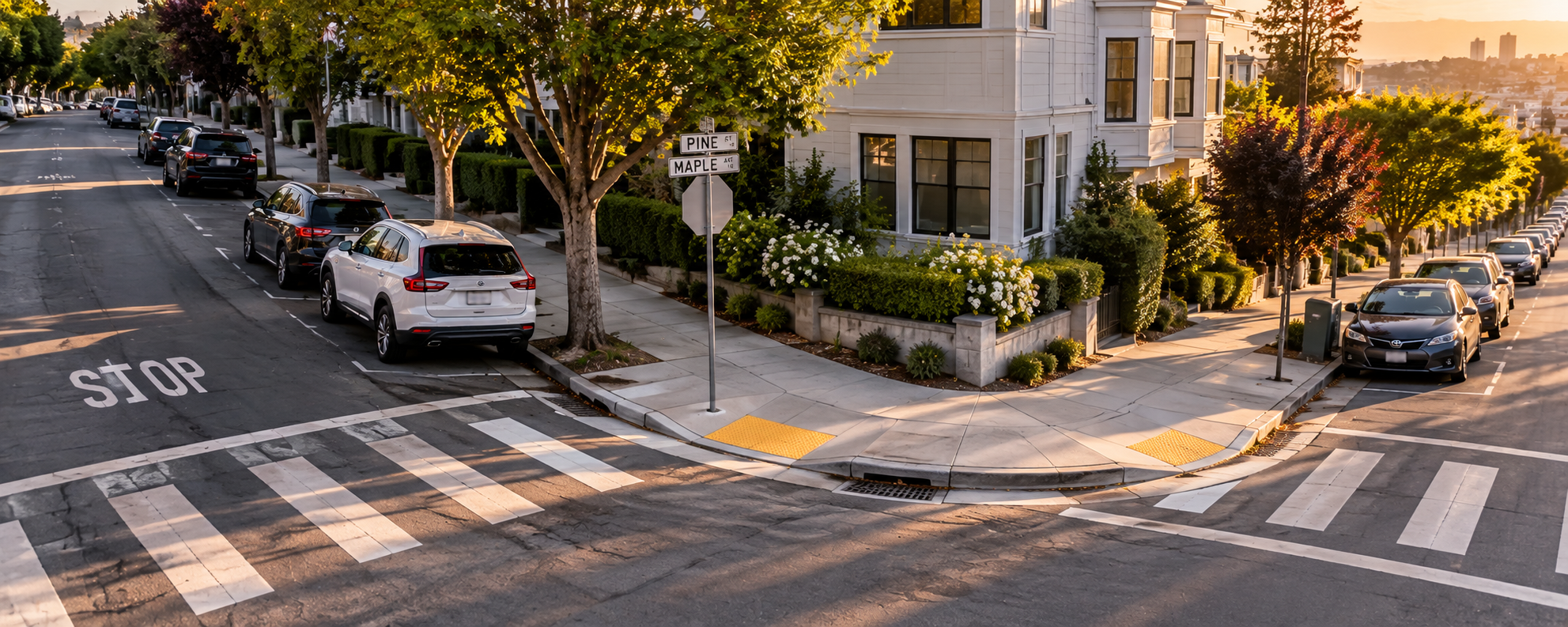
You find an open space near the end of a block. Your car fits, there is no obvious No Parking sign, and the curb looks available. But are you too close to the corner?
There isn’t one universal distance that applies everywhere. How close you can park to a corner depends on local parking laws and what is located at the intersection, including crosswalks, stop signs, traffic signals, curb markings, and posted restrictions.
That means an empty stretch of curb near a corner isn’t automatically a legal parking space.
Why Is Parking Near a Corner Restricted?
Corners need visibility and clearance.
Drivers approaching an intersection need to see pedestrians, cyclists, traffic signs, and vehicles coming from other directions. Pedestrians also need enough visibility to cross safely.
A vehicle parked too close to a corner can interfere with those sightlines.
Restrictions can also help preserve space around crosswalks, traffic controls, curb ramps, emergency access, and turning vehicles.
How Many Feet From a Corner Can You Park?
This is where drivers need to be careful: there is no single nationwide distance you can rely on.
Parking-distance requirements vary by jurisdiction and by what is present at the corner.
Instead of assuming a specific number of feet, determine what local rule applies to that particular intersection.
You may need to consider the distance from a:
- Crosswalk
- Stop sign
- Traffic signal
- Intersection
- Fire hydrant
- Curb ramp
- Posted No Parking area
Some of these features can have separate clearance requirements.
What If There Is No No Parking Sign?
No sign does not necessarily mean you can park all the way to the corner.
Some parking restrictions come directly from state or local law and do not require a sign beside every prohibited space.
This is particularly important around intersections, crosswalks, driveways, fire hydrants, and other areas where drivers may encounter legal clearance requirements.
So before taking that last space on the block, look at more than the signpost.
Can You Park Right Up to an Intersection?
Possibly not.
An intersection may have parking restrictions designed to preserve visibility and safe movement even when the curb itself is not painted.
The exact rule depends on the jurisdiction and intersection.
Our guide to parking near an intersection explains some of the other restrictions drivers should consider when parking where two streets meet.
Does a Crosswalk Affect How Close You Can Park?
Yes, it can.
A crosswalk may affect where parking is permitted near a corner. Importantly, not every crosswalk is necessarily marked with painted lines.
That makes it risky to decide that a space is legal simply because you don’t see white stripes on the pavement.
Our guide to parking near a crosswalk explains why both marked and potentially unmarked crossings deserve attention.
What About a Stop Sign at the Corner?
A stop sign introduces another consideration.
Local law may require vehicles to remain a certain distance from a stop sign so approaching drivers can see the traffic control clearly.
That means a curb space could look physically large enough for your vehicle but still fall within a restricted area.
See our guide to parking near a stop sign for more information.
Does a Red Curb Mean You Cannot Park Near the Corner?
A painted curb can provide another clue about how the space may be used.
If the curb is red, yellow, white, green, blue, or another color, determine what that color means in the jurisdiction where you’re parking.
Curb-color meanings are not universal, so don’t rely on color alone.
Our guide to curb colors and their meanings explains why nearby signs and local rules should also be considered.
What If Only Part of the Corner Has a No Parking Sign?
Look for arrows.
A directional arrow can indicate where a restriction begins, ends, or continues along the curb. The restricted area may extend beyond the exact point where the sign stands.
Our guide to parking sign arrows can help you determine which section of curb a sign is intended to control.
Can You Park Across the Street From a Corner?
Being on the opposite side of the street does not automatically remove intersection-related restrictions.
Look at the corner where your vehicle will be parked and determine which rules apply to that side of the roadway.
The configuration of the intersection can matter, particularly when there are crosswalks, traffic controls, curb extensions, driveways, or unusual street geometry.
What About Corners in Residential Neighborhoods?
Residential streets can feel less regulated because they may have fewer signs and painted curbs.
But general parking laws can still apply.
A quiet neighborhood intersection may still contain an unmarked crosswalk, curb ramp, stop sign, driveway, fire hydrant, or another feature that affects where you can leave your vehicle.
This is one reason residential parking requires more than simply finding an open section of curb.
Can You Park Near a Corner Overnight?
The same corner-related restrictions generally don’t disappear simply because it is nighttime.
You should also check whether additional overnight rules apply to the street.
Permit parking, street cleaning, temporary restrictions, and other rules could affect a space later—even if parking is legal when you arrive.
Our guide to residential street parking overnight explains what to check before leaving your vehicle until morning.
Can You Get a Ticket for Parking Too Close to a Corner?
Yes. If local law requires clearance from an intersection feature and your vehicle violates that requirement, parking enforcement may issue a citation.
Depending on the jurisdiction and circumstances, additional enforcement may also be possible.
And remember: “There wasn’t a sign” isn’t always enough to establish that the space was legal.
Some restrictions exist independently of posted parking signs.
A Better Way to Evaluate That Last Space on the Block
When you find an open space beside a corner, don’t look only at whether your car physically fits.
Look around the entire intersection.
Identify crosswalks, stop signs, traffic signals, curb ramps, hydrants, painted curbs, driveways, temporary notices, and parking signs. Then determine whether local law requires clearance from any of them.
If several parking signs apply to the same area, our guide to multiple parking signs can help you work through overlapping restrictions.
Where ParkClear Fits In
Corners are a good example of why street parking isn’t always answered by a single sign.
ParkClear helps drivers understand confusing parking signs and location-based parking rules so they can get a clear Yes or No answer to “Can I park here?”
When a restriction depends on a local statutory distance that isn’t communicated on a parking sign, drivers should also verify the applicable official local rule.
You can use ParkClear’s parking sign scanner when posted restrictions are difficult to interpret.
Before You Leave the Car
An open curb near a corner may be tempting, but physical space and legal parking space aren’t necessarily the same thing.
Check the intersection itself—not just the curb immediately beside your car.
The crosswalk, stop sign, traffic signal, curb markings, signs, and applicable local clearance rules can all affect how close you can legally park to the corner.
Download ParkClear
Confused about whether you can park? Download ParkClear to scan parking signs or use your location to get a clear Yes or No answer to “Can I park here?”
Parking regulations vary by jurisdiction. Always follow posted signs and applicable local laws, and check official local rules when necessary.