
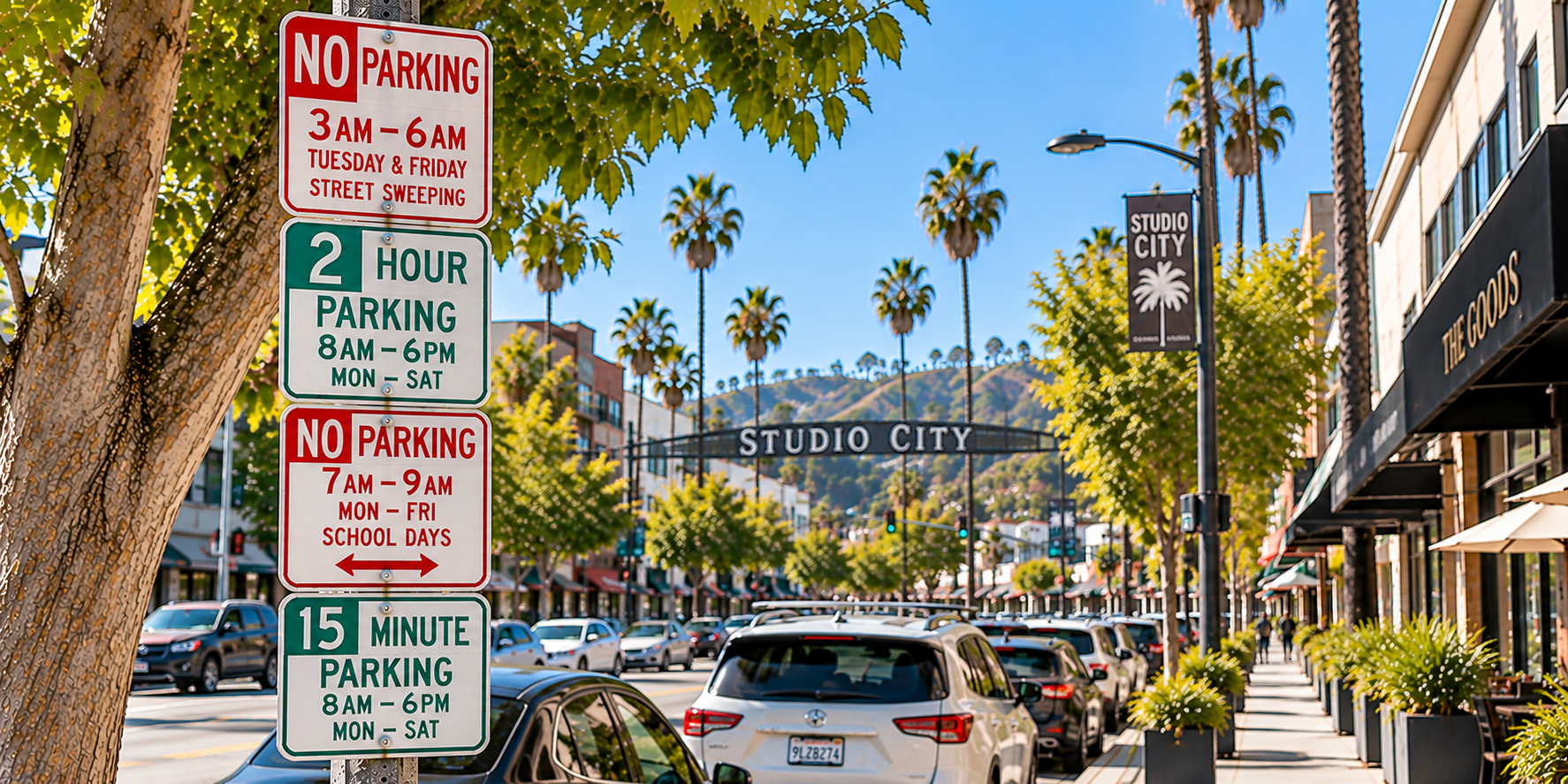
Studio City combines one of the San Fernando Valley’s busiest commercial corridors with quiet residential streets just a few turns away.
Along Ventura Boulevard and Ventura Place, drivers may encounter restaurants, cafés, shops, meters, loading zones and time-limited parking. Turn onto a nearby residential street, however, and the rules can change quickly.
You may suddenly encounter permit restrictions, street sweeping, overnight regulations or another set of parking signs.
That’s what makes parking in Studio City deceptively complicated.
Here’s what to check before leaving your vehicle.
How Does Street Parking Work in Studio City?
Studio City is part of the City of Los Angeles, so its public streets follow Los Angeles and California parking regulations.
Depending on the block, drivers may encounter:
- Parking meters.
- Posted time limits.
- Residential permit restrictions.
- Street sweeping.
- Loading zones.
- Colored curbs.
- Temporary No Parking signs.
- Overnight restrictions where posted.
- Driveway and intersection restrictions.
The most important rule is simple:
Evaluate the exact space where you’re parking.
Don’t assume the rules from Ventura Boulevard continue onto the next street—or that a residential street is unrestricted simply because there isn’t a meter.
What Is Parking Like Along Ventura Boulevard?
Ventura Boulevard is the center of much of Studio City’s restaurant, shopping and entertainment activity.
That also means considerable competition for curb space.
When parking along or near Ventura Boulevard, check for:
- Meters where present.
- Time limits.
- Passenger loading zones.
- Commercial loading zones.
- No Parking periods.
- No Stopping restrictions.
- Tow-away restrictions.
- Colored curbs.
- Temporary signs.
Pay particular attention to the hours printed on each sign.
A curb that allows parking during one part of the day may have a different restriction later.
If you’re meeting friends for dinner, for example, don’t evaluate the space only for the moment you arrive.
Check whether the rule changes before you expect to return.
Ventura Place Has Its Own Parking Environment
Ventura Place is a smaller commercial street near Ventura Boulevard and Laurel Canyon Boulevard, with restaurants, shops and other businesses attracting drivers throughout the day.
In 2026, LADOT reconfigured parking on a portion of Ventura Place between Laurel Canyon Boulevard and Ventura Boulevard to create diagonal parking and support businesses along the street.
That makes Ventura Place a good example of why drivers shouldn’t rely solely on past experience.
Street layouts and parking configurations can change.
Always follow the current markings and signs rather than assuming a space operates the way it did the last time you visited.
What Happens When You Leave Ventura Boulevard?
This is where Studio City parking gets particularly interesting.
Drivers who can’t find convenient parking along Ventura Boulevard often begin exploring nearby side streets.
Within a few blocks, the environment can shift from a commercial corridor to a residential neighborhood.
The parking rules may change with it.
Before parking on a residential street, look for:
- Preferential Parking District signs.
- Time limits.
- Street sweeping.
- Overnight restrictions.
- Temporary No Parking signs.
- Driveways.
- Red curbs.
An open residential curb isn’t automatically unrestricted parking.
Does Studio City Have Residential Permit Parking?
Los Angeles uses Preferential Parking Districts, or PPDs, in designated residential areas.
Where the applicable signs are posted, vehicles without permits may be prohibited or subject to stricter time limits during certain periods.
The purpose of these districts is to reduce the impact of non-resident parking on residential neighborhoods.
That’s particularly relevant in areas near busy commercial corridors.
If you’re leaving Ventura Boulevard to search for parking on a nearby residential street, don’t assume you can park simply because other cars are there.
Look for permit signs first.
Our guide to permit parking signs explains how these restrictions work.
Does a Residential Parking Permit Override Other Rules?
No.
A Los Angeles parking permit exempts the permitted vehicle from the particular preferential restriction that applies to the district.
Other parking rules remain in effect.
A permitted vehicle still needs to obey restrictions such as:
- Street sweeping.
- Red curbs.
- Temporary No Parking signs.
- Driveway restrictions.
- No Stopping zones.
- Other posted regulations.
Think of a permit as an exemption from one parking rule, not permission to ignore the rest of the block.
Watch for Street Sweeping
Street sweeping is easy to overlook when you’re focused on finding an open residential space.
Los Angeles restricts parking during designated street-cleaning periods where posted.
The schedule can vary by street and by side of the street.
Before leaving your vehicle, confirm:
- Day of the week.
- Start time.
- End time.
- Which side of the street is affected.
- Whether another parking restriction also applies.
Don’t assume the restriction has ended simply because the sweeper has already passed.
Follow the entire posted time window.
Our guide to parking during street sweeping explains why this matters.
Parking Meters Don’t Tell the Whole Story
Finding an available meter can feel like you’ve solved the parking problem.
Not necessarily.
Los Angeles operates thousands of metered parking spaces, but paying a meter doesn’t eliminate other restrictions affecting the curb.
Before paying, read the surrounding signs.
A space can potentially have:
- Metered parking during one period.
- A loading restriction during another.
- A No Parking period later.
- A temporary restriction.
- Another rule affecting part of the curb.
The question isn’t simply whether the meter accepts payment.
It’s whether parking is legally permitted for the period you intend to stay.
Watch for Loading Zones Near Restaurants and Businesses
Studio City’s concentration of restaurants and businesses creates considerable demand for loading space.
Drivers may encounter both passenger and commercial loading zones.
An empty loading zone isn’t necessarily an ordinary parking space.
Check:
- Type of loading allowed.
- Operating hours.
- Time limit.
- Curb color.
- Nearby signs.
Some loading restrictions apply only during certain hours.
Outside those hours, another parking rule may take effect.
Our guides to loading zone parking rules and passenger loading zones explain the differences.
What Do Studio City’s Curb Colors Mean?
Curb markings can add another layer to the parking rules.
Depending on the location, colored curbs can identify restrictions involving:
- No Parking or No Stopping.
- Passenger loading.
- Commercial loading.
- Short-term parking.
- Accessible parking.
Don’t evaluate a sign without checking the curb beneath it.
And don’t evaluate the curb without looking for nearby signs.
Both may be necessary to understand whether you can legally park.
Our guide to parking curb colors explains common curb restrictions.
Multiple Parking Signs Can Apply to One Space
Studio City drivers may encounter several regulations mounted on the same pole.
For example:
2 HOUR PARKING
NO PARKING — STREET CLEANING
PASSENGER LOADING
EXCEPT BY PERMIT
Those signs may look contradictory.
Usually, they’re controlling different times, days, vehicles or sections of curb.
The goal is to determine which rule applies to your vehicle at the specific time you’re parking.
Don’t stop reading when you find the first sign that appears favorable.
Read the entire stack.
Our guide to multiple parking signs explains how to work through overlapping restrictions.
Pay Attention to Parking Sign Arrows
Directional arrows determine which section of curb a parking restriction controls.
A sign may apply:
- To the left.
- To the right.
- In both directions.
- Between designated signs.
This is especially important when parking near the transition between a loading zone and ordinary parking.
Your vehicle may appear to be in a legal space while part of it extends into a different restricted area.
Our guide to parking sign arrows explains how to interpret them.
Don’t Block Residential Driveways
Studio City’s residential streets contain numerous driveways, and curb space can become tight near busy commercial areas.
A vehicle doesn’t have to completely block a driveway to create a problem.
Make sure your entire vehicle clears the driveway opening.
If the space is tight, get out and check the front and rear of your vehicle before walking away.
Our guide to driveway parking rules explains what drivers should consider.
Can You Park Overnight in Studio City?
Don’t assume there’s one universal Studio City overnight parking rule.
Los Angeles establishes Overnight Parking Districts in designated areas.
Where an overnight restriction applies, posted signs identify the district and applicable hours.
Other streets may instead have preferential parking restrictions, street sweeping or another time-specific rule.
Before leaving your vehicle overnight, check for:
- Overnight Parking District signs.
- Preferential permit restrictions.
- Early-morning street sweeping.
- Temporary restrictions.
- Other posted No Parking periods.
Our guide to overnight parking rules explains what to check.
Can You Leave a Car on a Studio City Street for Several Days?
Even when no shorter posted time limit exists, Los Angeles prohibits leaving a vehicle continuously parked in the same location on a public street for more than 72 hours.
That means an apparently unrestricted residential curb shouldn’t be treated as long-term vehicle storage.
The 72-hour rule can matter even when the vehicle has otherwise complied with the posted restrictions.
Read our guide to how long a car can be parked on the street for more information.
Watch for Temporary No Parking Signs
Temporary restrictions can override the parking conditions you’re accustomed to seeing on a street.
They may be installed for:
- Construction.
- Utility work.
- Moving activity.
- Filming.
- Street work.
- Special events.
- Other temporary uses.
Filming is particularly worth remembering in Los Angeles neighborhoods.
If you regularly park on the same Studio City street, don’t rely entirely on habit.
Look for newly posted temporary restrictions each time.
Check the effective date, hours and portion of curb affected.
Our guide to temporary No Parking signs explains what to look for.
Be Careful Around Intersections and Crosswalks
An open section of curb near a corner isn’t automatically a legal parking space.
Parking laws also restrict vehicles around locations such as:
- Intersections.
- Crosswalks.
- Fire hydrants.
- Driveways.
- Bus zones.
- Red curbs.
Some restrictions come directly from state or municipal law rather than a sign immediately beside the vehicle.
So inspect the surrounding street before walking away.
Our guides to intersection parking rules, crosswalk parking rules and how close you can park to a corner explain these situations in more detail.
Make Sure You’re Parked in the Correct Direction
When moving between Ventura Boulevard and residential side streets, don’t cross over simply because you spot an open curb on the opposite side.
On a normal two-way street, vehicles should be parked in the proper direction of travel.
A convenient space isn’t necessarily a legal space if your vehicle is facing against traffic.
Our guide to parking on the wrong side of the street explains this rule.
What About Sundays and Holidays?
Sunday or a holiday doesn’t automatically make every Studio City parking restriction disappear.
Los Angeles relaxes enforcement of certain parking regulations on designated holidays unless otherwise posted. These can include some meters, time limits and street-sweeping restrictions.
However, other restrictions remain enforceable, including important safety rules, temporary restrictions and Preferential Parking District regulations.
Always read the signs controlling the particular space rather than relying on a general assumption that holiday parking is free or unrestricted.
What if You Get a Parking Ticket in Studio City?
Studio City parking citations are handled through the City of Los Angeles.
If you receive one, check:
- Violation.
- Date and time.
- Location.
- Payment deadline.
- Contest instructions.
If you believe the citation was issued incorrectly, photograph the parking environment before conditions change.
Document:
- Your vehicle’s position.
- Every relevant sign.
- Directional arrows.
- Curb markings.
- Temporary signs.
- Nearby driveways or intersections.
Then follow the City’s citation review process.
Our guide to how to avoid parking tickets covers common parking mistakes.
Studio City Street Parking Checklist
Before walking away from your vehicle:
- Read every parking sign affecting the space.
- Check the arrows to determine which portion of curb each rule controls.
- Look for permit restrictions when moving from Ventura Boulevard onto residential streets.
- Check street-sweeping days and hours.
- Inspect the curb color.
- Look for loading-zone restrictions near businesses and restaurants.
- Check for temporary No Parking signs.
- Make sure your entire vehicle clears driveways and restricted areas.
- Park in the correct direction of travel.
- Confirm the rules won’t change before you return.
The important question isn’t simply:
Can I park here now?
It’s:
Can I legally leave my vehicle here until I come back?
How ParkClear Helps With Studio City Street Parking
Studio City demonstrates why street parking can become complicated within only a few blocks.
A driver may leave Ventura Boulevard, turn onto a residential street and suddenly need to interpret permit restrictions, street sweeping, curb markings and several stacked signs.
ParkClear helps drivers interpret municipal street-parking regulations using parking-sign scanning and location-based information.
The goal is to provide a clear Yes or No answer to:
Can I park here?
Future date and time checks can help drivers evaluate whether parking will be permitted later, while parking-expiration reminders can help keep track of when permitted parking ends.
ParkClear doesn’t locate vacant parking spaces, provide live parking occupancy or offer turn-by-turn navigation.
Its focus is helping drivers understand the municipal rules governing the curb where they want to park.
Learn more about the ParkClear parking sign scanner.
Make Studio City Parking Easier to Understand
Whether you’re having dinner on Ventura Boulevard, visiting businesses around Ventura Place or parking on a nearby residential street, don’t judge a parking space simply because the curb is empty.
Read every sign. Inspect the curb. Check for permit restrictions, street sweeping and loading zones.
Most importantly, confirm that the rules won’t change before you return.
Understanding Parking Rules Across Los Angeles
Hollywood follows City of Los Angeles parking regulations, but individual streets can have different meter hours, permit restrictions, street sweeping schedules, and temporary parking rules.
For a broader explanation, explore our Los Angeles Street Parking Guide, which covers parking signs, curb colors, meters, residential permits, and other common restrictions throughout the city.
Confused about whether you can park? Download ParkClear to scan parking signs or use your location to get a clear Yes or No answer to “Can I park here?”
Parking regulations vary by jurisdiction. Always follow posted signs and applicable local laws, and check official local rules when necessary.