
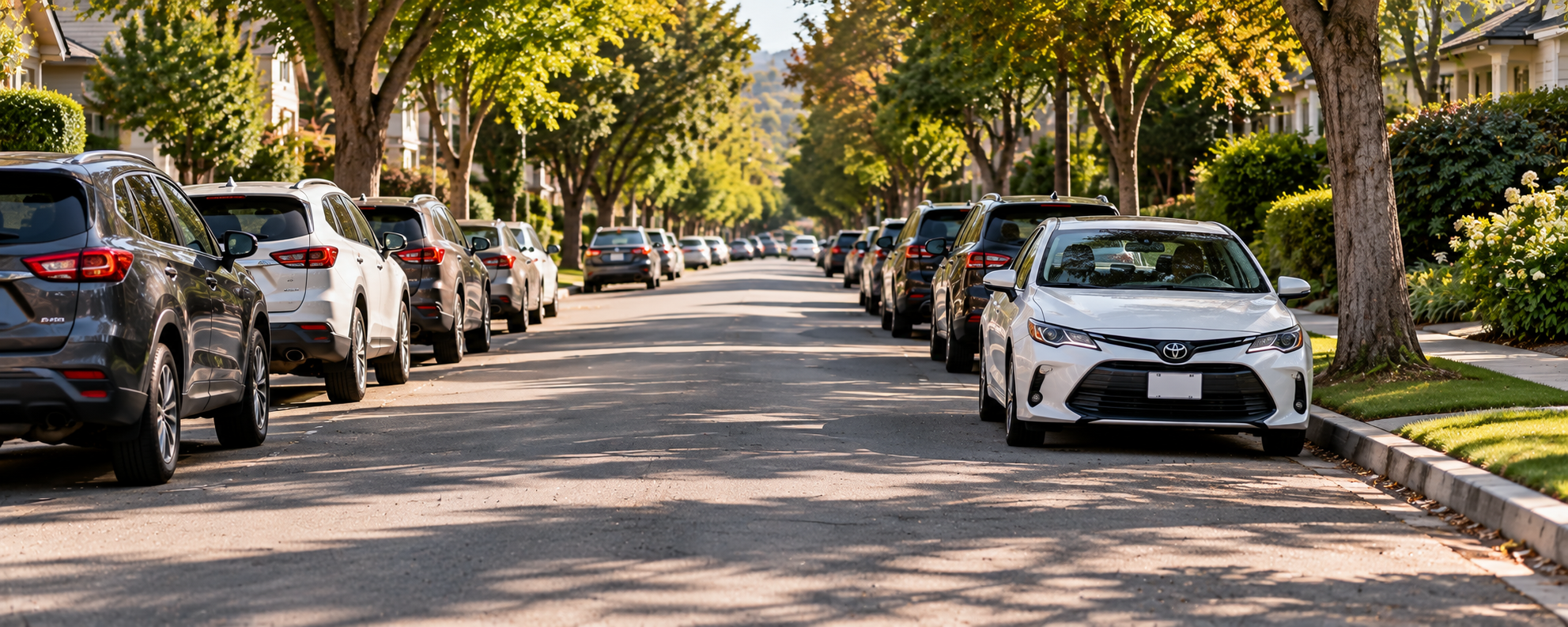
You spot an open parking space across the street. Instead of turning around, you cross over and pull directly into it—leaving your car facing the opposite direction from the other vehicles.
Your car fits. There’s no obvious No Parking sign. The curb appears legal.
But are you allowed to park facing the wrong way?
Parking on the wrong side of the street may violate local traffic or parking laws even when the curb itself allows parking. Many jurisdictions regulate the direction a parked vehicle must face, particularly on two-way streets.
It’s an important distinction: the parking space may be legal while the way your vehicle is parked may not be.
What Does “Parking on the Wrong Side of the Street” Mean?
Usually, people mean parking a vehicle facing against the normal direction of traffic on that side of the roadway.
Imagine a two-way residential street.
Cars traveling north use one side of the road, while cars traveling south use the other. When drivers park along the curb, their vehicles will typically face the same direction as traffic traveling on that side.
If you cross the center of the street and park facing toward oncoming traffic, your vehicle is facing the opposite direction.
Drivers sometimes call this:
- Wrong-way parking
- Opposite-direction parking
- Facing traffic while parked
- Parking against traffic
Whatever you call it, local law determines whether it is permitted.
Do You Have to Park in the Direction of Traffic?
Many jurisdictions require drivers parking on a two-way roadway to position their vehicles in the direction of traffic on that side of the street.
However, parking laws vary by state and municipality, so don’t assume one rule applies everywhere.
The direction requirement can also depend on the type of road.
A two-way residential street, one-way street, divided roadway, private street, and angled parking area may each present different rules.
If you’re unsure, check the applicable local parking law rather than relying on how other vehicles are parked.
Why Does Parking Direction Matter?
At first glance, the direction a stationary vehicle faces might not seem important.
But think about what has to happen when a driver parks against traffic.
To reach the space, the vehicle may need to cross the roadway. When leaving, the driver may again have to move across opposing traffic to return to the proper travel lane.
Vehicle visibility can also be different when the car faces the opposite direction from surrounding traffic.
Parking-direction rules therefore aren’t necessarily about whether your car physically fits at the curb. They can regulate how vehicles enter, occupy, and leave curbside parking spaces.
Can You Park Facing the Wrong Way on a Residential Street?
Don’t assume residential streets are exempt.
A quiet neighborhood may have little traffic, wide streets, and no parking signs at all. That can make parking on either side in either direction seem harmless.
But general roadway rules may still apply.
The absence of a posted sign doesn’t necessarily mean there is no parking-direction requirement.
This is similar to other residential parking situations where the applicable rule may come from local law rather than a sign directly beside the vehicle.
Our guide to residential street parking overnight explains some of the other restrictions drivers should consider when leaving a vehicle on a neighborhood street.
What If There Are No Parking Signs?
A legal curb and a legally positioned vehicle are two separate questions.
Suppose a street has no:
- No Parking sign
- Permit restriction
- Street-cleaning restriction currently in effect
- Painted curb
- Temporary restriction
The curb might otherwise allow parking.
But if local law requires vehicles to park in the direction of traffic, parking against traffic could still create a violation.
That’s why “There wasn’t a sign” doesn’t always answer every parking question.
Some parking rules apply regardless of whether a nearby sign repeats them.
What About a One-Way Street?
One-way streets require a different analysis.
Because all normal vehicle traffic travels in the same direction, local rules may allow parking on one or both sides of the street while still regulating the direction the parked vehicle must face.
Don’t apply the logic of a two-way road automatically to a one-way street.
Look for:
- One-way signs
- Parking signs
- Curb markings
- Bike lanes
- Bus lanes
- Loading zones
- Street-cleaning restrictions
- Other lane-specific controls
The street configuration matters just as much as the availability of an open curb.
Can You Cross the Street to Take an Open Parking Space?
Seeing an open space across the road doesn’t necessarily mean you should pull directly across and park facing the opposite direction.
If local rules require your vehicle to face with traffic, you may need to approach the parking space from the proper direction.
That could mean continuing around the block or safely turning around where permitted before entering the space.
The fact that crossing directly into the space is faster doesn’t determine whether the final parking position is legal.
What If Every Other Car Is Parked That Way?
Other parked cars aren’t a substitute for checking the rule.
This principle comes up repeatedly with street parking.
A row of vehicles can make a particular behavior look legal, but those drivers may be mistaken, may have parked under different circumstances, or may simply not have received enforcement attention.
Use the street design, posted restrictions, and applicable local rules—not neighboring vehicles—as your guide.
Can You Get a Parking Ticket for Facing the Wrong Direction?
If the jurisdiction prohibits parking against traffic and your vehicle violates that rule, enforcement may issue a citation even if the curb itself otherwise permits parking.
That can surprise drivers because nothing about the space looks illegal.
The problem is the vehicle’s orientation.
This is another reason parking legality isn’t always determined by asking only:
“Can a car park on this curb?”
You may also need to ask:
“Is my car positioned legally within this space?”
Does Street Sweeping Change Anything?
Street sweeping introduces a separate restriction.
Your vehicle might be facing the correct direction but still violate a scheduled street-cleaning rule.
Or the curb may allow parking at that time while your vehicle’s orientation creates a different issue.
Each rule needs to be considered independently.
Our guide to street sweeping parking explains how days and hours can affect otherwise available street parking.
What If You Have a Residential Parking Permit?
A permit doesn’t necessarily override other parking requirements.
A residential permit may authorize you to park within a particular district or exempt your vehicle from certain time restrictions, depending on the local program.
It does not automatically mean every parking behavior becomes legal.
You may still need to comply with parking direction, driveway clearance, curb restrictions, street cleaning, temporary signs, and other applicable rules.
Our guide to permit parking zones explains how permit restrictions can affect residential parking.
What About Parking in Front of Someone Else’s House?
The same direction rules can apply whether you’re parking outside your own home or somebody else’s.
On a public street, the homeowner generally doesn’t gain control of an otherwise legal curb space simply because it sits in front of the property.
But you still need to park legally.
That means checking both the space and the vehicle’s position.
Our guide to parking in front of someone’s house explains the other residential rules that may affect the space.
Does a Bike Lane Affect Which Direction You Can Park?
Bike lanes can make street configuration even more important.
A street may have a bicycle lane between moving traffic and the curb, or it may use a parking-protected design where parked vehicles sit between the bike lane and the vehicle travel lane.
Don’t cross, stop in, or occupy a bicycle area simply because you’re trying to reach a curbside space.
Our guide to parking in a bike lane explains how to distinguish bicycle travel areas from designated vehicle parking.
What If the Street Has Angled Parking?
Angled or perpendicular parking spaces should be evaluated according to their markings, signs, and local rules.
If pavement lines clearly show how vehicles should enter and position themselves, follow the designated configuration.
Don’t assume rules for ordinary parallel curb parking apply identically to a marked angled-parking area.
A Simple Check Before You Leave the Car
When parking on a street, don’t stop your evaluation once you’ve determined that the curb allows parking.
Ask two separate questions.
First: Can I use this space?
Check the signs, curb, permits, time restrictions, temporary notices, driveways, hydrants, crosswalks, and other location-based restrictions.
Second: Is my vehicle positioned correctly?
Check the direction of traffic, road configuration, parking-space markings, and applicable local parking rules.
That second question is easy to overlook.
Where ParkClear Fits In
Wrong-way parking demonstrates something important about street parking: not every rule is communicated by a parking sign.
ParkClear helps drivers interpret confusing parking signs and location-based parking rules to provide a clear Yes or No answer to “Can I park here?”
When signs are difficult to interpret, ParkClear’s parking sign scanner can help drivers understand the posted restriction.
But when a rule—such as a vehicle-positioning requirement—comes from state or local law rather than a sign, drivers should also verify the applicable official regulation.
Understanding both pieces gives you a much better picture of whether you’re parked legally.
The Space Can Be Legal—and Your Parking Can Still Be Wrong
This is the key takeaway.
You can find a perfectly legal stretch of curb and still create a parking problem by positioning your vehicle incorrectly.
Before crossing the street to grab an open space, look at the direction of traffic and how vehicles are supposed to park on that roadway.
If you’re approaching from the wrong direction, the safer legal choice may be to turn around where permitted or circle the block and approach the space from the proper direction.
A few extra moments can be easier than discovering later that an apparently legal parking space wasn’t legal the way you used it.
Download ParkClear
Confused about whether you can park? Download ParkClear to scan parking signs or use your location to get a clear Yes or No answer to “Can I park here?”
Parking regulations vary by jurisdiction. Always follow posted signs and applicable local laws, and check official local rules when necessary.