
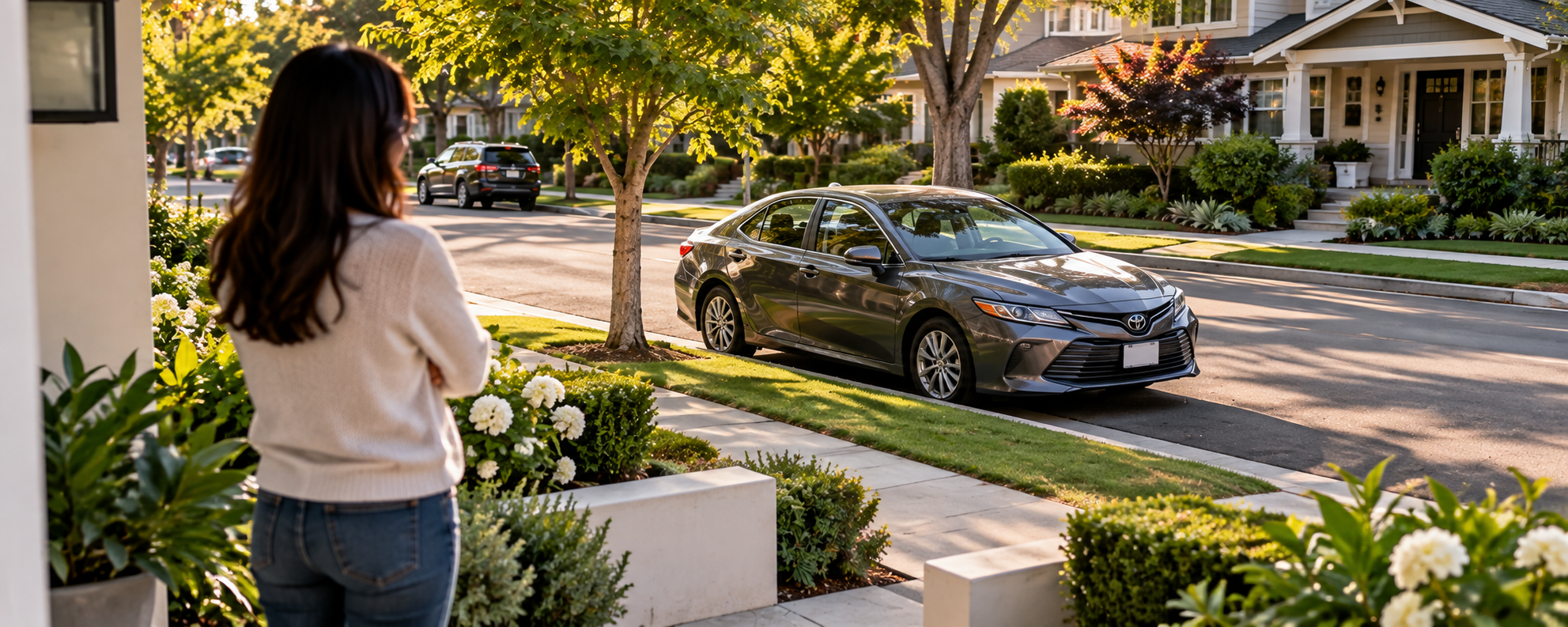
You look outside and see a car you don’t recognize parked directly in front of your home. Maybe it has been there all afternoon. Maybe it belongs to a neighbor. Or perhaps someone has left it there overnight.
It can feel like the curb in front of your house should belong to you. But if you live on a public street, the parking space in front of your home generally isn’t reserved for the homeowner simply because the property sits beside it.
That doesn’t mean anyone can park there under any circumstances. Driveways, permits, time limits, street cleaning, overnight restrictions, temporary signs, and other local parking rules can all affect whether a vehicle may legally remain there.
So the better question isn’t necessarily “Whose house is this?”
It’s “What parking rules apply to this curb?”
Do You Own the Parking Space in Front of Your House?
Owning a home generally does not mean you own the public street or curb directly in front of it.
If the street is public and parking is otherwise legal, another driver may be able to park there even if the space is directly outside your house.
There are important exceptions.
Private streets, HOA-controlled communities, permit districts, reserved accessible spaces, and other specially regulated areas may operate differently.
The first thing to determine is whether you’re dealing with an ordinary public street or a location subject to additional parking controls.
Can Your Neighbor Park in Front of Your House?
Potentially, yes.
On a public street, a legal parking space usually doesn’t become reserved for a particular household just because it is closest to that property.
The same parking rules generally apply whether the vehicle belongs to you, your neighbor, or someone visiting the neighborhood.
But the vehicle still has to comply with applicable restrictions.
For example, it may need to follow:
- Permit requirements
- Posted time limits
- Street sweeping restrictions
- Overnight parking rules
- Driveway clearance requirements
- Curb restrictions
- Temporary parking restrictions
- Rules governing how long a vehicle may remain in one location
So a neighbor’s car may be legally parked in front of your house—or it may be violating an entirely separate parking rule.
What If the Car Is Blocking Your Driveway?
That’s a different issue.
A driver generally cannot treat the entrance to a driveway as an ordinary curbside parking space when doing so would violate applicable driveway-clearance rules.
Even partially blocking a driveway can create problems depending on the vehicle’s position and local regulations.
If the car extends into your driveway opening, see our guide to parking in front of a driveway for the factors drivers should check.
The distinction matters:
Parking in front of the property and parking in front of the driveway are not necessarily the same thing.
Can Someone Leave Their Car in Front of Your House Overnight?
Possibly.
If overnight street parking is allowed and the vehicle complies with the other applicable rules, the fact that it belongs to someone else doesn’t necessarily make the parking illegal.
However, many areas have additional overnight restrictions.
A street may require a permit, prohibit parking during certain overnight hours, impose time limits, or have restrictions that take effect early the next morning.
Our guide to residential street parking overnight explains what drivers should check before leaving a vehicle overnight.
What If Your Neighborhood Requires a Parking Permit?
Permit districts can change the answer.
Some residential neighborhoods limit parking to vehicles displaying a particular permit or allow non-permitted vehicles to remain only for a limited period.
The rules can also change by time of day.
A visitor might legally park in front of your house during one part of the day but need a permit later.
If your street has permit signs, our guide to permit parking zones explains what to look for.
What About Street Sweeping?
This is another reason a car cannot necessarily stay in front of a house indefinitely.
A space that is legal today may become restricted tomorrow morning when scheduled street cleaning begins.
Drivers need to pay attention to the day and time, not simply whether parking was allowed when they arrived.
Our guide to street sweeping parking explains how scheduled restrictions can affect otherwise legal residential spaces.
Can Someone Park There for Days?
Local laws may limit how long a vehicle can remain parked in the same location on a public street.
These rules vary considerably by jurisdiction.
A vehicle therefore shouldn’t automatically be considered illegally parked merely because it hasn’t moved since yesterday. At the same time, legal curbside parking doesn’t necessarily give someone the right to leave a vehicle in the same place indefinitely.
If a vehicle appears abandoned or has remained stationary for an unusually long period, check the applicable local parking or abandoned-vehicle rules rather than assuming a particular time limit.
Does a Homeowner Get Priority Over the Space?
Usually, the important factor is the parking regulation, not which driver lives closest to the curb.
That can be frustrating when street parking is scarce.
You might regularly park in the same space because it’s convenient, but routine use doesn’t necessarily turn a public curb into a reserved space.
A different driver who legally parks there may have the same right to use that public parking space, subject to applicable local rules.
What If Someone Puts a Cone in Front of Their House?
A cone, trash bin, chair, or other household object does not automatically create a legally reserved parking space on a public street.
Local laws may regulate placing objects in the roadway or attempting to reserve public curb space.
There can be exceptions when a government agency has authorized a temporary restriction, construction activity requires an approved closure, or properly issued temporary signage reserves the area.
The key is official authorization, not simply placing an object at the curb.
Can Temporary No Parking Signs Reserve the Space?
They can affect whether someone may park there, but the restriction should be evaluated according to the applicable local requirements.
Temporary parking restrictions may appear for:
- Construction
- Moving activity
- Utility work
- Street maintenance
- Special events
- Filming
- Other authorized uses
A space you normally use may temporarily become unavailable.
Our guide to temporary No Parking signs explains what drivers should check when temporary restrictions appear.
What If the Curb Is Painted?
Curb markings can introduce another restriction.
A curb may indicate a loading area, passenger zone, accessible space, parking limitation, or another regulated use depending on the jurisdiction.
Don’t assume the curb in front of a residence follows different rules simply because a house is beside it.
If the curb is painted, our guide to curb colors and their meanings explains why you should consider both the color and the applicable local rules.
Can You Put Up Your Own No Parking Sign?
Putting a privately purchased No Parking sign beside a public street doesn’t necessarily create an enforceable public parking restriction.
Official parking restrictions generally come from the appropriate government authority or another entity legally authorized to control that location.
Private property is different. Property owners may have authority over parking on their own property, subject to applicable laws.
But the public curb in front of a house should not automatically be treated as private property.
What If It’s a Private Street or HOA Community?
This is an important exception.
Private streets and communities governed by homeowners associations may have parking rules that differ from ordinary municipal street parking.
There may be:
- Resident-only spaces
- Guest parking
- Assigned parking
- Overnight restrictions
- Vehicle registration requirements
- Towing rules
- Private enforcement
If you’re unsure whether a street is public or private, determine who controls the roadway before assuming normal public-street parking rules apply.
What Should You Check Before Parking in Front of Someone’s House?
If you’re the driver looking for a space, the fact that a curb sits in front of somebody else’s home shouldn’t be your only consideration.
Look around.
Check whether you’re blocking a driveway. Read nearby signs. Look for permit requirements, curb markings, hydrants, temporary restrictions, street-cleaning schedules, and time limits.
And if you’re leaving the vehicle overnight, consider whether the rules will change before you return.
The question is not simply whether there’s room for your car.
It’s whether the location allows you to park there at that time.
Where ParkClear Fits In
Residential parking is a good example of how a seemingly simple parking space can involve several overlapping rules.
ParkClear helps drivers interpret confusing parking signs and location-based parking rules to provide a clear Yes or No answer to “Can I park here?”
If a residential street has posted restrictions that are difficult to understand, you can use ParkClear’s parking sign scanner to help interpret them.
ParkClear can also help drivers check a future date and time—useful when a space is legal now but a street-cleaning, permit, or other time-based restriction may begin later.
When legality depends on a local rule that isn’t communicated on a sign, drivers should also verify the applicable official local regulation.
The Curb Isn’t Necessarily Part of the House
Seeing someone else’s vehicle directly outside your home can certainly be inconvenient, particularly in a neighborhood where parking is limited.
But on a public street, proximity to your property isn’t usually what determines who can use a legal parking space.
The parking rules do.
If the vehicle isn’t blocking a driveway and complies with permits, posted restrictions, time limits, overnight rules, curb regulations, and other applicable laws, another driver may be permitted to park there.
And if you’re the person looking for a space in front of someone else’s house, apply the same test: read the curb, read the signs, check the time, and make sure the space is actually legal before you leave your car.
Download ParkClear
Confused about whether you can park? Download ParkClear to scan parking signs or use your location to get a clear Yes or No answer to “Can I park here?”
Parking regulations vary by jurisdiction. Always follow posted signs and applicable local laws, and check official local rules when necessary.