
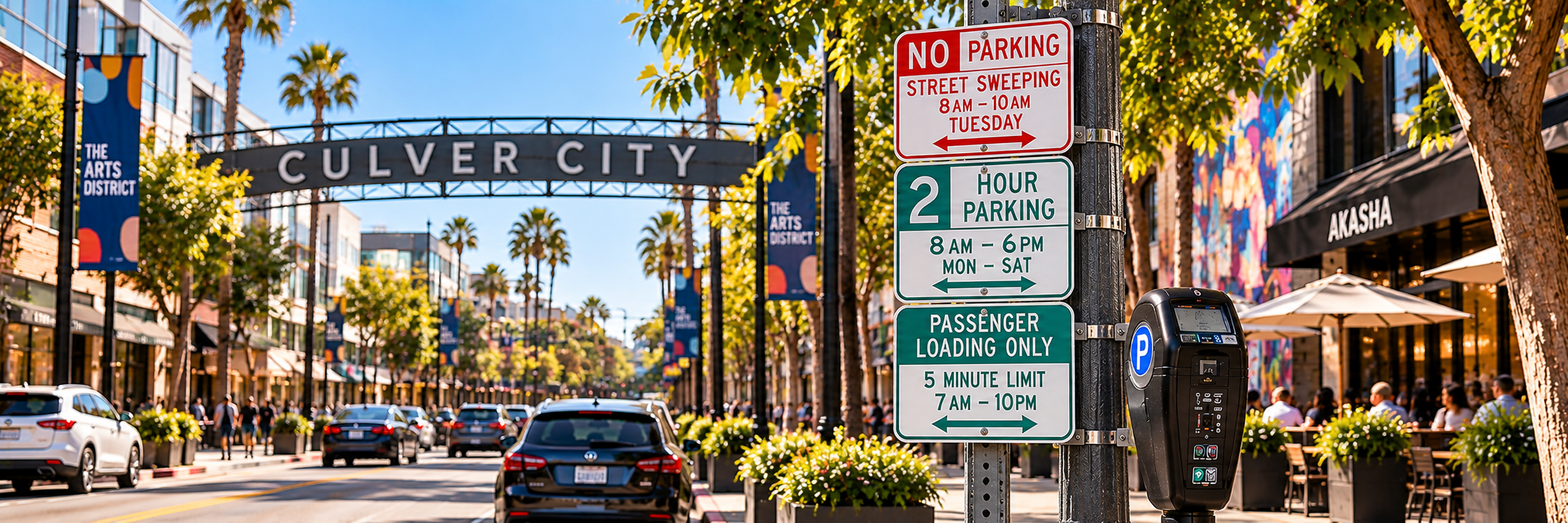
Culver City packs restaurants, shops, entertainment, offices, studios and residential neighborhoods into a relatively compact area.
That can make parking deceptively complicated.
Within a short drive, you can move from metered commercial parking in Downtown Culver City to residential streets with permit restrictions, street sweeping or time limits. You can also cross between Culver City and the City of Los Angeles without realizing you’ve entered a different municipality.
Finding an open curb is only the beginning.
Here’s what to check before parking in Culver City.
How Does Street Parking Work in Culver City?
Culver City is its own municipality with its own parking programs and enforcement.
It is not simply another Los Angeles neighborhood.
That’s particularly important because the city’s irregular boundaries mean drivers can move between Culver City and Los Angeles during an ordinary trip.
Always evaluate the rules at your exact location.
Before leaving your vehicle, check:
- Every parking sign affecting the space.
- Parking meter instructions.
- Time limits.
- Directional arrows.
- Residential permit restrictions.
- Street-sweeping schedules.
- Colored curbs.
- Loading zones.
- Temporary No Parking signs.
- Restrictions beginning later in the day.
Most importantly, make sure the space remains legal until you plan to return.
What About Parking in Downtown Culver City?
Downtown Culver City is one of the city’s busiest dining, shopping and entertainment districts.
Restaurants, theaters, hotels and businesses generate significant parking demand throughout the day and evening.
Drivers can encounter both street parking and city parking facilities in the area.
If you’re using a curb space, check the exact location for:
- Meter requirements.
- Maximum parking duration.
- Posted operating hours.
- Loading restrictions.
- Colored curbs.
- Temporary restrictions.
Don’t assume that parking rules are identical from one downtown block to another.
And don’t treat a successful meter payment as permission to ignore other signs affecting the space.
How Do Parking Meters Work in Culver City?
Culver City operates a substantial network of parking meters and pay stations.
Rates and restrictions can vary by location, so the safest approach is to read the meter and surrounding signs where you actually park.
Check:
- Required payment.
- Meter operating hours.
- Maximum parking duration.
- Other restrictions on the block.
A meter and a parking sign answer different questions.
The meter tells you when and how payment is required.
Other signs determine whether your vehicle is permitted to occupy the space.
Our guide to parking meter rules after hours explains why those two issues shouldn’t be confused.
What About Parking in the Culver City Arts District?
The Culver City Arts District stretches through an active mix of galleries, restaurants, creative businesses and residential areas.
Parking conditions can change as you move through the district.
Some streets may have metered or time-limited parking, while nearby residential blocks can have different restrictions.
This is also an area where municipal boundaries matter.
Parts of the broader neighborhood surrounding Culver City’s eastern side connect directly with streets governed by the City of Los Angeles.
Don’t assume that a parking rule from one block continues indefinitely.
Read the signs at the exact curb where you stop.
Why Do Culver City and Los Angeles Boundaries Matter?
This is one of the most interesting parking issues in Culver City.
Culver City is surrounded by Los Angeles in many areas, and its municipal boundary doesn’t always feel obvious when you’re driving.
You may cross from a Los Angeles street into Culver City—or back again—without passing through anything that feels like a traditional city boundary.
That matters because parking programs, permits and local regulations can differ.
If you’re uncertain, don’t rely on what you remember from a nearby street.
Check the signs and regulations governing your current location.
For comparison, our Los Angeles Street Parking Guide explains the City of Los Angeles system.
Does Culver City Have Residential Permit Parking?
Yes.
Culver City operates Residential Permit Parking Districts on qualifying streets.
Where permit parking applies, signs may establish a time restriction and indicate that qualifying permit holders are exempt.
For example, a sign may limit ordinary parking while stating:
EXCEPT BY PERMIT
or
PERMIT EXEMPT
A valid permit for the applicable district can allow a qualifying vehicle to remain beyond the posted time limit.
But permits are district-specific.
A permit issued for one residential parking district doesn’t automatically authorize parking in another.
Our guide to permit parking signs explains what drivers should look for.
Does a Residential Parking Permit Override Every Restriction?
No.
This is an important Culver City distinction.
A residential parking permit can exempt a qualifying vehicle from certain posted time restrictions within its permit district.
It does not give the vehicle unlimited parking privileges.
Other regulations can still apply, including:
- Street sweeping.
- Colored curbs.
- Fire hydrant restrictions.
- Blocking a driveway.
- The 72-hour parking maximum.
- Other applicable local or state parking laws.
So even when a vehicle has a valid permit, the driver still needs to inspect the rest of the parking environment.
Can Guests Get Residential Parking Permits?
Culver City’s residential permit program includes guest parking options for qualifying residences within permit districts.
That can be useful when visiting friends or family on a permit-restricted street.
But a guest permit serves a specific purpose: allowing an eligible guest vehicle to receive the applicable permit exemption.
It doesn’t cancel unrelated parking regulations.
If you’re using a guest permit, still check street sweeping, curb restrictions, temporary signs and other applicable rules.
What About Street Sweeping in Culver City?
Street sweeping is another important part of Culver City parking.
The city sweeps residential streets regularly, while certain arterial streets receive more frequent service.
Where parking restrictions are posted for street sweeping, check the exact:
- Day.
- Start time.
- End time.
Don’t assume the parking restriction disappears because the sweeper has already passed.
Follow the posted parking schedule.
This is particularly important when leaving a vehicle overnight or for an extended period.
A space that’s legal when you park may become restricted the following morning.
Read our guide to parking during street sweeping for more information.
Can You Leave a Car Parked on the Street for Several Days?
Don’t assume that an unrestricted-looking curb allows indefinite vehicle storage.
Culver City’s residential permit rules specifically identify a 72-hour parking maximum among the regulations that a residential permit does not override.
That means even a properly permitted vehicle isn’t necessarily allowed to remain continuously parked in the same place indefinitely.
If you’re planning to leave a vehicle on the street for an extended period, check the applicable city regulations rather than relying only on nearby signs.
Our guide to how long a car can be parked on the street explains why extended parking requires additional attention.
What Do Culver City Curb Colors Mean?
Drivers may encounter colored curbs indicating specific parking restrictions or uses.
These can include red, yellow, white, green and blue curb markings.
Don’t interpret the curb paint without checking nearby signs.
A sign may establish operating hours, time limits or additional conditions.
Before leaving your vehicle:
Inspect the curb and read every applicable sign.
Our guide to parking curb colors explains the common restrictions drivers should recognize.
Watch for Loading Zones
Culver City’s commercial areas contain restaurants, shops, offices and other businesses that need curb access for deliveries and passengers.
That means drivers may encounter commercial loading areas and passenger-loading zones.
An empty loading space isn’t automatically available for ordinary parking.
Check the sign for:
- Type of loading permitted.
- Applicable hours.
- Maximum duration.
- Other restrictions.
A loading restriction may apply during only part of the day, but you need to confirm that before parking.
See our guides to loading zone parking rules and passenger loading zones.
How Do You Read Multiple Parking Signs?
Culver City parking can become confusing when several rules apply to the same curb.
Imagine seeing:
2 HOUR PARKING
EXCEPT BY PERMIT
NO PARKING — STREET SWEEPING
PASSENGER LOADING — CERTAIN HOURS
Those instructions don’t necessarily contradict each other.
Each may apply at a different time or under different conditions.
A permit might exempt one vehicle from the two-hour limit while doing nothing to override the street-sweeping restriction.
That’s why reading only the most favorable sign can lead to a parking ticket.
Directional arrows also matter because they help define which section of curb a restriction controls.
Our guides to multiple parking signs and parking sign arrows explain how to work through stacked parking regulations.
Watch for Temporary No Parking Signs
Temporary restrictions can override the parking conditions you normally expect on a street.
Culver City uses Temporary No Parking signs for situations where curb access must temporarily be restricted.
These signs can be associated with activities such as construction, moving or other permitted uses.
Before parking, look for temporary signs and check:
- Effective date.
- Start time.
- End time.
- Beginning and ending points.
- Portion of curb affected.
Don’t assume a familiar street has the same parking conditions every day.
Read our guide to temporary No Parking signs for more information.
What About Parking Near Driveways?
Residential streets can create another common problem: squeezing a vehicle into a curb space that’s slightly too short.
Don’t block a driveway.
A residential parking permit doesn’t give a vehicle permission to interfere with driveway access.
After parking in a tight space, get out and inspect both ends of your vehicle.
Our guide to driveway parking rules explains what drivers should consider before leaving the vehicle.
Be Careful Near Intersections and Crosswalks
An open section of curb near an intersection isn’t automatically a legal parking space.
California’s daylighting rules restrict parking near many crosswalks to improve visibility between drivers and pedestrians.
Culver City has also been implementing red curb near intersections as part of its compliance with California’s daylighting requirements.
Pay attention to newly painted curb areas and don’t assume that a place where vehicles historically parked is still legal.
Our guides to intersection parking rules, crosswalk parking rules and how close you can park to a corner explain what drivers should check.
What About Parking on Holidays?
Holiday schedules can affect municipal services such as street sweeping.
But don’t assume that every parking restriction disappears because it’s a holiday.
Different parking regulations can operate under different enforcement rules.
If your parking decision depends on a holiday exemption, check current Culver City information and read the signs at your location.
A holiday doesn’t automatically turn a restricted curb into unrestricted parking.
What if You Get a Parking Ticket in Culver City?
Because Culver City is its own municipality, don’t automatically follow City of Los Angeles procedures for a citation issued there.
Read the citation carefully.
Note:
- Violation.
- Date and time.
- Location.
- Payment instructions.
- Contest instructions.
- Applicable deadline.
If you believe the citation was issued incorrectly, document the parking environment as soon as possible.
Photograph:
- Your vehicle’s position.
- Every relevant parking sign.
- Directional arrows.
- Curb markings.
- Meter information.
- The surrounding block.
Then follow the Culver City instructions provided with the citation.
Culver City Street Parking Checklist
Before walking away from your vehicle:
- Confirm which city you’re in. Culver City and Los Angeles rules aren’t interchangeable.
- Read every applicable sign. Don’t stop after finding one that permits parking.
- Check directional arrows. Determine which section of curb each sign controls.
- Check the meter. Review payment requirements and time limits.
- Inspect the curb. Look for colored restrictions.
- Check permit requirements. Residential streets may have district-specific restrictions.
- Check street sweeping. Another rule may begin before you return.
- Look for loading zones. Commercial areas can have specialized curb uses.
- Look for temporary signs. Normal parking conditions can change.
- Check your return time. Make sure the space remains legal throughout your stay.
The key question isn’t simply:
Can I park here right now?
It’s:
Can I legally remain here until I return?
How ParkClear Helps With Culver City Street Parking
Culver City demonstrates why location matters when interpreting street-parking rules.
A driver may need to determine which municipality controls the street, interpret multiple signs, check a meter, understand a residential permit restriction and account for street sweeping or a temporary restriction.
ParkClear helps drivers interpret municipal street-parking regulations using parking-sign scanning and location-based information.
The goal is to provide a clear Yes or No answer to:
Can I park here?
Future date and time checks can help drivers evaluate whether parking will be permitted later, while parking-expiration reminders can help track when permitted parking ends.
ParkClear doesn’t locate vacant parking spaces, provide live parking occupancy or offer turn-by-turn navigation.
Its focus is helping drivers understand the rules governing the curb where they want to park.
Learn more about the ParkClear parking sign scanner.
Make Culver City Parking Easier to Understand
Whether you’re dining in Downtown Culver City, visiting the Arts District or parking on a residential street, don’t judge a space simply because the curb is empty.
Read every sign. Check the meter. Inspect the curb. Look for permit and street-sweeping restrictions.
And pay attention to your exact location—especially when traveling near the Culver City and Los Angeles boundary.
Most importantly, check whether the parking rules will change before you plan to return.
Confused about whether you can park? Download ParkClear to scan parking signs or use your location to get a clear Yes or No answer to “Can I park here?”
Parking regulations vary by jurisdiction. Always follow posted signs and applicable local laws, and check official local rules when necessary.