
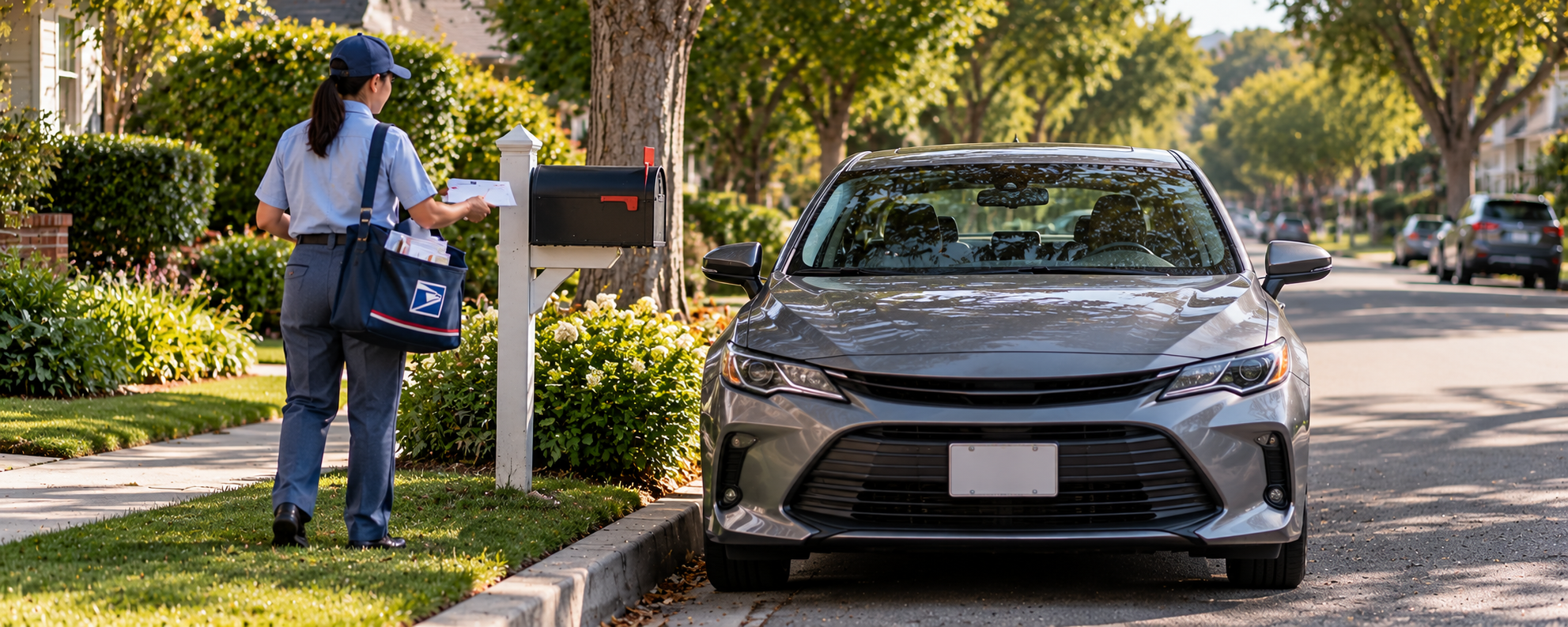
You find an open space on a residential street, pull up to the curb, and then notice a mailbox beside your car.
Can you park there?
The answer isn’t as simple as many drivers assume. A curbside mailbox does not automatically create the same No Parking zone everywhere. Whether you can legally park in front of a mailbox depends on applicable state and local parking laws, posted restrictions, the location of the mailbox, and other conditions around the space.
But there is another issue to consider: mail delivery access.
A vehicle may interfere with a mail carrier’s ability to reach a mailbox even when the parking question itself is governed separately by local traffic laws.
Understanding that distinction can help you make a better parking decision.
Is It Illegal to Park in Front of a Mailbox?
There isn’t one universal parking rule you should apply to every mailbox in every jurisdiction.
Local parking laws can regulate the curb where the mailbox is located, and posted signs or other restrictions may prohibit parking there.
So rather than assuming that every mailbox creates an automatic No Parking zone, check what actually controls the space.
Look for:
- No Parking signs
- Time restrictions
- Permit requirements
- Painted curbs
- Driveways
- Fire hydrants
- Street-cleaning restrictions
- Temporary parking signs
- Other local parking rules
The mailbox is one part of the situation—not necessarily the only thing determining whether the curb is legal.
Does a Mailbox Create Its Own No Parking Zone?
Not necessarily.
A mailbox beside a public street should not automatically be treated like a fire hydrant, driveway, crosswalk, or other location that may have specific statutory parking-clearance requirements.
The rules can vary by jurisdiction and by the type and location of the mailbox.
If a sign specifically prohibits parking near the mailbox or the curb falls within another restricted area, follow that restriction.
If there is no sign, you still need to check whether another local parking law applies.
What About Mail Delivery?
This is where parking legality and practical access can become two different questions.
Many curbside mailboxes are designed so a mail carrier can deliver mail from a vehicle without leaving the roadway.
A car parked directly in front of—or extremely close to—the mailbox can interfere with that access.
Even if you don’t see a traditional No Parking sign, blocking the approach to a mailbox may create problems for mail delivery.
So when you have a choice between two otherwise legal spaces, leaving reasonable access around a curbside mailbox is the better approach.
Can Mail Still Be Delivered If a Car Blocks the Mailbox?
That depends on the circumstances and delivery conditions.
A carrier may not always be able to safely reach a curbside mailbox when a vehicle or other obstruction prevents normal access.
This doesn’t mean every vehicle near a mailbox automatically stops mail delivery. The position of the car, street configuration, mailbox placement, and delivery method can all matter.
From a driver’s perspective, the simplest approach is to avoid positioning your vehicle in a way that clearly prevents access to the mailbox.
What If There Is No No Parking Sign?
Don’t use the absence of a sign as your only test.
The mailbox itself may not create a universal No Parking zone, but the curb can still be regulated by rules that aren’t repeated on a sign directly beside the vehicle.
For example, you could also be too close to:
- A driveway
- An intersection
- A crosswalk
- A stop sign
- A fire hydrant
Or a general local rule could restrict how long you may leave the vehicle there.
So the correct question isn’t simply:
“Is there a No Parking sign?”
It’s:
“What rules apply to this particular section of curb?”
What If the Mailbox Is Next to a Driveway?
This can change the parking analysis significantly.
Many residential curbside mailboxes sit beside driveways.
You may think you’re parking in front of the mailbox when the more important legal issue is actually driveway clearance.
Make sure no part of your vehicle improperly obstructs the driveway entrance.
Our guide to parking in front of a driveway explains why drivers should evaluate the entire driveway opening rather than looking only at where the vehicle’s tires sit.
Can You Park in Front of Your Own Mailbox?
Owning the property associated with a mailbox doesn’t necessarily exempt your vehicle from the parking rules governing a public street.
If the curb is subject to a parking restriction, the fact that it’s your mailbox doesn’t automatically override that rule.
And from a practical standpoint, your own vehicle can interfere with access to your mailbox just as another vehicle can.
If you receive curbside mail delivery, consider whether the carrier can reach the mailbox while your car is parked there.
Can Someone Else Park in Front of Your Mailbox?
If the curb is part of a public street, another driver may potentially be able to use a legal parking space in front of your property.
The presence of your house or mailbox does not necessarily turn the public curb into a reserved private parking space.
However, the driver still needs to comply with all applicable parking laws.
We explain the broader issue in Can Someone Park in Front of Your House?.
Mailbox access creates an additional practical consideration, but it doesn’t automatically mean the homeowner owns the curb.
Can You Put a No Parking Sign on Your Mailbox?
A privately purchased No Parking sign does not necessarily create an enforceable public parking restriction.
Public-street parking restrictions generally come from the appropriate government authority or another entity legally authorized to regulate that location.
That is different from a sign on private property.
If repeated parking is interfering with mail delivery, the appropriate solution depends on the local circumstances and who controls the roadway—not simply attaching your own parking sign to the mailbox.
What About Community or Cluster Mailboxes?
Cluster mailboxes can present a different situation from an individual curbside residential mailbox.
A neighborhood may have a centralized group of mailboxes serving multiple homes or units.
The area around those mailboxes may include:
- Designated parking
- No Parking zones
- Passenger or loading areas
- Fire lanes
- Private-road restrictions
- HOA rules
- Accessible spaces
- Other site-specific controls
In these locations, read the signs and markings around the entire mailbox area rather than assuming the same rules that apply to a single residential curbside mailbox.
What If the Mailbox Is on a Private Street?
Private streets can operate differently from ordinary public streets.
An HOA, apartment community, property owner, or other authorized entity may establish parking rules for the property, subject to applicable law.
That can include restrictions around mailboxes or designated delivery areas.
If you’re in a private community, determine who controls the roadway and check the applicable parking rules before assuming public-street standards apply.
Can You Leave Your Car in Front of a Mailbox Overnight?
The mailbox isn’t the only consideration.
Even if the curb allows parking during the day, overnight parking restrictions may take effect later.
There could also be:
- Residential permit requirements
- Street cleaning the next morning
- Time limits
- Temporary restrictions
- General extended-parking limits
Our guide to residential street parking overnight explains what to check before leaving a vehicle until morning.
And if you plan to leave the vehicle for several days, see How Long Can You Leave a Car Parked on the Street?.
What If Street Sweeping Happens the Next Morning?
A space can be legal when you park and restricted later.
For example, you might legally park near a mailbox in the evening but need to move the vehicle before street cleaning begins the next morning.
The mailbox doesn’t override that scheduled restriction.
Our guide to street sweeping parking explains why drivers should check what happens after they leave the car—not only what applies when they arrive.
What If There Are Multiple Parking Signs Nearby?
Read them together.
Residential streets can combine permit restrictions, street cleaning, time limits, and other parking controls on the same block.
One sign may tell you when you can park while another tells you who may park or how long a vehicle can remain.
Our guide to reading multiple parking signs can help you work through overlapping restrictions.
Also pay attention to parking sign arrows, since the restriction may extend toward or away from the mailbox depending on the sign.
A Simple Mailbox Parking Check
Before leaving your vehicle beside a curbside mailbox, evaluate the whole space.
First, check whether parking is legal at the curb. Read the signs, curb markings, and applicable local rules.
Second, check nearby restrictions. Make sure you’re not blocking a driveway or violating another clearance requirement.
Third, consider mail access. Ask whether your vehicle’s position would prevent a carrier from reasonably reaching the mailbox.
Finally, look ahead. If you’re leaving the vehicle for hours or overnight, check whether the parking rules change before you return.
That gives you a much more complete answer than treating the mailbox itself as the only parking rule.
Where ParkClear Fits In
Parking near a mailbox demonstrates why street parking decisions can involve more than one piece of information.
ParkClear helps drivers interpret confusing parking signs and location-based parking rules to provide a clear Yes or No answer to “Can I park here?”
If nearby signs are difficult to understand, ParkClear’s parking sign scanner can help interpret the posted restriction.
Drivers can also check a future date and time when parking rules change later.
When legality depends on a state or local rule that isn’t communicated by a parking sign, drivers should verify the applicable official regulation.
And because mail delivery access is a separate consideration from the parking sign itself, drivers should avoid obstructing a curbside mailbox when possible.
Don’t Look at the Mailbox Alone
A mailbox beside your parking space deserves attention—but it doesn’t tell you everything about whether you can park there.
Look at the entire curb.
Check the parking signs, driveway, curb markings, nearby restrictions, time limits, and what will happen while your vehicle remains there.
Then consider whether your car will interfere with reasonable access to the mailbox.
The result is a better parking decision for both you and the people who need to use the curb after you leave your car.
Download ParkClear
Confused about whether you can park? Download ParkClear to scan parking signs or use your location to get a clear Yes or No answer to “Can I park here?”
Parking regulations vary by jurisdiction. Always follow posted signs and applicable local laws, and check official local rules when necessary.