Burbank may be famous for movie studios, television production and entertainment companies, but its parking environment extends far beyond the studio districts.
Downtown Burbank, Magnolia Park, residential neighborhoods, commercial corridors and areas surrounding major entertainment destinations can all have different parking conditions.
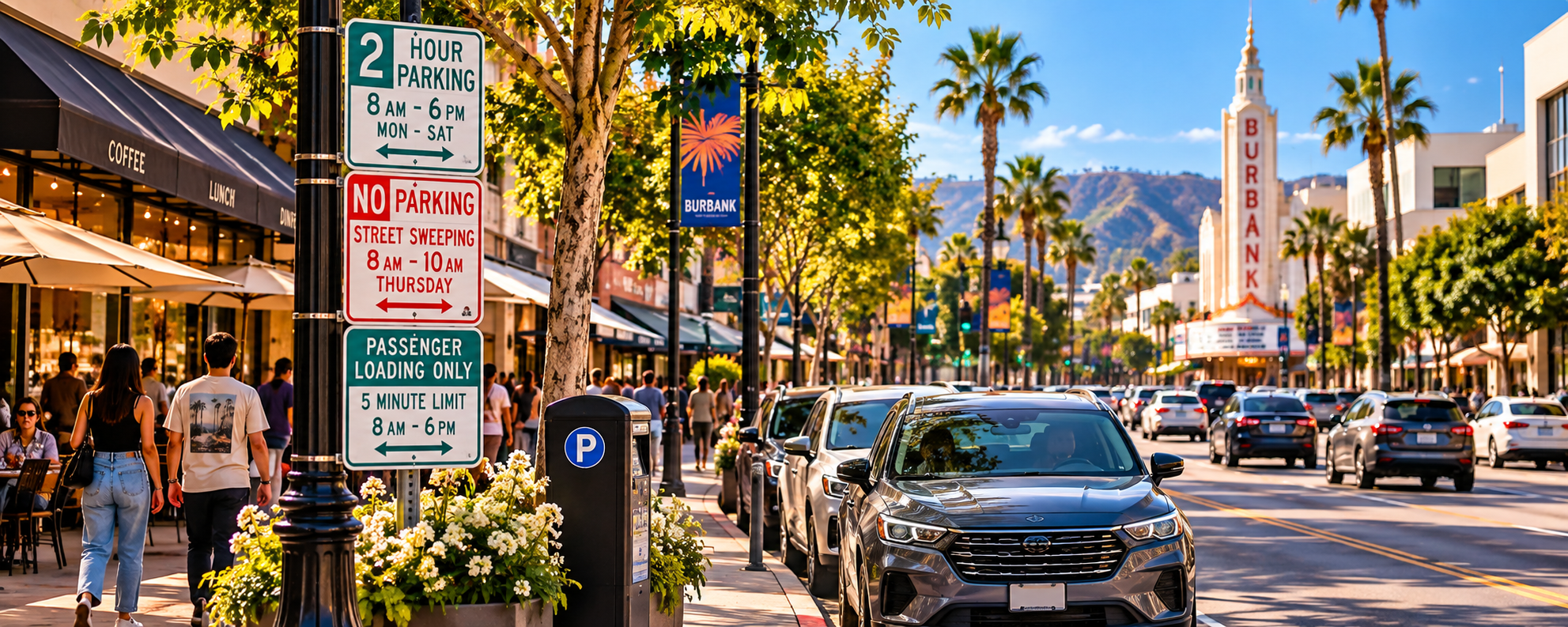
Drivers may encounter paid street parking, time limits, residential permit restrictions, street sweeping, colored curbs, loading zones and temporary parking rules.
And because Burbank is its own city, its parking system shouldn’t be confused with neighboring Los Angeles.
Here’s what to check before parking in Burbank.
How Does Street Parking Work in Burbank?
Burbank operates its own parking programs, public parking facilities and enforcement system.
Before leaving your vehicle, check:
- Every parking sign affecting the space.
- Meter or payment instructions.
- Posted time limits.
- Directional arrows.
- Residential permit restrictions.
- Street-sweeping restrictions.
- Colored curbs.
- Loading zones.
- Temporary No Parking signs.
- Restrictions beginning later during your stay.
Finding an empty curb only tells you that a space is physically available.
It doesn’t tell you whether you’re legally allowed to park there.
Is Street Parking Free in Downtown Burbank?
Not all of it.
Downtown Burbank introduced paid street parking in 2025.
That makes older advice claiming Downtown Burbank street parking is generally free potentially outdated.
Drivers parking on affected Downtown streets should check the meter or payment information at the exact location.
However, Burbank’s public parking lots and structures operate differently and continue to offer free parking subject to their applicable time restrictions.
That’s an important distinction:
Street parking and public parking structures don’t necessarily follow the same rules.
How Do Downtown Burbank Parking Meters Work?
Downtown Burbank’s paid street-parking system currently charges by the hour during designated operating hours.
But rates and policies can change over time, so drivers should always follow the current instructions at the space.
Check:
- Whether payment is required.
- Current rate.
- Payment hours.
- Maximum parking duration, if applicable.
- Nearby signs controlling the curb.
Most importantly, paying for parking doesn’t override another restriction.
If a sign prohibits parking during a particular period, paying the meter doesn’t give you permission to remain there.
Our guide to parking meter rules after hours explains why meter payment and permission to park are separate questions.
What About Parking in Downtown Burbank?
Downtown Burbank combines restaurants, theaters, shops, offices and entertainment destinations around streets including San Fernando Boulevard.
Because parking demand can be high, drivers have several options.
You may find:
- Paid street parking.
- Public parking structures.
- Public parking lots.
- Time-limited spaces.
- Loading areas.
- Other specialized curb restrictions.
If you’re planning to stay for a movie, dinner or shopping, don’t consider only whether parking is legal when you arrive.
Check whether a time limit or another restriction will begin before you return.
Does Downtown Burbank Have Free Public Parking?
Yes.
The City of Burbank operates several Downtown public parking structures and lots that continue to provide free parking subject to varying time restrictions.
That’s useful because it gives drivers an alternative to paid curb parking.
But pay attention to the signs inside the facility.
Some Downtown public parking facilities have two- to four-hour limits during specified weekday hours.
A free space isn’t necessarily an unlimited space.
If you’re planning to stay for several hours, confirm the permitted duration before leaving the vehicle.
What About Parking in Magnolia Park?
Magnolia Park has a different character from Downtown Burbank.
The Magnolia Boulevard corridor combines restaurants, boutiques, specialty stores and residential streets.
That mix can create an important parking transition.
A commercial street may have one set of rules, while a nearby residential block may have another.
If you move away from Magnolia Boulevard looking for parking, check again for:
- Residential permit restrictions.
- Posted time limits.
- Street sweeping.
- Colored curbs.
- Driveways.
- Temporary signs.
Don’t assume that an unmetered residential space is unrestricted simply because it’s near a commercial destination.
Does Burbank Have Residential Permit Parking?
Yes.
Certain Burbank residential streets have parking restrictions designed to preserve parking availability for residents.
Qualifying residents can obtain parking permits that allow eligible vehicles to park beyond certain posted restrictions.
Burbank also offers visitor permits for eligible households.
However, only residences located within qualifying posted areas are eligible for these permits.
If you’re visiting a residential neighborhood, read the signs carefully before parking.
Our guide to permit parking signs explains what drivers should look for.
How Does Burbank’s Permit-By-Plate System Work?
Burbank transitioned its residential parking permit program to a digital Permit-By-Plate system in 2025.
Instead of relying on a physical decal or hangtag for regular residential permits, the vehicle’s license plate functions as the permit.
Parking enforcement can verify the plate electronically.
For visitors, residents within qualifying permit areas can also obtain applicable visitor parking authorization.
For drivers, however, the practical rule remains simple:
Read the parking sign.
Don’t assume that another vehicle parked on the block proves you’re allowed to park there.
That vehicle may have a valid permit associated with its license plate.
Does a Residential Permit Override Every Parking Rule?
No.
A permit generally provides an exemption from the particular residential restriction for which it was issued.
It doesn’t mean the vehicle can ignore every other parking regulation.
A driver still needs to check for:
- Street sweeping.
- Colored curbs.
- Temporary restrictions.
- Driveways.
- Safety restrictions.
- Other applicable signs.
Several rules can apply to the same curb at the same time.
How Does Street Sweeping Work in Burbank?
Burbank provides regular street sweeping throughout residential, commercial and industrial areas.
Residential street sweeping generally operates on weekdays, except designated city holidays.
Where parking restrictions are posted, check the exact day and time shown on the sign.
Don’t rely on what happens on another street or even the opposite side of the same street.
And don’t assume you’re automatically permitted to park once the sweeper passes.
Follow the complete posted restriction.
Our guide to parking during street sweeping explains why the full restriction window matters.
Can You Leave a Car Parked on a Burbank Street for Several Days?
Be careful.
Burbank requires vehicles parked on public streets to be moved at least every 72 hours.
That rule can matter even when the curb doesn’t appear to have a shorter posted time limit.
So if you’re leaving town or planning to store a vehicle on the street for several days, don’t assume an unrestricted-looking curb allows indefinite parking.
Our guide to how long a car can be parked on the street explains why extended street parking deserves additional attention.
What About Parking Near Burbank’s Studios?
Burbank is home to major production and entertainment facilities, creating concentrated parking demand in certain areas.
Studio employees, visitors, production crews and nearby businesses can all compete for parking.
That makes nearby residential streets particularly important to check carefully.
Don’t assume that a curb outside a studio or office district is available simply because it isn’t metered.
Look for:
- Permit restrictions.
- Time limits.
- Loading zones.
- No Parking periods.
- Street sweeping.
- Temporary production-related restrictions.
Always follow the rules posted at the exact location.
What Do Burbank Curb Colors Mean?
Colored curbs can establish specialized parking and stopping rules.
Drivers may encounter curb markings associated with:
- No Parking or No Stopping areas.
- Commercial loading.
- Passenger loading.
- Short-term parking.
- Accessible parking.
Nearby signs may establish additional conditions or operating hours.
Don’t interpret curb paint without checking the signs around it.
Our guide to parking curb colors explains the common curb restrictions drivers should recognize.
Watch for Loading Zones
Burbank’s commercial areas and entertainment industry create significant demand for loading and unloading.
An empty loading space isn’t automatically available for ordinary parking.
Check:
- Type of loading permitted.
- Posted operating hours.
- Maximum duration.
- Curb markings.
- Other signs affecting the space.
A loading restriction can also apply during only part of the day.
See our guides to loading zone parking rules and passenger loading zones for more information.
How Do You Read Multiple Parking Signs in Burbank?
Several rules can apply to the same curb.
Imagine seeing:
2 HOUR PARKING
EXCEPT BY PERMIT
NO PARKING — STREET SWEEPING
PASSENGER LOADING — CERTAIN HOURS
These instructions don’t necessarily contradict one another.
They may control different vehicles or different periods of the day.
A residential permit could exempt a qualifying vehicle from the two-hour restriction while doing nothing to override street sweeping.
A loading restriction might apply during the morning and another parking rule later in the day.
Directional arrows can further determine which portion of curb each restriction controls.
Our guides to multiple parking signs and parking sign arrows explain how to work through stacked parking rules.
Watch for Temporary No Parking Signs
Temporary restrictions are particularly important in a city with construction, events and entertainment production activity.
A street that’s normally legal for parking can temporarily become restricted.
Before leaving your vehicle, look for temporary signs and check:
- Effective date.
- Start time.
- End time.
- Directional arrows.
- Portion of curb affected.
Don’t assume that a familiar parking space is legal today simply because you’ve parked there before.
Read our guide to temporary No Parking signs for more information.
What About Parking Near Driveways?
Residential neighborhoods can create another common parking mistake.
A space may look large enough for your vehicle while still interfering with driveway access.
Don’t block a driveway.
If the space is tight, get out of your vehicle and inspect its position before walking away.
Our guide to driveway parking rules explains what drivers should consider.
Be Careful Near Intersections and Crosswalks
An empty curb near an intersection isn’t automatically a legal parking space.
California parking laws include restrictions intended to preserve visibility around intersections and crosswalks.
Pay attention to:
- Red curbs.
- Crosswalks.
- Corners.
- Fire hydrants.
- Driveways.
- Other safety-related restrictions.
Some rules apply because of state or local law even when there isn’t a traditional parking sign immediately beside the vehicle.
Read our guides to intersection parking rules, crosswalk parking rules and how close you can park to a corner for more information.
What About Overnight Parking in Burbank?
Overnight parking depends on the exact location and type of parking facility.
Don’t assume every Burbank street or public facility follows the same overnight rule.
For example, certain Downtown parking permits cannot be used during posted overnight No Parking periods in the applicable public facilities.
Residential streets can have their own posted restrictions.
If you’re planning to leave a vehicle overnight, check:
- Posted parking signs.
- Permit requirements.
- Street sweeping the following morning.
- Facility operating rules.
- Temporary restrictions.
- The 72-hour street-parking limit.
Our guide to overnight parking rules explains what drivers should consider.
What if You Get a Parking Ticket in Burbank?
Burbank operates its own parking citation and enforcement system.
If you receive a citation, read it carefully and note:
- Violation.
- Date and time.
- Location.
- Payment instructions.
- Contest instructions.
- Applicable deadline.
If you believe the citation was issued incorrectly, document the parking environment promptly.
Photograph:
- Your vehicle’s position.
- Every relevant sign.
- Directional arrows.
- Curb markings.
- Meter or payment information.
- The surrounding block.
Then follow the City of Burbank procedures provided with the citation.
Burbank Street Parking Checklist
Before walking away from your vehicle:
- Read every applicable sign. Don’t stop after finding one favorable rule.
- Check directional arrows. Determine which section of curb each restriction controls.
- Check whether payment is required. Downtown Burbank now has paid street parking.
- Check the time limit. Free parking doesn’t necessarily mean unlimited parking.
- Inspect the curb. Look for colored restrictions.
- Check residential permits. Some neighborhoods have permit-controlled streets.
- Check street sweeping. Another restriction may begin before you return.
- Look for loading and temporary restrictions.
- Remember the 72-hour rule. Don’t use a public street for indefinite vehicle storage.
- Check your return time. Make sure the space remains legal throughout your stay.
The key question isn’t simply:
Can I park here now?
It’s:
Can I legally remain here until I return?
How ParkClear Helps With Burbank Street Parking
Burbank demonstrates how quickly a city’s parking system can evolve.
Downtown street parking that drivers once associated with free parking now includes paid spaces, while nearby public facilities, residential permit districts and other streets operate under different rules.
A driver may need to interpret several signs, determine whether payment is required, recognize a permit restriction, account for street sweeping and check whether another rule begins later.
ParkClear helps drivers interpret municipal street-parking regulations using parking-sign scanning and location-based information.
The goal is to provide a clear Yes or No answer to:
Can I park here?
Future date and time checks can help drivers evaluate whether parking will be permitted later, while parking-expiration reminders can help track when permitted parking ends.
ParkClear doesn’t locate vacant parking spaces, provide live parking occupancy or offer turn-by-turn navigation.
Its focus is helping drivers understand the rules governing the curb where they want to park.
Learn more about the ParkClear parking sign scanner.
Make Burbank Parking Easier to Understand
Whether you’re parking in Downtown Burbank, visiting Magnolia Park, heading to a studio or leaving your vehicle on a residential street, don’t judge a parking space simply because it’s empty.
Read every sign. Check whether payment is required. Inspect the curb. Look for permit and street-sweeping restrictions.
Most importantly, check whether the rules will change before you plan to return.
Confused about whether you can park? Download ParkClear to scan parking signs or use your location to get a clear Yes or No answer to “Can I park here?”
Parking regulations vary by jurisdiction. Always follow posted signs and applicable local laws, and check official local rules when necessary.