
Sometimes the most important parking instruction isn’t on a sign at all.
It’s painted directly on the curb.
Red, yellow, white, green, and blue curbs can communicate everything from “don’t stop here” to passenger loading, time-limited parking, or accessible parking. But knowing exactly what each curb color means isn’t always as straightforward as it looks.
That’s because curb colors can have different meanings depending on the city, state, posted signs, and local parking regulations.
So, what do curb colors mean?
Here’s how the most common curb colors are generally used—and what you should check before deciding whether you can park.
What Do Curb Colors Mean?
Colored curbs are used to communicate special parking and stopping restrictions.
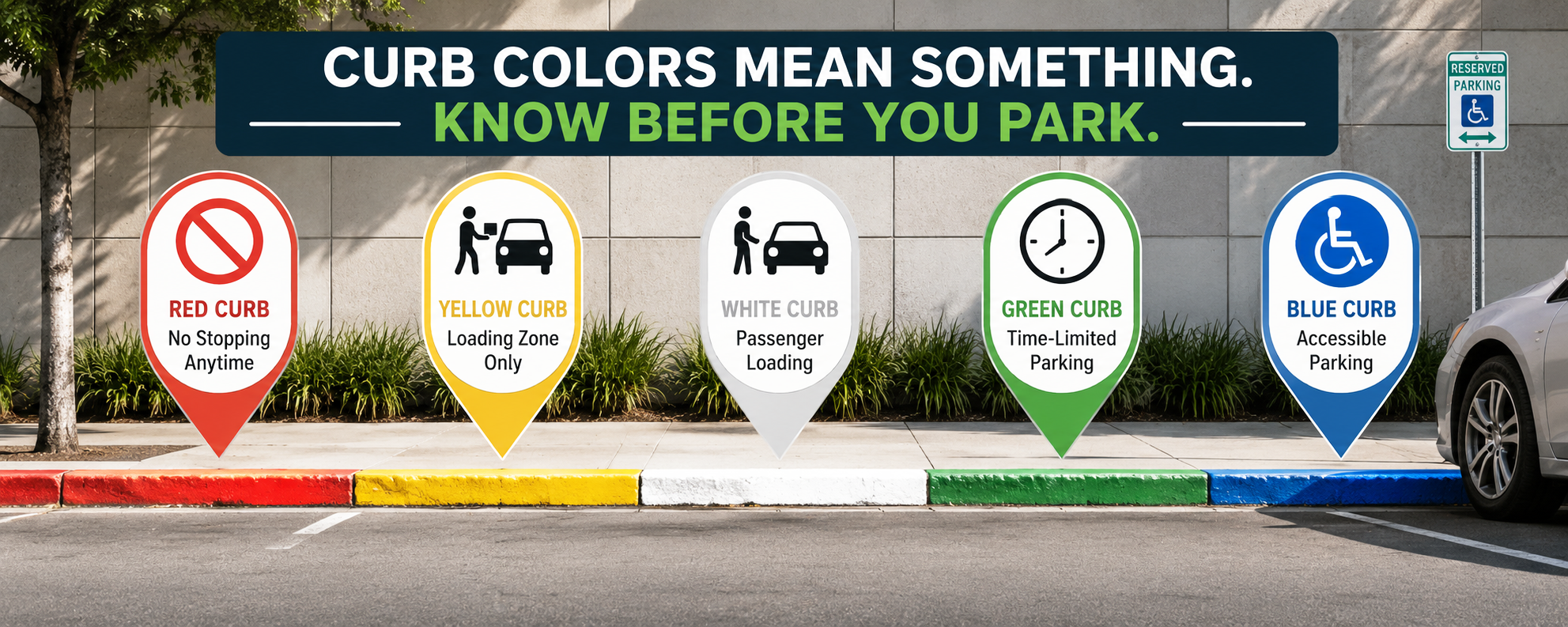
Although the exact rules vary by location, you’ll commonly encounter five colors:
Red → Often means no stopping, standing, or parking.
Yellow → Commonly designates a loading zone with specific restrictions.
White → Often designates passenger loading or unloading.
Green → Commonly indicates short-term or time-limited parking.
Blue → Generally designates parking reserved for people with qualifying disabled parking privileges.
That’s a useful starting point—but the color alone may not tell you everything you need to know.
Posted signs, painted curb markings, hours of enforcement, permits, vehicle type, and local regulations can all affect whether you’re allowed to use the space.
What Does a Red Curb Mean?
A red curb generally indicates one of the strongest curbside restrictions.
In many jurisdictions, a red curb means no stopping, standing, or parking in the designated area, subject to applicable exceptions under local law.
That means simply staying inside your vehicle or turning on your hazard lights doesn’t necessarily make stopping there legal.
If you’re unsure how these restrictions differ, our guide to No Parking vs. No Standing vs. No Stopping explains what each term commonly means.
Red curbs are often used where keeping the curb clear is particularly important, such as near certain intersections, fire-safety areas, transit zones, or other locations where stopping could interfere with safety or traffic.
Can You Park at a Red Curb?
Generally, you should not assume you can park at a red curb.
Always check nearby signs and local regulations because restrictions and exceptions can vary.
What Does a Yellow Curb Mean?
A yellow curb commonly indicates some type of loading zone.
But “loading zone” doesn’t automatically mean anyone can park there while running an errand.
Depending on the jurisdiction, a yellow curb may be reserved for:
Commercial loading and unloading
Certain types of vehicles
Active loading during designated hours
Brief passenger or freight activity
Specific days or times shown on nearby signs
Can You Park at a Yellow Curb?
Sometimes—but only when the applicable rules allow it.
A yellow curb may have restrictions that change according to the time of day, day of the week, vehicle type, or activity taking place.
Always read accompanying signs before using the space.
What Does a White Curb Mean?
A white curb is commonly associated with passenger loading and unloading.
The key idea is usually that the stop is temporary and connected to an immediate permitted activity rather than ordinary parking.
For example, a white curb may allow a vehicle to stop while a passenger gets in or out but prohibit the driver from remaining there simply waiting.
White curb rules can vary substantially between locations, so check the posted signs and local parking regulations before relying on the color alone.
What Does a Green Curb Mean?
A green curb commonly indicates short-term or time-limited parking.
You may see a nearby sign or curb marking specifying something like:
10 MINUTES
20 MINUTES
30 MINUTES
The important detail is the time limit.
Can You Park at a Green Curb?
You may be able to park there for the permitted amount of time and during the applicable enforcement period.
But don’t assume a green curb automatically means unrestricted short-term parking.
Check for:
Posted time limits
Enforcement hours
Days of enforcement
Meter requirements
Additional parking restrictions
Once the permitted time expires, remaining in the space may put you in violation of the applicable parking rule.
What Does a Blue Curb Mean?
A blue curb generally indicates parking reserved for people who have qualifying disabled parking privileges, such as an appropriate placard or license plate.
These spaces are designed to provide accessible parking and should not be used by drivers who don’t meet the applicable requirements.
Can Anyone Park at a Blue Curb?
Generally, no.
A driver typically needs the appropriate authorization required by the jurisdiction to legally use designated accessible parking.
The rules governing placards, plates, time limits, meters, and other parking requirements can vary by location.
Does the Curb Color Override the Parking Sign?
Don’t treat the curb and the sign as competing instructions.
Read them together.
A colored curb may communicate one restriction while a nearby sign provides additional information about:
Hours
Days
Time limits
Loading requirements
Permit restrictions
Street cleaning
Vehicle eligibility
For example, a yellow curb might identify a loading zone while the sign above it explains exactly when the loading restriction is in effect.
Understanding the complete parking rule means checking all applicable information—not just one piece of it.
If several signs are posted together, our guide How to Read Multiple Parking Signs on One Pole explains how to work through overlapping parking restrictions.
Do Curb Color Rules Change by City?
Yes—and this is one of the most important things to remember.
There is no reason to assume every city uses every curb color in precisely the same way.
Local governments can establish specific rules governing curb markings, including what activities are permitted, when restrictions apply, and which vehicles may use particular spaces.
That’s why a curb color you recognize from one city shouldn’t automatically be interpreted the same way somewhere else.
When in doubt, check the posted signs and applicable local parking rules.
Curb Color and Parking Sign Together? Check Both.
A common parking mistake is focusing entirely on either the curb or the sign.
Instead, scan the whole parking area.
Before leaving your vehicle, check:
1. The curb color — Is it painted red, yellow, white, green, blue, or another locally regulated color?
2. Nearby signs — Are there time limits, loading restrictions, permits, arrows, or other rules?
3. The time and day — Is the restriction currently in effect?
4. Additional restrictions — Are there street-cleaning, meter, accessibility, or vehicle-specific requirements?
If the sign contains an arrow, our guide What Do Parking Sign Arrows Mean? can help you determine which section of curb the restriction applies to.
What If the Curb Isn’t Painted?
An unpainted curb does not automatically mean parking is legal.
Parking may still be restricted by:
- Posted parking signs
- Street-cleaning schedules
- Meters
- Permit zones
- Driveways
- Intersections
- Fire hydrants
- Crosswalks
- Local parking regulations
The absence of colored paint is only one part of the parking decision.
That’s why learning How to Read Parking Signs is just as important as understanding curb colors.
The Easy Way to Remember Common Curb Colors
If you’re trying to remember the most common curb color meanings, start with:
Red → Think STOP — usually highly restricted.
Yellow → Think LOADING — check who can load and when.
White → Think PASSENGERS — often for immediate pickup or drop-off.
Green → Think SHORT TIME — look for the permitted time limit.
Blue → Think ACCESSIBLE — generally reserved for authorized accessible parking.
Just remember: these are general associations, not universal parking laws. Always verify the signs and local rules where you’re actually parking.
ParkClear Helps Make Sense of Street Parking
Curb colors are only one piece of the street-parking puzzle.
A single location can combine colored curbs with parking signs, arrows, time restrictions, street-cleaning schedules, meters, permit requirements, and other local rules.
ParkClear is designed to help simplify confusing street parking information so drivers can make more informed parking decisions.
Because ultimately, whether you’re looking at a red curb, a green curb, or several parking signs at once, the question you really want answered is simple:
Can I park here?
Learn more in Can ParkClear Help Me Read Street Parking Signs?
Download ParkClear
Parking and curb regulations vary by jurisdiction. Always follow posted signs, curb markings, and applicable local laws.



18 Comments