
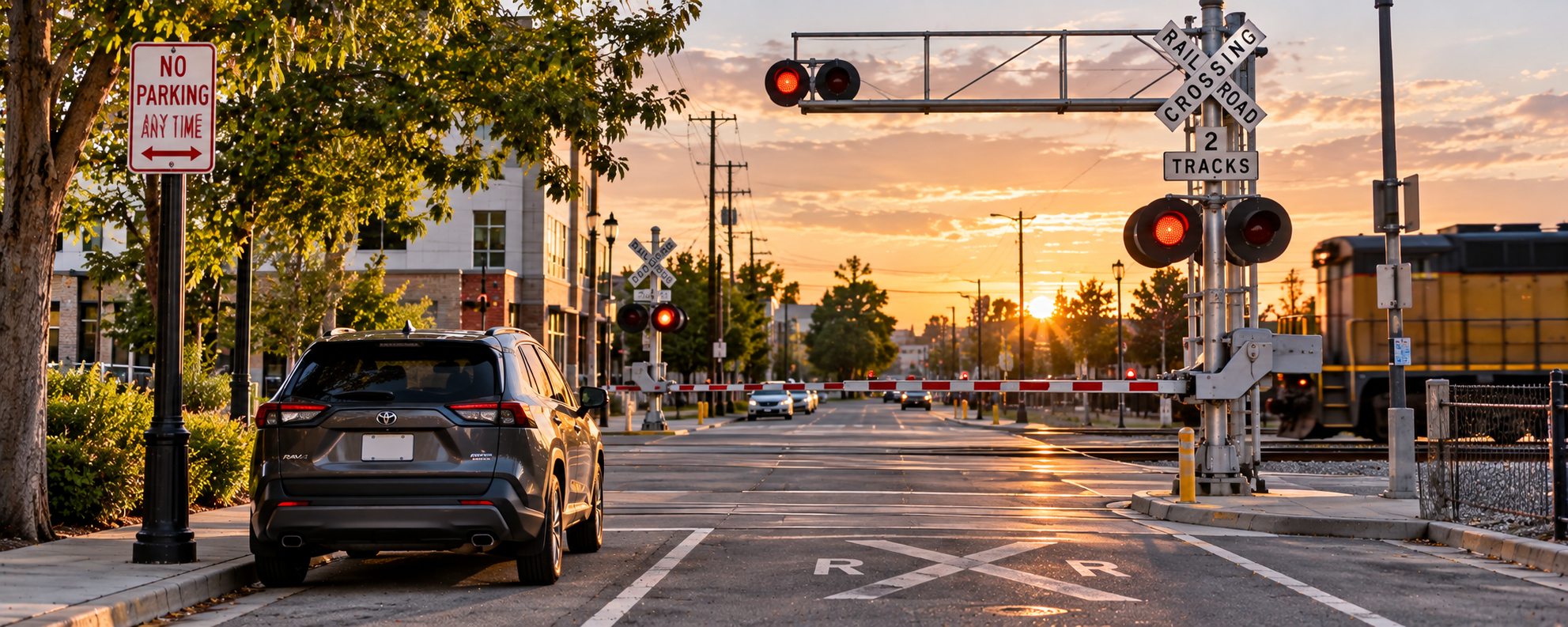
You find an open stretch of curb near railroad tracks. There’s no obvious No Parking sign beside your car, and you’re not actually on the tracks.
Can you park there?
The answer depends on where your vehicle is in relation to the railroad crossing, what signs or markings apply, and the parking laws in that jurisdiction.
Railroad areas can be particularly confusing because drivers may encounter tracks running parallel to a street, a roadway crossing the tracks, crossing gates, warning signals, or nearby curbside parking—all within a relatively small area.
The first step is determining exactly what you’re parking near.
Can You Park Near Railroad Tracks?
Potentially, but the presence of railroad tracks nearby does not by itself tell you whether a particular curb space is legal.
There is an important difference between:
Parking alongside railroad tracks that run near or parallel to a roadway
and
Parking near a railroad crossing where vehicles or pedestrians actually cross the tracks.
A highway-rail crossing can have specific stopping, standing, or parking restrictions designed to keep the crossing visible and unobstructed.
Local parking restrictions may also apply to nearby streets.
Before leaving your vehicle, identify whether you’re simply near railroad property or within an area regulated because of the crossing.
How Close Can You Park to a Railroad Crossing?
Don’t rely on one universal distance.
Parking and stopping requirements around railroad crossings can be established by state and local law, and the applicable distance or restriction can depend on the jurisdiction and roadway.
Instead of estimating how many feet you are from the tracks, look for the actual crossing area and traffic controls.
These may include:
- Railroad crossing signs
- Crossbuck signs
- Warning lights
- Crossing gates
- Pavement markings
- Stop lines
- No Parking or No Stopping signs
- Painted curbs
Then check the applicable local rule governing parking near that crossing.
Is the Distance Measured From the Tracks or the Crossing?
This is an important question because the two aren’t necessarily interchangeable.
A railroad crossing includes the area where the roadway intersects the railroad tracks and may include associated signs, gates, signals, pavement markings, and other traffic-control features.
A driver shouldn’t simply choose one rail and measure an assumed parking distance from it.
If a law establishes a specific clearance requirement, follow the way that jurisdiction defines and measures the restricted area.
This is another reason we avoid giving drivers a single nationwide number.
What If There Is No No Parking Sign?
No sign doesn’t necessarily mean no restriction.
Some parking and stopping rules come directly from traffic law rather than a parking sign installed beside every prohibited location.
We see the same principle around other regulated areas, including intersections, crosswalks, driveways, and fire hydrants.
So if you’re close to a railroad crossing, don’t conclude that the curb is legal simply because there is no No Parking sign immediately beside your vehicle.
Check the applicable crossing and parking rules.
What Do Railroad Crossing Signs Mean for Parking?
Railroad warning signs tell drivers that they are approaching or entering a railroad crossing, but a railroad warning sign isn’t automatically a parking sign.
You still need to determine whether a separate parking or stopping restriction applies.
For example, you may encounter a railroad warning sign together with a No Parking sign or another traffic control.
Read each sign according to its purpose.
If several parking restrictions appear in the same area, our guide to reading multiple parking signs can help you work through overlapping rules.
Does a Railroad Crossing Gate Affect Where You Can Park?
A crossing gate is a strong indication that you’re dealing with an active controlled crossing.
Never position a parked vehicle where it could interfere with the operation of a gate, obstruct the crossing, or impede traffic approaching or leaving it.
But don’t use the physical length of the gate as your only measure of where legal parking begins.
The applicable parking restriction may extend beyond the equipment itself.
Look for signs and markings and follow the relevant state or local clearance requirements.
Can You Park Between the Crossing Gate and the Tracks?
A vehicle should never occupy a location that places it within or obstructs an active railroad crossing.
Drivers also need enough room to remain clear of the tracks when crossing traffic stops.
If you’re uncertain whether a space is part of the crossing or its required clearance area, don’t treat it as ordinary curbside parking.
Move farther away and verify the applicable local rule.
Can You Wait in Your Car Near Railroad Tracks?
Staying behind the wheel doesn’t automatically make a restricted location legal.
Parking, standing, and stopping can have different legal meanings.
A restriction may prohibit parking but allow certain brief activity, while another may prohibit standing or stopping altogether.
The wording matters.
Our guide to No Parking, No Standing, and No Stopping signs explains why remaining inside the vehicle doesn’t necessarily exempt you from a restriction.
Can You Stop Near Railroad Tracks to Pick Someone Up?
Don’t assume passenger pickup or drop-off automatically permits stopping near a railroad crossing.
If the location prohibits stopping or standing, a quick passenger exchange may still violate the applicable restriction.
Look for a designated passenger loading area or another legal curb space away from the crossing.
Our guide to passenger loading zones explains how designated pickup and drop-off areas work.
What About Loading or Deliveries?
The same principle applies to deliveries.
A commercial delivery doesn’t automatically override railroad-crossing restrictions.
If a designated loading zone exists nearby, determine whether your vehicle and activity qualify to use it and whether the restriction is currently in effect.
See our guide to loading zone parking rules for more on time limits, signs, and loading activity.
Can You Park on a Street That Runs Alongside Railroad Tracks?
Possibly.
Some roads run parallel to railroad tracks for blocks or even miles. Parking along those roads is a different situation from parking immediately beside a highway-rail crossing.
The applicable curb may permit ordinary street parking.
But you still need to check:
- Posted parking restrictions
- Railroad or transit property boundaries
- No Stopping areas
- Curb markings
- Time limits
- Permit requirements
- Driveways and access points
- Local parking laws
Don’t assume that land beside the tracks is public parking simply because there appears to be enough room for a vehicle.
What If There Is an Unpaved Area Beside the Tracks?
Be especially cautious.
A gravel shoulder, dirt area, or open space beside railroad tracks isn’t automatically a public parking area.
It may be railroad property, private property, a maintenance access area, or a location where parking is otherwise restricted.
The absence of a curb or parking sign doesn’t establish that drivers may leave vehicles there.
Use clearly designated public parking whenever possible.
What If the Tracks Are No Longer Used?
Don’t assume tracks are abandoned merely because you haven’t seen a train.
Rail lines can have infrequent service, seasonal use, freight movements, maintenance vehicles, or other operations that aren’t obvious to someone parking nearby.
Traffic-control equipment and local restrictions may also remain applicable.
Treat the crossing according to its current signs, markings, and legal status rather than judging it by how active the tracks appear.
Can You Park Near a Railroad Crossing Overnight?
If parking is otherwise legal, you still need to determine whether the space remains legal throughout the night.
Other restrictions may take effect later, including:
- Overnight parking rules
- Street cleaning
- Permit restrictions
- Time limits
- Temporary No Parking controls
Our guide to residential street parking overnight explains why drivers should evaluate what happens after they leave the vehicle.
And if you’re planning to leave the car for several days, see How Long Can You Leave a Car Parked on the Street?.
What If Temporary Signs Appear Near the Tracks?
Railroad maintenance, construction, utility work, street repairs, and other projects can temporarily change parking around a crossing.
A curb that normally allows parking may become unavailable while work is underway.
Temporary signs can therefore be particularly important around transportation infrastructure.
Our guide to temporary No Parking signs explains what drivers should look for when normal curb access changes.
Can You Get Towed for Parking Too Close to Railroad Tracks?
Parking enforcement and towing rules vary by jurisdiction and circumstances.
If a vehicle violates an applicable parking or stopping restriction, obstructs a crossing, interferes with access, or creates another legally defined hazard, enforcement action may be possible.
Don’t assume that the absence of a ticket on another nearby vehicle proves that the location is legal.
As with other parking situations, what other drivers are doing isn’t the rule.
How Should You Evaluate Parking Near Railroad Tracks?
When you find a potential space near railroad infrastructure, work through the location systematically.
First, identify the tracks and the crossing. Determine whether you’re beside railroad tracks or near the point where the roadway actually crosses them.
Next, look for traffic controls. Find crossing gates, warning lights, crossbucks, pavement markings, stop lines, and other indicators of the crossing area.
Then, read the parking signs. Check for No Parking, No Standing, No Stopping, time restrictions, and directional arrows.
If an arrow controls the curb, our guide to parking sign arrows can help you determine which direction the restriction extends.
Finally, check the applicable local rule. If the required clearance isn’t shown on a sign, don’t guess the distance.
That process is much safer than simply asking whether your car physically fits beside the tracks.
Where ParkClear Fits In
Railroad crossings show why parking decisions sometimes require information beyond the nearest sign.
ParkClear helps drivers interpret confusing parking signs and location-based parking rules to provide a clear Yes or No answer to “Can I park here?”
If a posted restriction near the crossing is difficult to understand, ParkClear’s parking sign scanner can help interpret the sign.
Drivers can also check a future date and time when parking restrictions change later.
When parking legality depends on a statutory clearance requirement or another state or local rule that isn’t communicated on the sign, drivers should verify the applicable official regulation.
Look at the Crossing, Not Just the Empty Curb
An empty space near railroad tracks can look like ordinary street parking.
But the physical space available for your car isn’t what determines whether parking is legal.
Identify the railroad crossing. Look for gates, warning equipment, pavement markings, and parking signs. Determine whether you’re on public roadway or railroad/private property. Then check any applicable clearance requirement.
Most importantly, don’t guess how close is close enough.
When the law establishes a specific distance from a railroad crossing, use the rule for the jurisdiction where you’re actually parking.
Download ParkClear
Confused about whether you can park? Download ParkClear to scan parking signs or use your location to get a clear Yes or No answer to “Can I park here?”
Parking regulations vary by jurisdiction. Always follow posted signs and applicable local laws, and check official local rules when necessary.