
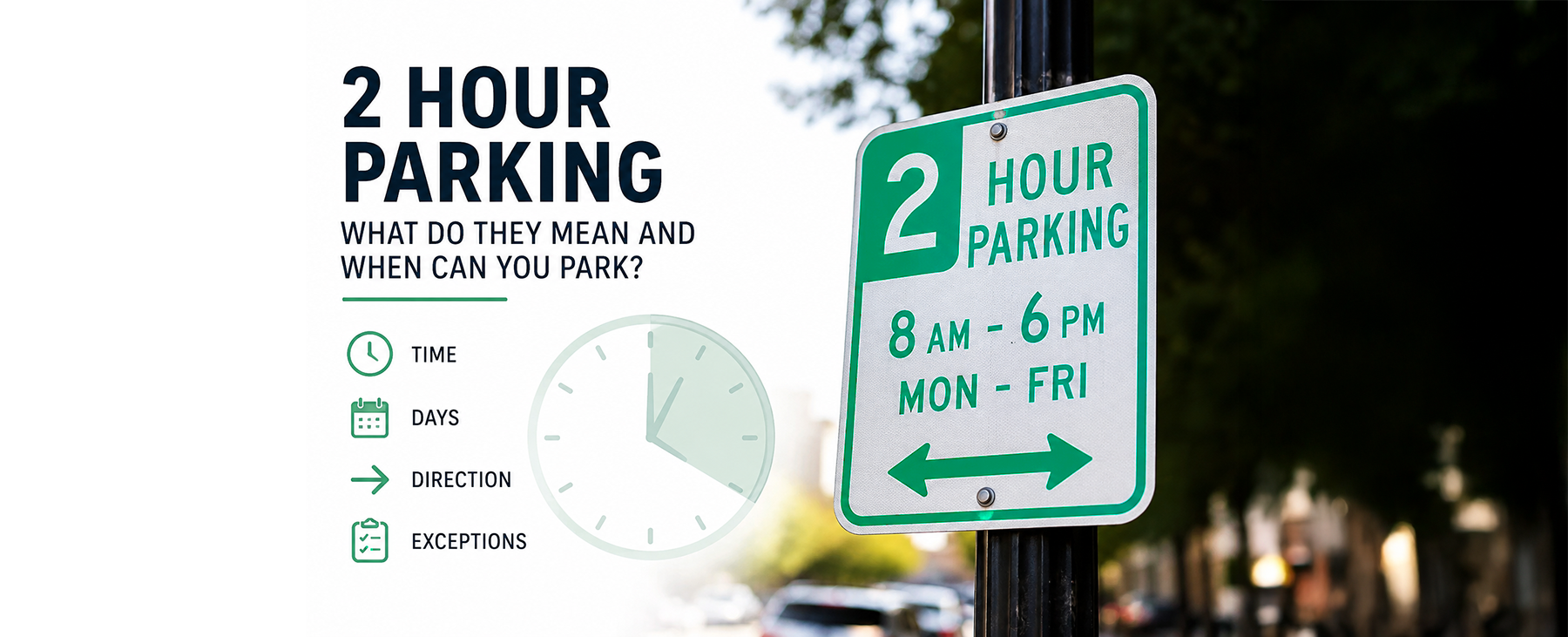
What does a 2-hour parking sign mean? It means you can generally park for a maximum of two hours during the days and hours specified on the sign, provided no other parking restrictions prohibit it.
For example, a sign reading:
2 HOUR PARKING
8 AM–6 PM
MON–FRI
generally means the two-hour limit applies Monday through Friday, between 8 AM and 6 PM.
But here’s where parking gets complicated.
What happens if you arrive at 4:30 PM? Can you stay until 6:30 PM?
Does the two-hour limit apply after 6 PM?
Can you move your car to another space and restart the clock?
What if another sign on the same pole says NO PARKING during certain hours?
And does that small arrow at the bottom change which spaces the restriction applies to?
Suddenly, a simple two-hour parking sign raises several important questions.
The key is to read the entire parking rule—not just the time limit. Check the days, hours, arrows, exceptions, and any additional restrictions before leaving your vehicle.
Let’s break down how two-hour parking signs work and what drivers should check to avoid parking violations.
What Does a 2 Hour Parking Sign Mean?
At its simplest, a 2 HOUR PARKING sign indicates that parking is limited to a maximum period of two hours when that posted restriction applies.
But the words 2 HOUR PARKING usually aren’t the only information you need.
A sign might say:
2 HOUR PARKING
8 AM–6 PM
MON–FRI
Those additional details matter.
Rather than reading only the largest words on the sign, read the entire parking rule:
What is the limit?
Which days does it apply?
During what hours?
Where does it apply?
Are there exceptions or other restrictions?
That’s how you get from simply reading a sign to understanding whether its rule applies to your parking decision.
For a broader step-by-step approach, see our guide on how to read parking signs and interpret the days, times, arrows, restrictions, and exceptions that may apply.
Step 1: Check the Days
Start with the days listed on the sign.
A two-hour restriction might apply:
MON–FRI
MON–SAT
EXCEPT SUNDAYS
or according to another posted schedule.
If the restriction specifies certain days, determine whether today is one of them.
But don’t assume that a two-hour limit being inactive means there are no other parking restrictions.
Another sign or local rule may still affect the space.
What about Sundays? If a two-hour parking sign says “MON–SAT” or “EXCEPT SUNDAYS,” the two-hour limit generally does not apply on Sunday. However, other parking restrictions may still apply.
For more information, read our guide to Can You Park Here on Sunday?.
Step 2: Check the Hours
Next, look for the hours associated with the two-hour limit.
Suppose the sign says:
2 HOUR PARKING
8 AM–6 PM
That tells you the posted two-hour restriction is associated with that time period.
Now suppose you arrive at 10:00 AM.
That’s different from arriving at 7:00 PM.
The sign hasn’t changed.
The time has.
And because parking restrictions can be time-dependent, the parking decision may change with it.
If I Park at 4:30 PM, Can I Stay Until 6:30 PM?
This is exactly the kind of question that makes seemingly simple parking signs complicated.
Suppose the posted two-hour restriction operates from:
8 AM–6 PM
and you arrive at:
4:30 PM
It may be tempting to calculate two hours and assume you’re automatically allowed to remain until 6:30 PM.
But the correct answer can depend on what rules apply after 6 PM in that particular location.
The end of the posted two-hour period doesn’t necessarily tell you everything about what happens next.
There may be another restriction, permit requirement, overnight rule, temporary notice, or applicable local regulation.
So don’t rely on the two-hour calculation alone.
Check what rules govern the space after the posted time period ends.
If your parking period extends into the evening or overnight, our guide to Overnight Parking Rules explains what to check before leaving your vehicle for a longer period.
Step 3: Look for Parking Sign Arrows
A two-hour parking sign may include a directional arrow.
For example:
← 2 HOUR PARKING
or:
2 HOUR PARKING →
The arrow can help indicate which portion of the curb is affected by that restriction.
This means the location of your vehicle relative to the sign matters.
A two-hour restriction on one side of a sign may not necessarily tell you what’s permitted on the other side.
Always evaluate the sign + arrow + location of your vehicle together.
Not sure how the direction affects your space? Our guide to what parking sign arrows mean explains left, right, and two-way arrows in more detail.
Step 4: Read the Other Signs on the Pole
This is one of the most important steps.
Imagine seeing:
2 HOUR PARKING
8 AM–6 PM
along with:
NO PARKING
7 AM–9 AM
MON–FRI
and:
NO PARKING — STREET CLEANING
TUESDAY
10 AM–12 PM
Which one applies?
Potentially, each rule can matter depending on the day and time.
For example, seeing 2 HOUR PARKING doesn’t necessarily mean you can park there for two hours at every moment of the day.
A separate restriction may apply during part of the same period.
Instead of choosing the sign that seems most favorable, evaluate all the applicable rules together.
When several restrictions appear together, see how to read multiple parking signs on one pole and determine which rules apply to your space at a particular day and time.
Does 2 Hour Parking Mean Exactly Two Hours?
A posted two-hour parking limit generally means you shouldn’t exceed the applicable maximum parking period established by the sign and local regulations.
But there’s an important distinction:
The sign tells you the parking restriction. Local rules determine how that restriction is administered and enforced.
For example, questions about how parking duration is measured or how a vehicle’s presence is documented can depend on the jurisdiction and enforcement system.
That’s why we shouldn’t assume every city handles two-hour parking exactly the same way.
Can I Move My Car and Get Another Two Hours?
This is one of the most common—and potentially risky—assumptions about time-limited parking.
You park for nearly two hours.
Then you move the car twenty feet.
New space.
New two hours?
Not necessarily.
Some jurisdictions may have rules preventing drivers from simply moving within the same block, street segment, meter zone, or regulated area to reset a time limit. The exact rules vary by location.
So don’t assume that moving your vehicle a short distance automatically restarts the clock.
If you need to remain longer than the posted limit, check the applicable local parking regulations rather than relying on a “move and reset” strategy.
Can I Leave and Come Back?
The same caution applies here.
Leaving a time-limited space and returning later doesn’t necessarily guarantee that a new parking period begins immediately.
Some jurisdictions may impose rules about re-parking within the same block, zone, or regulated area.
Because these rules can vary considerably, the safest approach is to check the regulations for the location where you’re parking.
What Happens After the 2 Hour Parking Limit Ends?
There are actually two different questions here.
The first is:
What happens if I stay longer than two hours while the limit is in effect?
You may be violating the posted parking restriction and could be subject to local enforcement.
The second is:
What happens when the posted enforcement hours themselves end?
That’s a different situation.
If the sign says:
2 HOUR PARKING
8 AM–6 PM
you need to determine what parking rules apply after 6 PM.
Another restriction may take effect—or the time-limited restriction may no longer apply according to the posted signs and local rules.
Again, don’t assume.
Read the complete parking environment.
What If I Have a Parking Permit?
Some signs include exceptions for vehicles with qualifying permits.
You might see language indicating that certain permit holders are exempt from a particular time limit.
But permit programs and exemptions vary by jurisdiction.
A permit also shouldn’t automatically be interpreted as permission to disregard every other restriction affecting the space.
Street cleaning, temporary restrictions, loading zones, tow-away periods, and other rules may still apply.
Always read the specific permit language and the other signs around it.
Don’t Forget About Street Cleaning
Here’s another scenario:
2 HOUR PARKING
8 AM–6 PM
and below it:
NO PARKING — STREET CLEANING
WEDNESDAY
10 AM–12 PM
It’s Wednesday at 10:30 AM.
The fact that the general sign allows two-hour parking doesn’t necessarily mean the street-cleaning restriction can be ignored.
This is why multiple parking signs need to be interpreted together rather than independently.
One rule may establish what’s normally allowed.
Another may create a more specific restriction during a particular period.
If street sweeping is one of those restrictions, our guide to street cleaning parking signs explains how to evaluate the posted day, time, arrows, and other applicable parking rules.
A Simple Formula for Reading 2 Hour Parking Signs
When you encounter a time-limited parking sign, use this sequence:
LOCATION → LIMIT → DAY → TIME → ARROW → EXCEPTIONS → OTHER RESTRICTIONS
LOCATION
Does this sign apply to my parking space?
LIMIT
What is the maximum posted parking duration?
DAY
Does the restriction apply today?
TIME
Is the restriction currently in effect?
ARROW
Which section of curb does the sign cover?
EXCEPTIONS
Are permits or other exceptions listed?
OTHER RESTRICTIONS
Are additional signs or rules affecting the same space?
Then ask the question that matters:
Can I park here right now—and for how long?
Why a Simple “2 Hour Parking” Sign Can Become Complicated
The two-hour limit itself isn’t difficult to understand.
The challenge is determining when and where that limit applies—and whether another rule changes the answer.
A single pole might display several parking signs with different restrictions, including:
- Two-hour parking from 8 AM–6 PM
- No parking during morning rush hour
- Street cleaning on Wednesday
- Permit exceptions
- Directional arrows showing where each restriction applies
and:
directional arrows defining where each rule applies
Suddenly, “2 HOUR PARKING” isn’t the entire parking rule.
It’s one part of it.
Can ParkClear Help With Time-Limited Parking Signs?
This is the type of parking decision ParkClear was designed to make easier.
ParkClear uses location-based technology and parking sign analysis to help drivers understand applicable parking information and provide clearer “Yes” or “No” parking guidance.
When time limits, days, arrows, street-cleaning restrictions, and other rules overlap, ParkClear helps simplify the information drivers need to consider.
Learn more about how ParkClear helps read street parking signs and simplify complicated parking information into clearer guidance.
Because most drivers aren’t standing on the sidewalk thinking:
“I would really like to analyze municipal parking restrictions.”
They’re thinking:
Can I park here?
And often:
How long can I stay?
Before You Leave Your Car
When you see a 2 HOUR PARKING sign, don’t stop reading after those three words.
Check:
Where does the rule apply?
What days does it apply?
What hours does it apply?
Which way do the arrows point?
Are there permit exceptions?
Are there other restrictions?
What happens when the posted period ends?
A few extra seconds spent understanding the complete sign can make the difference between confidently walking away from your car and wondering whether you interpreted the parking rules correctly.
Park with confidence. Save time. Skip the parking-sign headache.
Scan confusing parking signs, understand applicable restrictions, and get a clearer Yes or No answer to “Can I park here?”
Parking regulations vary by jurisdiction. Always follow posted signs and applicable local laws, and check official local rules when necessary.



3 Comments