
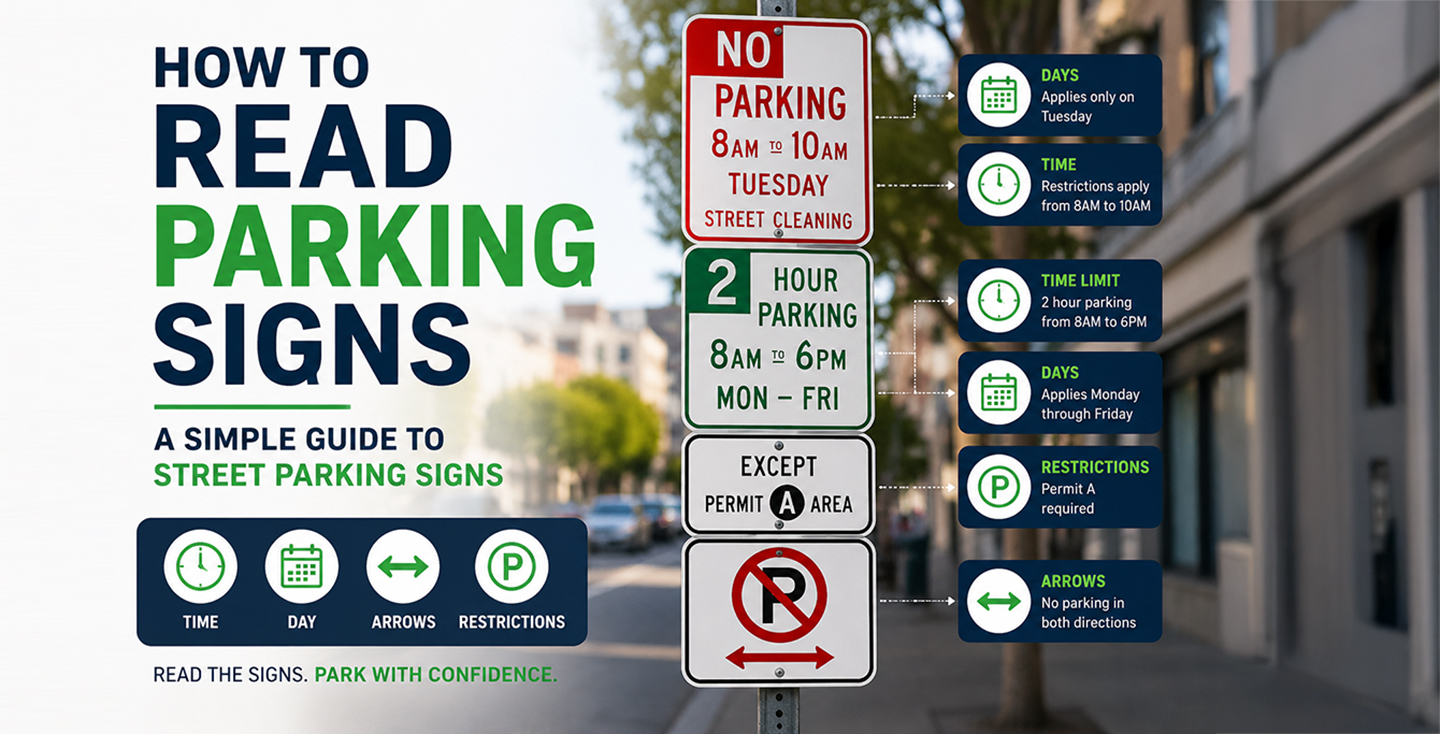
Parking signs aren’t meant to be read like a paragraph. They’re meant to be decoded.
Start with a typical sign:
NO PARKING
7 AM–9 AM
MON–FRI
→
Four short lines.
But each one answers a different question.
NO PARKING tells you WHAT the restriction is.
7 AM–9 AM tells you WHEN it applies.
MON–FRI tells you WHICH DAYS it applies.
And the → helps tell you WHERE the restriction applies.
Miss just one of those details and you can completely change the meaning of the sign.
Now imagine adding a second sign for 2 HOUR PARKING, a third for STREET CLEANING, and an exception for permit holders.
That’s when reading street parking signs starts feeling less like reading—and more like solving a logic problem.
But there’s a simpler way to approach it.
Don’t read everything at once. Read the sign in layers.
Start with where you are, identify what the rule says, then work through the day, time, direction, and any additional restrictions.
Once you know what information to look for—and in what order—even confusing parking signs become much easier to understand.
Here’s how to read parking signs step by step.
1. Start With Your Exact Location
Before interpreting the words on a sign, determine whether the sign actually applies to where you’re parked.
Street parking restrictions can change from one part of a block to another. A rule might begin or end at a sign, intersection, driveway, curb marking, or other boundary.
Two vehicles parked relatively close together may even be subject to different restrictions.
So start with a simple question:
Does this sign apply to my parking space?
Look at the position of your vehicle in relation to nearby signs, arrows, curb markings, intersections, and other posted restrictions.
2. Read the Most Restrictive Language Carefully
Words such as NO PARKING, NO STOPPING, NO STANDING, LOADING ONLY, or PERMIT REQUIRED deserve immediate attention.
These terms can sound similar but may represent very different restrictions. If you’re unsure, see our guide to No Parking vs. No Standing vs. No Stopping for a simple breakdown of the differences.
Don’t stop reading after those words, though.
The rest of the sign usually tells you when, where, or under what circumstances the restriction applies.
For example, a parking restriction may apply only during certain hours or on certain days. Outside that period, a different parking rule may apply.
The entire sign matters—not just its biggest words.
3. Check the Days
Next, look for days of the week.
A restriction may apply:
MON–FRI
SATURDAY
EXCEPT SUNDAYS
or only on a particular day for something like street cleaning.
This is where drivers can easily make mistakes. A sign may look restrictive at first glance, but the rule might not apply on the day you’re actually parking.
Always connect the restriction to the day it applies.
4. Check the Times
Now look at the hours.
A street might prohibit parking during morning rush hour but allow it later in the day. Another space could become a loading zone during certain hours and regular parking afterward.
For example:
NO PARKING
7 AM–9 AM
MON–FRI
The words NO PARKING alone don’t tell you enough.
You need to read the complete rule:
What restriction? On which days? During what hours?
That combination is what helps determine whether the rule applies right now.
If you’re planning to leave your vehicle until the next day, our guide to Overnight Parking Rules explains the additional restrictions you should check before parking overnight.
5. Pay Close Attention to Arrows
Arrows are small, but they can completely change the meaning of a parking sign.
They are commonly used to indicate the direction or area where a restriction applies. Depending on the sign system and jurisdiction, the rule may apply to one side of the sign, both directions, or a particular stretch of curb.
This is why simply finding the nearest parking sign isn’t enough.
You need to determine whether its restriction extends to your particular parking space.
When several signs have different arrows, slow down and evaluate each one separately.
6. Read Multiple Signs Together
This is where street parking gets especially confusing.
A single pole may contain several signs because several parking rules apply to the same section of street at different times.
Imagine seeing:
2 HOUR PARKING
8 AM–6 PM
along with:
NO PARKING
TUESDAY
10 AM–12 PM
STREET CLEANING
The first sign may establish the general parking rule, while the second creates a more specific restriction during a particular period.
Instead of asking:
“Which sign is the right one?”
ask:
“Which of these rules apply to my car right now?”
Ultimately, all of these rules lead to the question drivers really want answered: Can I park here?
7. Look Beyond the Signpost
Not every parking restriction appears on the same pole.
Before leaving your vehicle, scan the surrounding area.
Depending on local regulations, things such as curb markings, fire hydrants, driveways, crosswalks, bus zones, loading areas, accessible spaces, construction notices, temporary signs, and permit zones may affect whether parking is allowed.
Painted curbs can provide another important clue. See our guide to Curb Colors Meaning for an explanation of how red, yellow, white, green, and blue curbs are commonly used.
A parking sign is an important source of information, but it isn’t necessarily the only one.
8. Watch for Temporary Parking Signs
A familiar parking space can suddenly have different rules.
Temporary restrictions may be posted for construction, road work, special events, moving activities, filming, emergencies, utility work, or other temporary uses.
These notices can change what is normally allowed.
That’s why it’s worth checking the area every time you park—even if you’ve parked on that street many times before.
Why Are Parking Signs So Confusing?
Most parking signs make sense when viewed individually.
The difficulty comes from having to combine several pieces of information at once:
- Where does the restriction apply?
- What activity is prohibited or permitted?
- Which day does the rule apply?
- What time does it begin and end?
- Which direction does an arrow indicate?
- Are there additional signs or restrictions?
And you often have to answer all of those questions while sitting in a car, watching traffic, and trying not to hold up the person behind you.
That’s why understanding the parking sign meaning isn’t always as simple as reading a single sentence.
Have more questions about parking signs and how ParkClear works? Visit our ParkClear FAQs for additional guidance.
A Simple Formula for Reading Street Parking Signs
When you encounter confusing parking signs, work through them in this order:
WHERE → WHAT → DAY → TIME → ARROW → OTHER RESTRICTIONS
WHERE: Does the sign apply to your exact parking space?
WHAT: What does it allow or prohibit?
DAY: Does the restriction apply today?
TIME: Does it apply right now?
ARROW: Which portion of the street does it cover?
OTHER RESTRICTIONS: Are there additional signs, curb markings, temporary notices, or local rules that also apply?
This won’t eliminate every complicated parking situation, but it gives you a much more organized way to interpret what you’re seeing.
Can Technology Make Parking Signs Easier to Understand?
This is exactly the problem ParkClear was designed to simplify.
Drivers shouldn’t have to become parking-sign experts every time they find an open space.
ParkClear uses location-based technology and parking sign analysis to help drivers understand applicable parking information and provide straightforward “Yes” or “No” parking guidance.
Instead of manually sorting through every restriction yourself, ParkClear is designed to help turn complicated parking information into a clearer parking decision.
Want to see how that works? Learn more about how ParkClear helps read street parking signs and simplifies multiple rules, time limits, and restrictions into clearer parking guidance.
From Confusing Signs to a Clearer Answer
Parking signs contain important information. The challenge is figuring out which information applies here, today, and right now.
So the next time you pull into a space and find yourself staring at a pole covered in regulations, remember:
Where. What. Day. Time. Arrow. Other restrictions.
Read the signs systematically, check your surroundings, and don’t assume one sign tells the entire story.
And when all you really want to know is—
Can I park here?
That’s the question ParkClear was built to help answer. Get clear parking guidance when confusing street parking signs leave you wondering what applies to your space.
Download ParkClear
Parking regulations vary by jurisdiction. Always follow posted signs and applicable local laws, and check official local rules when necessary.



16 Comments