
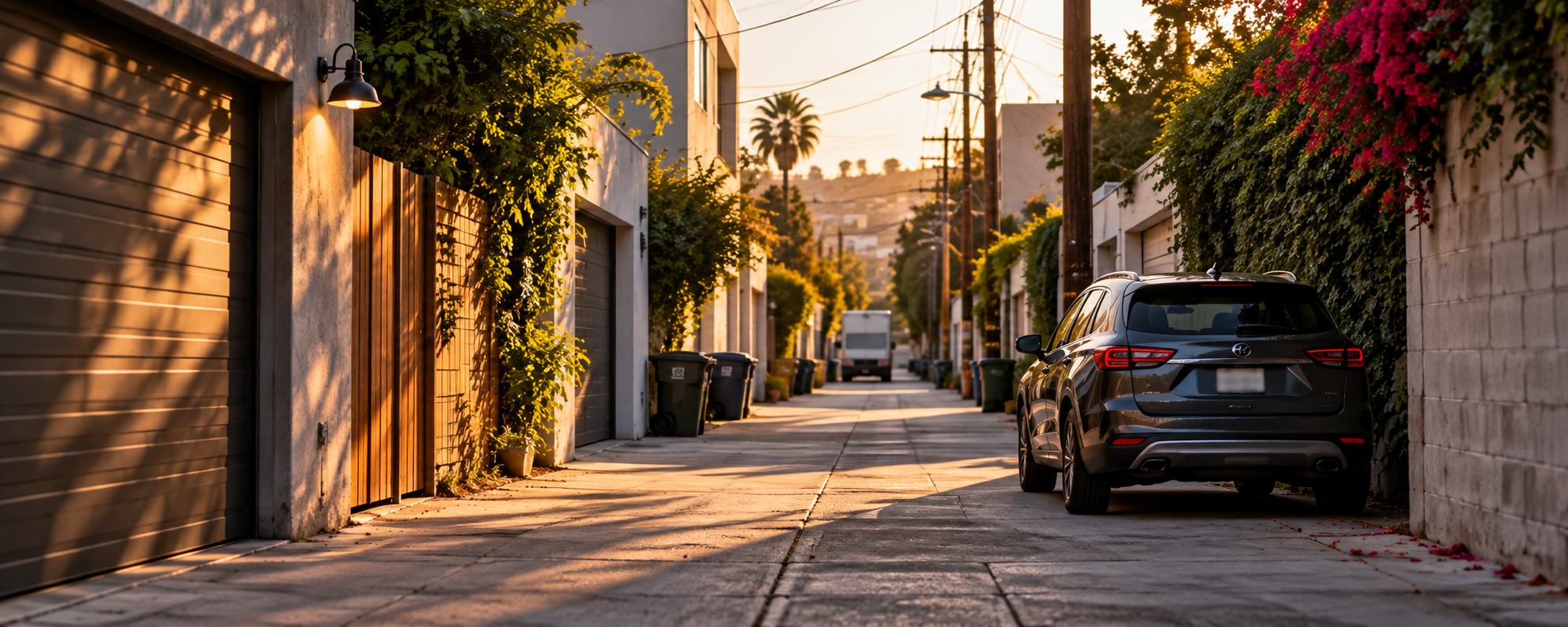
An alley can look like an easy place to park, especially when there are no meters, painted curbs, or obvious parking signs. But alleys often need to remain clear for vehicles, garages, deliveries, emergency access, and other uses.
If you’re wondering, “Can I park in an alley?” the answer depends on the alley parking rules, posted restrictions, access requirements, and local parking laws.
Even when you don’t see a No Parking sign, you should not automatically assume that parking in an alley is allowed.
Can You Park in an Alley?
Sometimes, but alley parking rules vary by jurisdiction.
Some locations restrict or prohibit parking in alleys, while others may allow certain types of stopping, loading, or parking as long as access remains clear and other requirements are met.
Before leaving your vehicle, check for:
- No Parking or No Stopping signs
- Driveways and garage entrances
- Loading areas
- Fire or emergency access
- Required roadway clearance
- Temporary restrictions
- Other local alley rules
The fact that another vehicle is parked in the alley does not necessarily mean your vehicle can legally park there too.
Can You Park in an Alley If There Is No Sign?
Do not assume that the absence of a sign means unrestricted parking.
Some parking restrictions come directly from local laws and may apply even when there is no sign beside the space.
This is particularly important in alleys because the roadway may need to remain accessible to residents, businesses, delivery vehicles, sanitation services, or emergency vehicles.
If you’re uncertain, check the official parking rules for the jurisdiction before leaving your vehicle.
Can You Block Part of an Alley?
You should not assume that leaving enough room for a small vehicle to pass makes parking legal.
Local rules may require a particular amount of clearance or prohibit parking that interferes with normal alley access.
The required amount of open roadway can vary by jurisdiction, so there is no single clearance distance that applies everywhere.
If your vehicle makes it difficult for other vehicles to enter, exit, turn, access property, or travel through the alley, find another parking location.
Can You Park in Front of a Garage in an Alley?
Parking in front of a garage or driveway can interfere with access even when the vehicle does not appear to completely block the entrance.
Consider whether another vehicle can reasonably enter or exit the property.
Local rules may prohibit blocking or obstructing driveways and garage access.
Our guide to parking in front of a driveway explains why an apparently open curb or roadway does not necessarily make a space legal.
Can You Stop in an Alley to Load or Unload?
Possibly.
Some jurisdictions distinguish between parking and temporarily stopping for active loading or unloading.
However, the ability to load or unload does not automatically give you permission to leave the vehicle there or remain longer than necessary.
Our guide to loading zone parking rules explains why loading activity and ordinary parking can be treated differently.
Always check the rules that apply to the specific alley.
Can You Wait in Your Car in an Alley?
Remaining inside your vehicle does not automatically make the stop legal.
Parking, standing, and stopping can have different meanings under local laws. An alley restriction may limit one or more of these activities.
For example, actively loading goods may be treated differently from sitting in the vehicle and waiting for someone.
Our guide to No Parking vs. No Standing vs. No Stopping explains why these distinctions matter.
Can You Park in an Alley Overnight?
Possibly, but you should check both the alley rules and any overnight parking restrictions that apply in that jurisdiction.
An alley that appears available during the evening could still have restrictions involving overnight parking, permits, access, sanitation, or other activities.
If you plan to leave your vehicle for several hours, make sure the space will remain legal for the entire period.
Our guide to residential street parking overnight explains why a space that is legal when you arrive may become restricted later.
What About Alleys Behind Businesses?
Commercial alleys can have additional activity involving deliveries, loading docks, dumpsters, service entrances, and other business operations.
An apparently unused space may need to remain clear for vehicles or equipment.
Do not assume that an alley behind a closed business becomes public parking after business hours.
Look for signs, markings, gates, loading areas, property-access restrictions, and any other indication that the space serves a specific purpose.
What About Alleys Behind Homes or Apartments?
Residential alleys often provide access to garages, parking areas, trash collection, utility infrastructure, and private property.
Parking a vehicle in the wrong location could interfere with a neighbor’s ability to access a garage or driveway even when the alley itself appears wide enough.
Check both local alley parking rules and any restrictions associated with the surrounding property.
Can You Park Next to a Dumpster in an Alley?
Do not assume that unused space beside a dumpster or trash area is available for parking.
Sanitation vehicles may need significant room to access containers, and local rules may prohibit vehicles from obstructing trash collection or service areas.
A vehicle that appears safely out of the way to a driver may still prevent equipment from reaching the container.
What About Temporary No Parking Signs in an Alley?
Temporary restrictions can apply in alleys just as they can on ordinary streets.
Construction, moving activity, utility work, filming, maintenance, or other temporary uses may require an alley to remain clear.
Always look for temporary notices before leaving your vehicle.
Our guide to temporary No Parking signs explains why temporary restrictions can override parking that would otherwise appear available.
Can You Get a Parking Ticket for Parking in an Alley?
Yes.
If your vehicle violates an applicable alley restriction, blocks required access, obstructs a driveway or garage, or violates another local parking rule, it may be subject to enforcement.
Depending on the jurisdiction and circumstances, that could include a citation or potentially towing.
The absence of a nearby parking sign does not necessarily prevent enforcement when a local rule independently prohibits the parking activity.
What If There Are Parking Signs in the Alley?
Read the entire sign and determine exactly where the restriction applies.
Pay attention to days, hours, arrows, vehicle restrictions, loading instructions, and No Parking or No Stopping language.
An arrow may indicate that a restriction extends farther through the alley than you initially expect.
Our guide to parking sign arrows explains how directional signs can define the area controlled by a parking restriction.
If several restrictions appear together, see our guide to multiple parking signs.
What Should You Check Before Parking in an Alley?
First, determine whether local alley parking rules allow your vehicle to occupy the space.
Then look at the physical environment around you.
Make sure you are not interfering with a driveway, garage, loading area, emergency route, trash collection area, service entrance, or the ability of vehicles to travel through the alley.
Finally, check for posted and temporary restrictions.
If parking signs are present but difficult to interpret, ParkClear’s parking sign scanner is designed to help drivers understand confusing parking restrictions.
How ParkClear Helps With Alley Parking Rules
Alley parking can be difficult because not every restriction is communicated by a single obvious sign.
When parking signs are present, ParkClear helps drivers interpret confusing restrictions and location-based parking rules so they can get a clear Yes or No answer to the question: “Can I park here?”
For alley restrictions established by local law rather than posted signage, drivers should also check the applicable official local parking rules.
The Bottom Line: Can You Park in an Alley?
Do not assume you can park in an alley simply because there is open space or no nearby No Parking sign.
Check the alley parking rules for the jurisdiction, posted restrictions, driveway and garage access, required clearance, loading activity, temporary notices, and any other rules that apply to the location.
When in doubt, choose another legal parking space rather than risk blocking access or violating an alley restriction.
Download ParkClear
Confused about whether you can park? Download ParkClear to scan parking signs or use your location to get a clear Yes or No answer to “Can I park here?”
Parking regulations vary by jurisdiction. Always follow posted signs and applicable local laws, and check official local rules when necessary.