
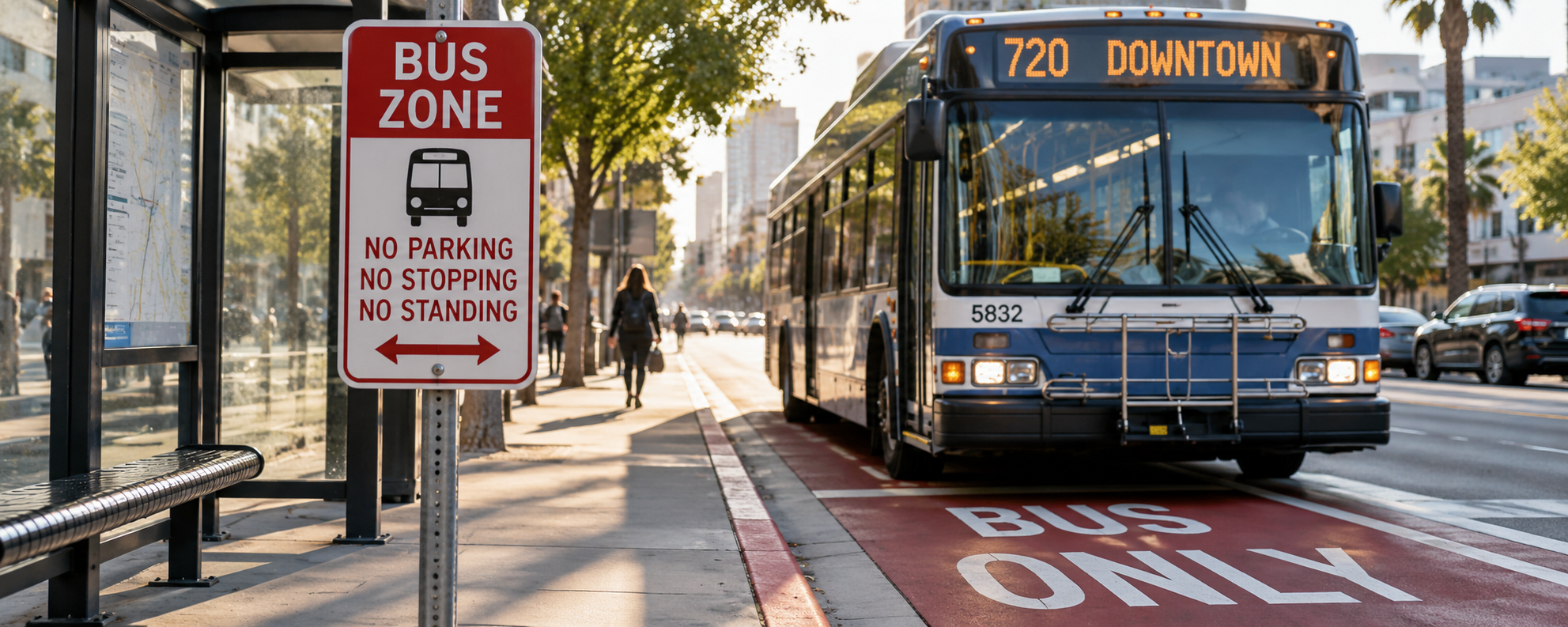
Bus zones are reserved areas intended to give buses space to safely pick up and drop off passengers. Because these areas often look like ordinary curb space, drivers may wonder whether parking is allowed when no bus is present.
If you’re asking, “Can I park in a bus zone?” the answer depends on the bus zone parking rules, posted signs, hours of restriction, curb markings, and local parking laws.
A bus zone that appears empty is not necessarily available for parking.
What Is a Bus Zone?
A bus zone is a designated curb area associated with bus operations and passenger boarding or unloading.
Depending on the location, the zone may include a marked bus stop, additional space needed for buses to approach the curb, or an area extending before or after the actual passenger boarding point.
Signs, curb markings, pavement markings, and other indicators may identify the restricted area.
Because the size and rules of bus zones vary by jurisdiction, always determine exactly where the restriction begins and ends before parking.
Can You Park in a Bus Zone?
Generally, you should not treat an active bus zone as an ordinary parking space.
Even when no bus is currently present, parking may interfere with buses approaching the curb, passenger boarding, accessibility, traffic flow, or transit operations.
However, some bus-zone restrictions may apply only during specified days or hours. Whether the space can legally be used at another time depends on the posted signs and local rules.
If you’re unsure whether a restriction is currently active, our guide to parking in a No Parking zone after hours explains what to check when posted restrictions have specific enforcement periods.
Is a Bus Zone the Same as a Bus Stop?
The terms are related, but they do not always describe exactly the same area.
A bus stop generally identifies the location where a bus picks up or drops off passengers.
A bus zone may refer to the larger curb area reserved for transit operations around that stop.
This distinction matters because the restricted curb area may extend beyond the exact location of the bus-stop sign.
Do not assume you can park immediately before or after a bus-stop sign simply because your vehicle is not directly beside it.
How Close Can You Park to a Bus Stop?
There is no single distance that applies everywhere.
Local laws may establish minimum distances from bus stops or define restricted areas using signs, painted curbs, pavement markings, or other indicators.
Instead of relying on a universal number, look carefully at the parking environment where you are actually stopping.
Pay particular attention to arrows on signs because they can indicate the direction or extent of a restriction. Our guide to parking sign arrows explains how directional parking signs can affect nearby spaces.
Can You Park in a Bus Zone After Hours?
Possibly, depending on the location.
Some bus-zone restrictions operate only during particular days or hours. If the posted restriction clearly ends, another type of parking may become permissible.
But the end of one restriction does not automatically mean unrestricted parking begins.
Another rule could take effect, including:
- No Parking
- Permit parking
- Metered parking
- Street cleaning
- Overnight restrictions
- Tow-away restrictions
Read all applicable signs before leaving your vehicle.
If several rules appear together, see our guide to multiple parking signs for help understanding overlapping restrictions.
Can You Stop in a Bus Zone to Pick Someone Up?
Do not assume that briefly picking up or dropping off a passenger is permitted simply because you do not intend to park.
Parking, standing, and stopping can have different legal meanings, and a particular bus zone may prohibit more than just leaving a vehicle parked.
Our guide to No Parking vs. No Standing vs. No Stopping explains why the type of restriction matters when you’re waiting for or picking up someone.
When passenger pickup is allowed nearby, a designated passenger loading area may be the appropriate location. See our guide to passenger loading zones for more information.
Can You Wait in Your Car in a Bus Zone?
Remaining inside your vehicle does not automatically make the stop legal.
A driver may think, “I’m not parked because I’m still in the car,” but local parking and stopping rules may treat the situation differently.
If the bus zone prohibits stopping or standing during the current period, simply staying behind the wheel may not make it permissible.
Always rely on the posted restriction and applicable local rules rather than whether you remain inside the vehicle.
What Do Bus Zone Signs Mean?
Bus-zone signs may contain several pieces of information, including restricted hours, days of operation, arrows, vehicle restrictions, tow-away warnings, or other instructions.
Read the entire sign.
For example, a sign may establish a bus restriction during certain hours while another nearby sign controls parking during the rest of the day.
If a sign is difficult to understand, ParkClear’s parking sign scanner is designed to help drivers interpret confusing parking restrictions.
Do Curb Colors Identify Bus Zones?
Some jurisdictions use painted curbs as part of their parking and stopping systems, but curb-color meanings are not universal.
A particular curb color can mean one thing in one city and something different elsewhere.
Never identify a bus zone based solely on curb color. Interpret the curb together with nearby signs and applicable local rules.
Our guide to curb colors and their meanings explains why the surrounding signs are important.
Can You Get a Parking Ticket for Parking in a Bus Zone?
Yes.
Parking, standing, or stopping in a bus zone in violation of the applicable restriction can result in enforcement. Depending on the jurisdiction and circumstances, consequences may include a citation or potentially towing.
The fact that no bus was present when you parked does not necessarily make the space legal.
The relevant question is whether the restriction was active and whether your vehicle was permitted to occupy that area.
What If the Bus Zone Sign Is Confusing?
Start by identifying every restriction that appears to apply to the curb space.
Look for:
- Days and hours
- Directional arrows
- Bus-zone or bus-stop wording
- No Parking, No Standing, or No Stopping language
- Tow-away notices
- Curb markings
- Additional signs on the same pole or nearby
Then determine which rules apply to the current day and time.
This is particularly important when a curb serves different purposes throughout the day.
How ParkClear Helps With Bus Zone Parking Rules
Street parking decisions often require drivers to interpret several signs, times, arrows, and restrictions at once.
ParkClear helps drivers understand confusing parking signs and location-based parking rules so they can get a clear Yes or No answer to the question: “Can I park here?”
ParkClear can also help with situations involving loading zones, parking meters, street cleaning, permit restrictions, curb colors, and multiple parking signs.
The Bottom Line: Can You Park in a Bus Zone?
You should not assume that you can park in a bus zone simply because the curb is empty or no bus is present.
Check the bus zone parking rules, posted days and hours, signs, arrows, curb markings, and any additional restrictions before stopping or leaving your vehicle.
If a bus-zone restriction is not currently active, determine whether another parking rule takes effect before assuming the space is available.
Download ParkClear
Confused about whether you can park? Download ParkClear to scan parking signs or use your location to get a clear Yes or No answer to “Can I park here?”
Parking regulations vary by jurisdiction. Always follow posted signs and applicable local laws, and check official local rules when necessary.