
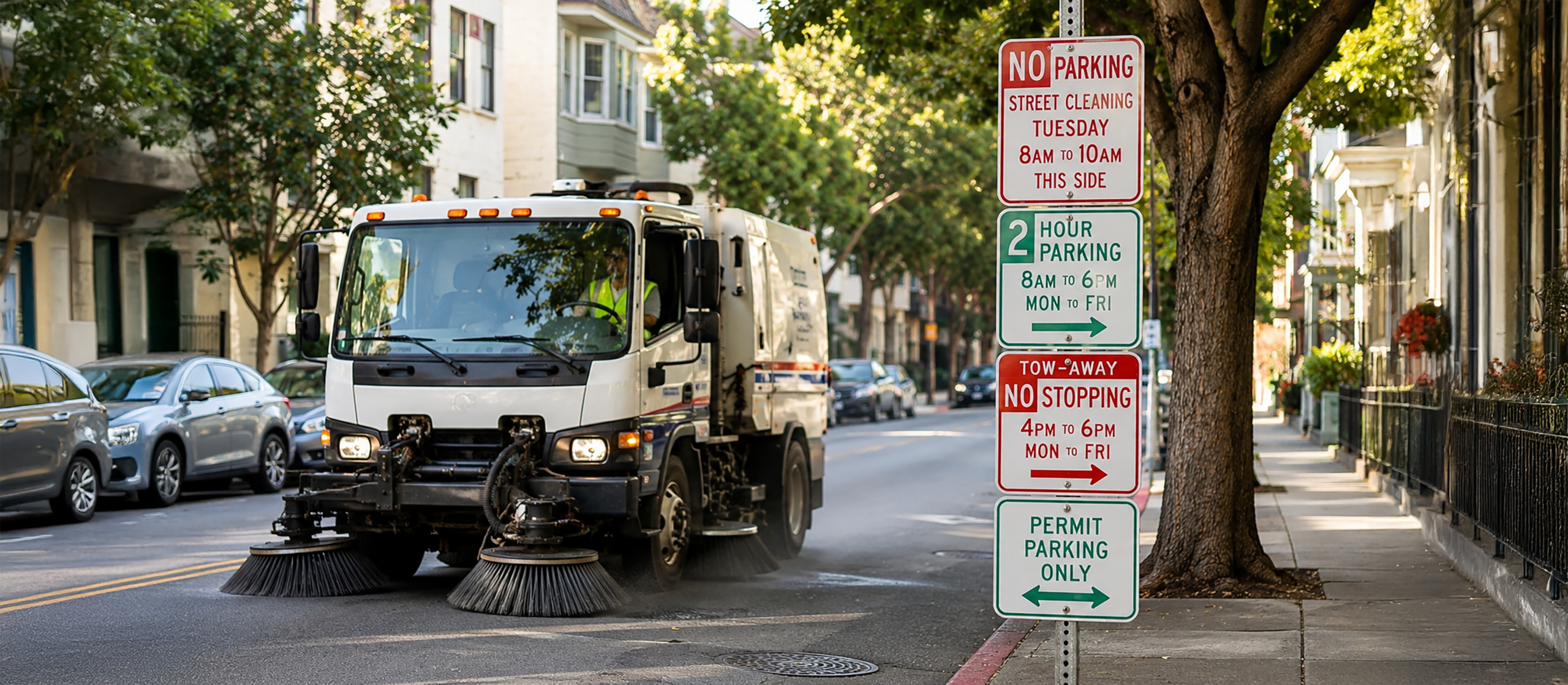
The street sweeper already passed. So you can park now…right?
Not necessarily.
Street sweeping signs tell drivers when parking is restricted for street cleaning. But even after the sweeper passes, a No Parking – Street Sweeping restriction may remain in effect until the posted time ends.
That assumption is exactly why street cleaning parking signs can be more confusing than they first appear.
A sign might read:
NO PARKING — STREET CLEANING
TUESDAY
8 AM–10 AM
At first glance, the rule seems straightforward. But real-world parking quickly raises more questions.
What if the sweeper passes at 8:30 AM?
What if it’s 10:05 AM?
What if another sign on the same pole allows 2 HOUR PARKING?
Does an arrow mean the street-cleaning restriction applies to your space—or only to the curb on the other side of the sign?
And what happens on holidays?
Understanding a street cleaning parking sign isn’t just about spotting the words “Street Cleaning.” You need to consider the day, time, location, directional arrows, other posted restrictions, and applicable local parking rules.
The most important thing to remember is simple:
The street sweeper and the parking restriction aren’t necessarily the same thing.
Whether you can park depends on the rules that apply to your space—not simply whether you’ve already watched the cleaning truck drive by.
So before you pull into that freshly swept curb and walk away from your car, here’s what to check.
What Does a Street Cleaning Parking Sign Mean?
Street cleaning—or street sweeping—parking signs typically establish a period when parking is restricted so the street can be cleaned.
A sign may specify:
the day
the time
the applicable section of street
and sometimes additional conditions or exceptions.
The important thing to understand is that “Street Cleaning” by itself isn’t enough information.
You need to read the complete restriction.
For example:
NO PARKING — STREET CLEANING
TUESDAY
8 AM–10 AM
communicates much more than simply “street cleaning happens here.”
The day and time help determine when that particular restriction applies.
Step 1: Check the Day
Start with the day listed on the sign.
A street-cleaning restriction may apply only on certain days of the week or according to another posted schedule.
For example:
MONDAY
TUESDAY & THURSDAY
1ST & 3RD WEDNESDAY
or another locally defined schedule.
If today isn’t one of the applicable days, that specific street-cleaning restriction may not currently be in effect.
But don’t stop there.
Other parking restrictions can still apply.
A street-cleaning sign not being active doesn’t automatically mean the space is legal to park in.
Step 2: Check the Time
Next, look at the enforcement hours.
Suppose the sign says:
NO PARKING — STREET CLEANING
TUESDAY
8 AM–10 AM
If it’s Tuesday at 9:00 AM, the posted street-cleaning restriction appears to fall within its stated time window.
If it’s 11:00 AM, that particular time window has passed—but you still need to check whether another parking rule applies.
This is why parking decisions require more than spotting the words NO PARKING.
You need to ask:
Does this restriction apply today and right now?
Step 3: Pay Attention to the Arrow
Street-cleaning parking signs may include directional arrows indicating where the restriction applies.
For example:
← NO PARKING — STREET CLEANING
or:
NO PARKING — STREET CLEANING →
The arrow can help indicate which section of curb is affected by the restriction.
That means the exact position of your vehicle relative to the sign may matter.
Don’t assume that because you can see a street-cleaning sign, it necessarily applies to every parking space around it.
Read the direction along with the restriction, day, and time.
If directional signs are what confuse you, learn more about what parking sign arrows mean and how they can affect which section of curb a restriction applies to.
Step 4: Check the Other Signs on the Pole
This is where things can get confusing.
Imagine a pole containing:
2 HOUR PARKING
8 AM–6 PM
and:
NO PARKING — STREET CLEANING
TUESDAY
8 AM–10 AM
It’s Tuesday at 9:15 AM.
The first sign appears to allow two-hour parking during the day.
But the second sign establishes a street-cleaning restriction during part of that same period.
You can’t simply choose the sign you’d prefer to follow.
You need to determine which restrictions apply at that particular day and time.
At 11:00 AM, the applicable combination of rules may be different.
Same curb.
Same signs.
Different time.
Different parking decision.
When several rules appear together, our guide to how to read multiple parking signs on one pole explains how to evaluate overlapping restrictions step by step.
Can I Park After the Street Sweeper Passes?
This is where drivers should be especially careful.
You might see the street sweeper drive past at 8:30 AM even though the sign says:
NO PARKING — 8 AM–10 AM
It’s tempting to assume:
The sweeper already passed. I can park now.
But that is not a safe universal rule.
Whether parking becomes permissible after a sweeper passes—or remains restricted for the entire posted enforcement period—can depend on local regulations.
The safest approach is to follow the posted restriction and applicable local parking rules, rather than assuming that the sweeper’s physical location determines whether enforcement has ended.
What If the Street Sweeper Hasn’t Arrived Yet?
The opposite situation can happen too.
Suppose it’s within the posted street-cleaning period, but you haven’t seen a street sweeper.
That doesn’t necessarily mean the parking restriction isn’t in effect.
The posted regulation—not whether you can currently see a cleaning vehicle—is what you should evaluate.
A delayed sweeper, changed route, or absence of visible cleaning activity shouldn’t automatically be interpreted as permission to park.
What Happens When Street Cleaning Ends?
Suppose the sign says:
NO PARKING — STREET CLEANING
TUESDAY
8 AM–10 AM
and it’s now 10:15 AM.
The street-cleaning restriction’s posted time window may have ended.
But before parking, check the other applicable rules.
The same space could also have:
2 HOUR PARKING
PERMIT PARKING
LOADING ONLY
NO PARKING DURING RUSH HOUR
or another restriction.
The end of one restriction does not necessarily mean unrestricted parking begins.
Think of street parking as layers.
When one layer ends, another may still apply.
This is especially important when leaving your car overnight, since a space that is legal when you park may become restricted the next morning. Our guide to Overnight Parking Rules explains what to check before leaving your vehicle overnight.
What About Holidays?
Holiday rules can be particularly tricky because they vary between cities and jurisdictions.
Some locations may suspend certain street-cleaning restrictions on particular holidays. Others may follow different schedules or exceptions.
Don’t assume that because it’s a holiday, street-cleaning parking rules are automatically suspended.
Check the posted signs and the applicable municipality’s current parking-enforcement information when a holiday may affect the schedule.
What About Temporary Street Cleaning Signs?
Not all street-cleaning restrictions are permanent.
Cities or other authorities may temporarily restrict parking for special cleaning, construction, events, emergencies, road work, or other purposes.
Temporary notices can sometimes change the rules you normally expect on a familiar street.
So even if you’ve parked in the same location many times before, look around for new or temporary signs before leaving your vehicle.
Yesterday’s parking rules may not tell you everything you need to know today.
A Simple Formula for Reading Street Cleaning Parking Signs
When you encounter a street-cleaning sign, work through it in this order:
LOCATION → DAY → TIME → ARROW → OTHER SIGNS → TEMPORARY RESTRICTIONS
LOCATION
Does this street-cleaning sign apply to where my car is parked?
DAY
Is today one of the restricted days?
TIME
Is the current time within the posted restriction?
ARROW
Which section of curb does the restriction cover?
OTHER SIGNS
Do additional parking rules apply to the same space?
TEMPORARY RESTRICTIONS
Are there temporary notices or changed conditions?
Then ask:
Why Street Cleaning Signs Cause So Much Confusion
Street-cleaning signs illustrate one of the biggest challenges with street parking.
The answer can change based on time.
At 7:30 AM, one rule may apply.
By 8:30 AM, street cleaning may create a different restriction.
Later 10:30 AM, that restriction may no longer apply—but a two-hour parking limit could.
So the sign isn’t simply telling you:
“You can park here.”
or:
“You can’t park here.”
It’s communicating:
“Whether you can park here depends on when you’re asking.”
For a broader look at interpreting days, times, restrictions, arrows, and exceptions, see our guide on how to read parking signs.
And that is exactly where parking gets complicated.
Can ParkClear Help With Street Cleaning Parking Signs?
ParkClear is designed to help simplify parking decisions involving time-sensitive restrictions such as street cleaning.
Using location-based technology and parking sign analysis, ParkClear helps drivers understand applicable parking information and provides clearer “Yes” or “No” parking guidance based on the circumstances of their parking decision.
Learn more about how ParkClear helps read street parking signs and simplifies complicated parking information into clearer guidance.
Instead of manually comparing the location, day, time, signs, arrows, and overlapping restrictions, ParkClear helps make that information easier to understand.
Because ultimately, you don’t want to become an expert on street-cleaning schedules.
You just want to know:
Can I park here?
Before You Park on Street Cleaning Day
Remember this sequence:
LOCATION → DAY → TIME → ARROW → OTHER SIGNS → TEMPORARY RESTRICTIONS
Don’t rely solely on whether the sweeper has already passed.
Don’t assume that the end of street cleaning means all parking restrictions have ended.
And don’t forget to check for additional signs that may govern the same parking space.
Street cleaning is only one layer of the parking rules around you.
The goal is to understand all the rules that apply here, today, and right now.
Park with confidence. Save time. Skip the parking-sign headache.
Download ParkClear
Parking regulations vary by jurisdiction. Always follow posted signs and applicable local laws, and check official local rules when necessary.



7 Comments