
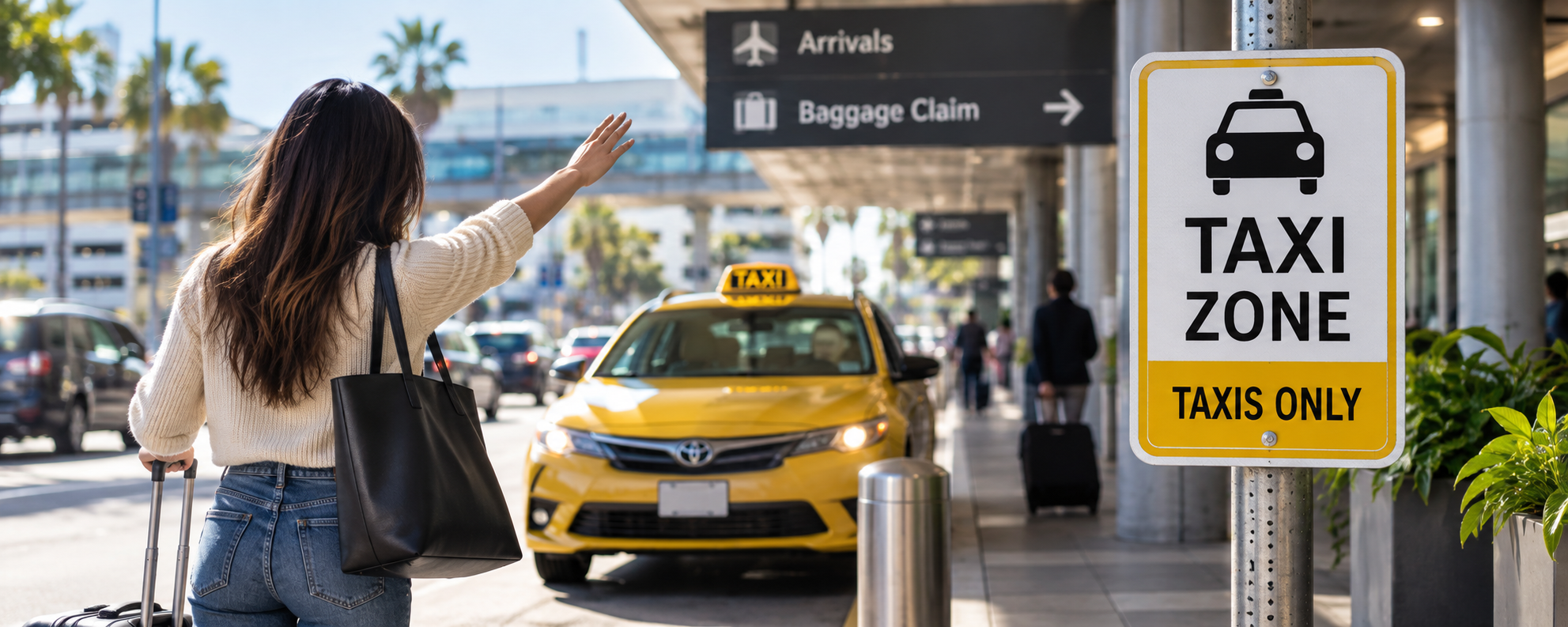
Taxi zones are designated curb areas intended to give taxis or other authorized vehicles space to pick up and drop off passengers. When the curb is empty, however, it can look like an available parking space.
If you’re wondering, “Can I park in a taxi zone?” the answer depends on the taxi zone parking rules, posted signs, hours of restriction, vehicle requirements, and local parking laws.
An empty taxi zone does not necessarily mean the space is available for regular parking.
What Is a Taxi Zone?
A taxi zone, sometimes called a taxi stand, is a designated curb area reserved for taxi operations or other specifically authorized vehicles.
These areas may be located near hotels, airports, transportation hubs, entertainment districts, hospitals, shopping areas, and other places where passengers frequently need transportation.
Signs, curb markings, pavement markings, or other indicators may identify the restricted area.
Because taxi zone parking rules vary by jurisdiction, always check the restrictions posted at the location before using the curb space.
Can You Park in a Taxi Zone?
Generally, you should not treat an active taxi zone as an ordinary parking space.
The space may remain reserved even when no taxi is currently waiting there.
Whether another vehicle may use the space depends on the restriction shown on the sign and applicable local rules. Some taxi zones operate continuously, while others may apply only during specified days or hours.
Before parking, read the entire sign rather than assuming an empty curb is available.
Can You Park in a Taxi Zone After Hours?
Possibly.
If a taxi-zone restriction applies only during specific hours, the curb may have different rules outside that period.
However, the end of the taxi restriction does not automatically mean unrestricted parking begins.
Another restriction could take effect afterward, such as metered parking, permit parking, street cleaning, No Parking, or an overnight restriction.
Our guide to parking in a No Parking zone after hours explains why you should determine what rule applies after a timed restriction ends.
Can You Wait in Your Car in a Taxi Zone?
Do not assume that remaining inside your vehicle makes the stop permissible.
Parking, standing, and stopping can have different meanings under local parking laws. A taxi-zone restriction may prohibit certain activities even when the driver remains behind the wheel.
For example, waiting several minutes for someone may be treated differently from immediately picking up a passenger.
Our guide to No Parking vs. No Standing vs. No Stopping explains why these distinctions matter.
Can You Pick Someone Up in a Taxi Zone?
That depends on the posted restriction and local rules.
A driver may assume that a quick passenger pickup is acceptable because taxis also use the area for passengers. However, a taxi zone may be reserved specifically for taxis or other authorized vehicles.
If general passenger pickup is allowed nearby, a designated passenger loading area may be the appropriate location.
See our guide to passenger loading zones for more information about short-term passenger pickup and drop-off areas.
Taxi Zone vs. Passenger Loading Zone: What’s the Difference?
The two curb areas may serve similar activities, but they are not necessarily interchangeable.
A taxi zone is generally associated with taxis or other specifically authorized transportation services.
A passenger loading zone is generally intended for short-term passenger pickup or drop-off, subject to the restrictions at that location.
Never assume that permission to use one type of curb zone means you can use the other.
The wording on the sign matters.
Taxi Zone vs. Loading Zone: What’s the Difference?
A general loading zone may be intended for passenger loading, commercial loading, goods delivery, or another specific activity depending on the jurisdiction.
A taxi zone serves a more specific transportation purpose.
Our guide to loading zone parking rules explains why drivers should identify the exact type of loading or curb restriction before stopping.
What Do Taxi Zone Signs Mean?
Taxi-zone signs may include more than the words Taxi Zone or Taxi Stand.
Look for information such as:
- Days and hours
- Directional arrows
- Vehicle restrictions
- Time limits
- No Parking, No Standing, or No Stopping language
- Tow-away warnings
- Additional restrictions
Arrows are particularly important because the restricted area may extend beyond the exact location of the sign.
See our guide to parking sign arrows for help understanding which direction a restriction applies.
What If Several Parking Signs Are Posted Near the Taxi Zone?
Read them together.
A curb may serve different purposes at different times of day. For example, one sign could establish taxi-zone hours while another governs parking outside those hours.
The applicable rule depends on the day, time, location, and wording of the signs.
Our guide to multiple parking signs explains how to work through overlapping restrictions.
Do Curb Colors Identify Taxi Zones?
Some jurisdictions use painted curbs to communicate parking or stopping restrictions, but curb-color meanings are not universal.
Do not assume that a particular curb color always means taxi parking—or that an unpainted curb means no taxi restriction exists.
Read the nearby signs together with the curb markings.
See our guide to curb colors and their meanings for more information.
Can You Get a Parking Ticket for Parking in a Taxi Zone?
Yes.
Using a taxi zone when your vehicle or activity is not permitted may result in parking enforcement. Depending on the jurisdiction and circumstances, consequences may include a citation or potentially towing.
The fact that the taxi zone was empty when you arrived does not necessarily affect whether the restriction applies.
What matters is whether your vehicle was allowed to occupy the space at that particular day and time.
Is a Taxi Zone the Same as a Bus Zone?
No.
Both reserve curb space for transportation purposes, but they serve different types of vehicles and operations.
A bus zone may provide space for buses to approach the curb, board passengers, and leave the stop safely. A taxi zone generally reserves space for taxi-related passenger service.
Our guide to bus zone parking rules explains what drivers should check around bus stops and bus zones.
What If the Taxi Zone Sign Is Confusing?
Start with the entire parking environment rather than focusing only on the words Taxi Zone.
Check the days, hours, arrows, curb markings, vehicle restrictions, nearby signs, and any temporary notices.
If the sign is difficult to interpret, ParkClear’s parking sign scanner is designed to help drivers understand confusing parking restrictions.
How ParkClear Helps With Taxi Zone Parking Rules
Curbside parking can involve several restrictions at the same location, especially in busy areas where curb space serves different purposes throughout the day.
ParkClear helps drivers interpret parking signs and location-based parking rules so they can get a clear Yes or No answer to the question: “Can I park here?”
ParkClear can also help with loading zones, passenger loading zones, bus zones, parking meters, street cleaning, permit restrictions, and other common street-parking situations.
The Bottom Line: Can You Park in a Taxi Zone?
You should not assume that you can park in a taxi zone simply because no taxi is currently using the space.
Check the taxi zone parking rules, posted days and hours, vehicle requirements, arrows, curb markings, and any additional restrictions before stopping or leaving your vehicle.
If the taxi-zone restriction is not currently active, determine what parking rule applies next before assuming the curb is available.
Download ParkClear
Confused about whether you can park? Download ParkClear to scan parking signs or use your location to get a clear Yes or No answer to “Can I park here?”
Parking regulations vary by jurisdiction. Always follow posted signs and applicable local laws, and check official local rules when necessary.