
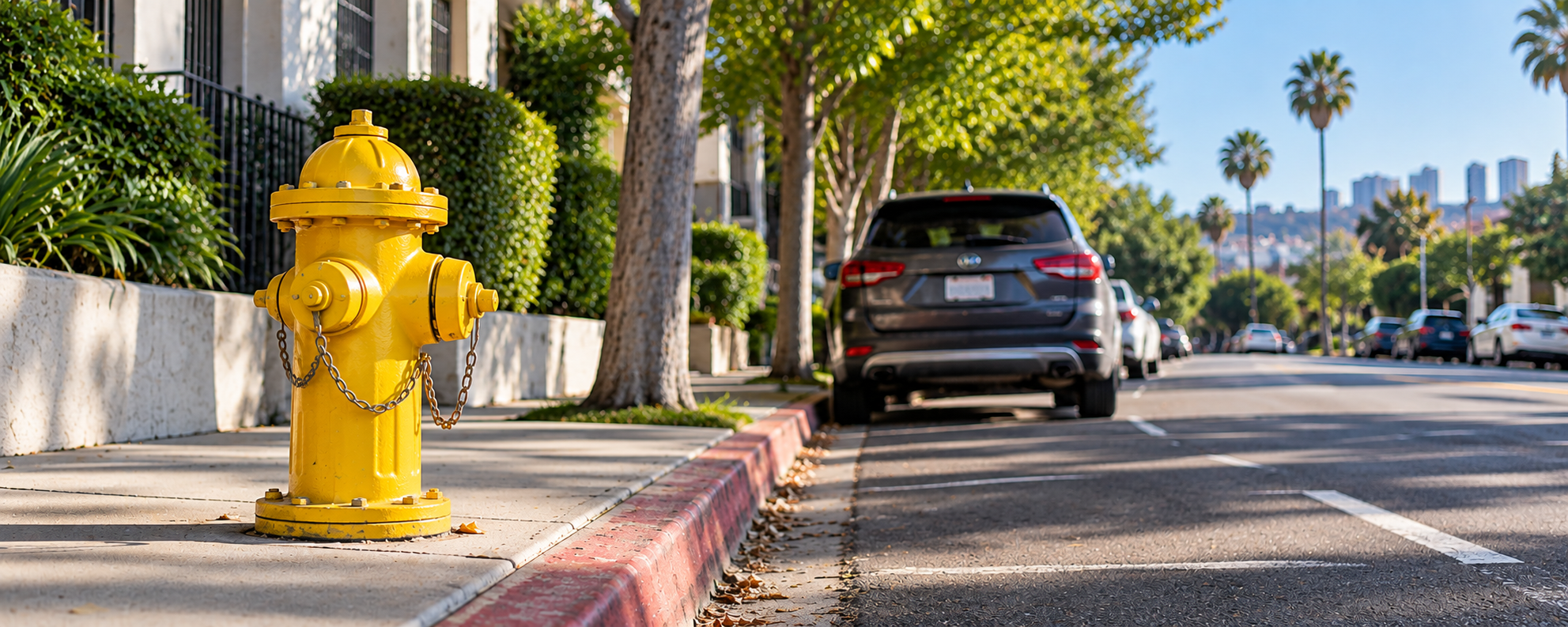
Parking near a fire hydrant can be confusing, especially when there are no obvious curb markings or nearby parking signs.
If you’re wondering, “Can I park in front of a fire hydrant?” the answer depends on applicable local parking laws and the required distance your vehicle must maintain from the hydrant.
Do not assume a space is legal simply because there is no No Parking sign or painted curb.
Can You Park in Front of a Fire Hydrant?
Generally, local parking laws prohibit vehicles from parking too close to a fire hydrant.
Each jurisdiction can set its own required distance from a fire hydrant, so drivers should not assume one distance applies everywhere.
Before parking near a hydrant, check the applicable local rule and make sure your entire vehicle meets the required clearance.
How Far Away Do You Have to Park From a Fire Hydrant?
The required distance depends on local law.
Different states and municipalities can establish different minimum distances, and additional restrictions may apply at a particular location.
This is why drivers should avoid relying on a distance they remember from another city.
When in doubt, check the official parking regulations for the jurisdiction where you are parking.
Does There Have to Be a No Parking Sign Near a Fire Hydrant?
Not necessarily.
Traffic and parking laws can restrict parking even when no sign appears at the location.
A fire hydrant may therefore have a legally required clearance area even when there is no separate No Parking sign beside it.
That makes it important to look beyond signs when evaluating whether a street parking space is legal.
Does the Curb Have to Be Painted Red?
Not necessarily.
Curb colors and marking practices vary by jurisdiction.
Local hydrant restrictions may still apply even when the curb has no red paint or other warning color.
Never assume you can park beside a hydrant simply because the curb has no paint.
See our guide to curb colors and their meanings for more information about interpreting painted curbs.
Can You Park Across the Street From a Fire Hydrant?
Parking across the street from a hydrant is different from parking directly beside one, but other parking restrictions may still apply.
Check for posted signs, curb markings, driveways, intersections, street-cleaning rules, and other restrictions affecting the space.
Instead, check the parking rules for the curb where you plan to leave your vehicle.
Can You Stop Temporarily in Front of a Fire Hydrant?
Do not assume that stopping temporarily makes the space legal.
Rules distinguishing parking, standing, and stopping vary by jurisdiction and by the restriction involved.
If you’re unsure about those terms, see ParkClear’s guide to No Parking vs. No Standing vs. No Stopping.
What If a Parking Meter Is Next to a Fire Hydrant?
A parking meter does not automatically override another parking restriction.
If a space is subject to a hydrant-clearance rule or another restriction, the presence of a nearby meter should not by itself be treated as permission to park.
Evaluate the specific space and all applicable restrictions before paying a meter or leaving your vehicle.
See our guide to parking meter rules for more information about meters and overlapping parking restrictions.
What If There Are Parking Signs Near the Hydrant?
Read every applicable sign.
A nearby sign may establish additional restrictions involving time limits, permit parking, street cleaning, loading, or other parking rules.
Parking legally often requires considering the hydrant rule and the posted parking signs at the same time.
Our guide to multiple parking signs explains how to work through overlapping restrictions.
Can You Get a Ticket for Parking Too Close to a Fire Hydrant?
Yes.
Parking within a prohibited hydrant-clearance area can result in enforcement, with penalties depending on the jurisdiction and circumstances.
Fire hydrant restrictions exist to preserve access for emergency responders, so drivers should treat them seriously even when the curb appears otherwise available.
Can Your Car Be Towed for Blocking a Fire Hydrant?
Potentially.
Towing authority and enforcement procedures vary by jurisdiction, but parking where a vehicle obstructs legally required access to a fire hydrant can carry consequences beyond an ordinary parking citation.
If you’re uncertain whether your vehicle is sufficiently far from a hydrant, verify the local requirement before leaving it.
How ParkClear Helps With Street Parking Rules
Determining whether a street parking space is legal can require more than reading one sign.
ParkClear helps drivers understand confusing parking signs and street parking rules.
Scan a parking sign or use your location to get a clear Yes or No answer to the question: “Can I park here?”
ParkClear can also help drivers interpret curb colors, multiple parking signs, parking meters, No Parking restrictions, and other street parking rules.
The Bottom Line: Can You Park Near a Fire Hydrant?
You should not park within the legally required clearance area around a fire hydrant.
Because the required distance and enforcement rules vary by jurisdiction, check applicable local regulations rather than assuming a universal distance.
Also remember that the absence of a sign or painted curb does not necessarily mean the space is legal.
When street parking rules are difficult to understand, ParkClear is designed to make parking decisions clearer.
Download ParkClear
Confused about whether you can park? Download ParkClear to scan parking signs or use your location to get a clear Yes or No answer to “Can I park here?”
Parking regulations vary by jurisdiction. Always follow posted signs and applicable local laws, and check official local rules when necessary.