
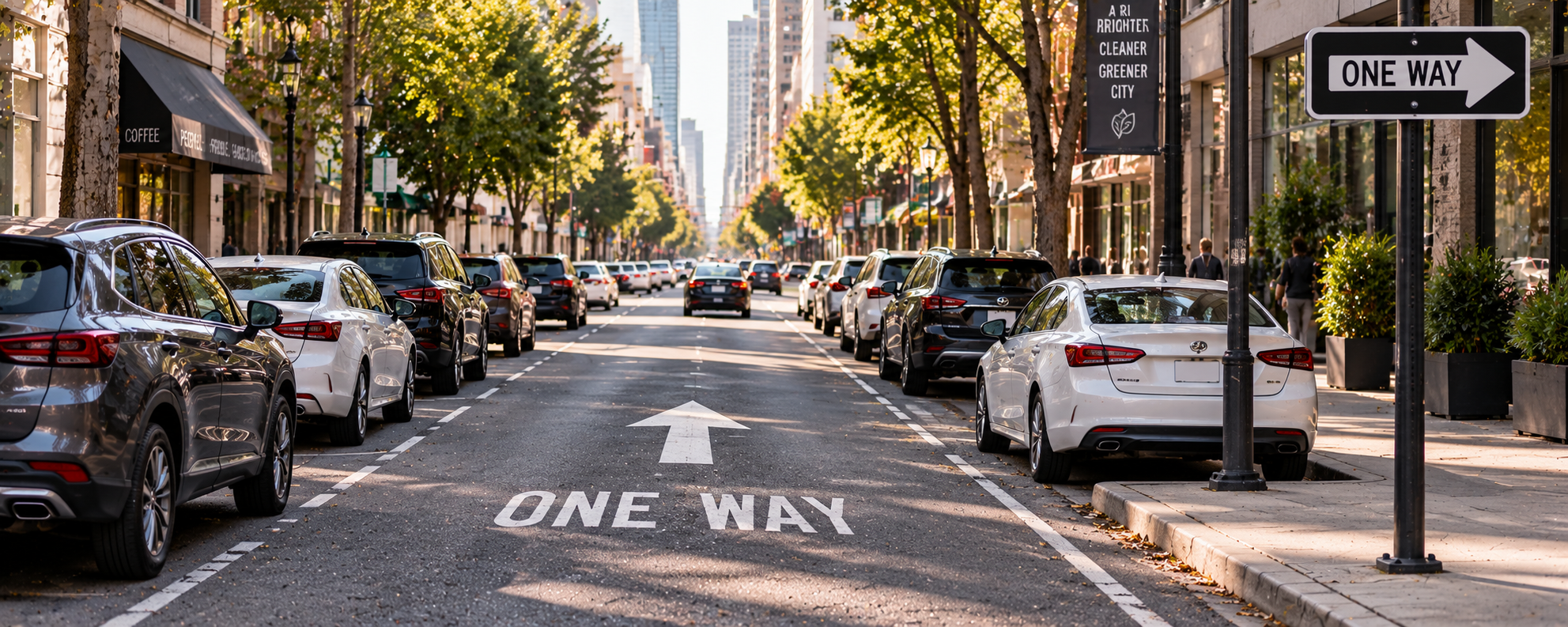
You turn onto a one-way street and see cars parked along both sides.
The right curb looks normal—but there are also vehicles parked along the left curb. Is that actually allowed? And if you park on the left side, which direction should your car face?
Parking on a one-way street depends on local law, posted restrictions, street design, and what each curb is designated for. A one-way traffic pattern does not automatically mean you can park on both sides of the street.
In some locations, parking may be permitted along either curb. In others, one side may be restricted because of bike lanes, loading zones, transit lanes, street cleaning, fire restrictions, or other uses.
The key is to evaluate each side of the street separately.
Can You Park on Either Side of a One-Way Street?
Possibly.
Unlike a typical two-way street, all normal vehicle traffic on a one-way street travels in the same direction. Depending on local law and the street configuration, parking may be permitted along the right curb, left curb, or both.
But don’t assume that because traffic moves only one way, every open curb becomes available parking.
One side of the street might contain:
- A bike lane
- A bus lane
- A loading zone
- A No Parking area
- A fire lane
- A passenger loading zone
- Metered parking
- Permit parking
- Temporary restrictions
Look at the rules controlling the specific curb where you want to park.
Can You Park on the Left Side of a One-Way Street?
In some jurisdictions and street configurations, yes.
Left-side parking can be one of the biggest differences drivers notice between one-way and two-way streets.
Because traffic is traveling in a single direction, local law may permit vehicles to park along the left curb when no other restriction prohibits it.
But “one-way street” does not automatically mean “left-side parking allowed.”
You still need to check the signs, curb markings, pavement markings, and applicable local parking rules.
Which Direction Should Your Car Face?
Parking location and parking direction are two different questions.
Even when local rules allow parking along the left side of a one-way street, your vehicle may still need to face in the direction of authorized traffic flow.
Don’t assume that parking on the left means you should turn the vehicle around to face the opposite direction.
Our guide to parking on the wrong side of the street explains why an otherwise legal curb space can still create a problem if the vehicle is positioned contrary to applicable parking-direction rules.
What If Cars Are Parked on Both Sides?
A row of parked vehicles can help you understand how a street is commonly used, but it doesn’t prove that every vehicle is legally parked.
Look at each curb independently.
The left side could allow parking while the right side has a restriction—or vice versa.
Restrictions may also change during the day.
For example, a curb used for parking during one period might become a loading area, traffic lane, or other restricted zone during another.
Read the signs rather than relying solely on what other drivers are doing.
What If There Are No Parking Signs?
The absence of a No Parking sign doesn’t automatically answer every question.
Some parking requirements come from state or local traffic law rather than a sign placed beside every individual space.
You should still consider:
- Vehicle direction
- Intersections
- Crosswalks
- Driveways
- Fire hydrants
- Bike lanes
- Curb markings
- General time limits
A street can appear completely unrestricted while still having rules that affect where or how you may park.
Does a Bike Lane Change Which Side You Can Park On?
It can.
One-way streets frequently share limited roadway space with bicycle infrastructure.
A bike lane may run along the right side, left side, or in a protected configuration separated from vehicle traffic.
Don’t treat an open bicycle lane as curbside parking simply because it sits beside the edge of the street.
Some protected bike-lane designs intentionally place a legal parking lane between moving vehicle traffic and the bicycle lane. Others do not.
Our guide to parking in a bike lane explains how to distinguish a designated vehicle parking area from bicycle travel space.
What About Bus Lanes?
A bus lane can also affect curb access on a one-way street.
The lane may prohibit parking entirely, restrict parking during particular hours, or operate under another set of local rules.
Nearby signs should tell you how that section of street is regulated.
If you’re near a designated bus stop or bus zone, see our guide to bus zone parking rules.
Don’t assume that a wide curb lane is intended for parked vehicles simply because there is enough physical space for a car.
Can You Park in a Loading Zone on a One-Way Street?
The fact that the street is one-way doesn’t override a loading-zone restriction.
If the curb is designated for loading during the applicable day and time, follow those rules.
Some loading zones may permit particular activity or vehicle types, while others have different restrictions depending on local law.
Our guide to loading zone parking rules explains what drivers should look for before using a loading area.
Do Parking Sign Arrows Matter?
Absolutely.
One-way streets can have multiple parking regulations along a relatively short block.
An arrow on a sign can indicate whether a restriction extends toward one end of the block or the other.
The fact that the sign isn’t directly beside your vehicle doesn’t necessarily mean it doesn’t apply to your space.
Our guide to parking sign arrows explains how arrows can define the section of curb controlled by a restriction.
What If There Are Several Signs on the Same Pole?
Read them together.
A one-way downtown street might combine:
2 Hour Parking
with
No Parking 7 AM–9 AM
and
Permit Excepted
or another restriction.
One sign doesn’t necessarily cancel the others.
Instead, determine which rules apply to your vehicle on the current day and at the current time.
Our guide to reading multiple parking signs can help when several restrictions apply to the same curb.
Can Street Cleaning Apply to Only One Side?
Yes, street-cleaning schedules can differ by side of the roadway.
One curb may be restricted on one day while the opposite curb has a different schedule.
This makes checking your specific side of the street especially important.
Seeing vehicles legally parked across the road doesn’t tell you whether your curb is currently legal.
Our guide to street sweeping parking explains how scheduled restrictions can change an otherwise legal parking space.
Can You Park Overnight on a One-Way Street?
Possibly, but the same principle applies: check what happens after you leave the vehicle.
A curb that allows parking during the evening may become restricted later because of:
- Overnight parking rules
- Permit requirements
- Street cleaning
- Morning traffic restrictions
- Loading hours
- Temporary restrictions
If you’re leaving your car overnight, don’t evaluate only the current conditions.
Our guide to residential street parking overnight explains why the next day’s restrictions matter too.
What About Angled Parking on a One-Way Street?
Some one-way streets use angled parking rather than parallel parking.
In that case, pavement markings and signs can indicate how vehicles should enter and occupy the spaces.
Follow the designated configuration rather than applying assumptions from ordinary parallel curb parking.
A clearly marked angled space may also require the vehicle to face a particular direction.
Can You Park Near the Corner of a One-Way Street?
One-way traffic doesn’t eliminate intersection-related parking restrictions.
Crosswalks, stop signs, traffic signals, curb ramps, and other intersection features may still affect how close you can legally park.
Our guide to how close you can park to a corner explains why an apparently open section at the end of a block isn’t necessarily a legal parking space.
How Should You Evaluate a One-Way Street?
Instead of asking only “Can I park on the left or right?”, work through the street in a simple order.
First, confirm the traffic direction. Make sure you’re actually on a one-way roadway and identify the permitted direction of travel.
Second, choose the curb you want to evaluate. Don’t assume the opposite side follows identical rules.
Third, read the signs for that side. Check days, hours, arrows, permits, meters, loading restrictions, and other controls.
Fourth, look at the roadway. Identify bike lanes, bus lanes, painted curbs, parking-space markings, driveways, and intersections.
Finally, check your vehicle’s position. Make sure you’re parking in the direction and manner required by applicable local law.
This separates two questions drivers often combine:
Can I use this curb?
and
Am I parking correctly on it?
Where ParkClear Fits In
One-way streets are a good example of why parking can become confusing even when the traffic direction itself is obvious.
One curb may allow parking while the other is restricted. Rules can change by time of day, and several signs may apply to the same block.
ParkClear helps drivers interpret confusing parking signs and location-based parking rules to provide a clear Yes or No answer to “Can I park here?”
When the posted restrictions are difficult to understand, ParkClear’s parking sign scanner can help interpret them.
Drivers can also check a future date and time when a restriction changes later.
When parking legality depends on a state or local rule that isn’t communicated by a sign, drivers should also verify the applicable official regulation.
One-Way Traffic Doesn’t Mean One Parking Rule
The biggest mistake is treating the entire street as though both curbs follow the same rules.
They may not.
A one-way street tells you which direction traffic moves. It doesn’t, by itself, tell you where parking is permitted.
Check the left curb and right curb separately. Read the signs. Look at the lane markings. Pay attention to bike lanes, loading areas, street-cleaning schedules, and time restrictions.
Then make sure your vehicle is facing and positioned correctly.
One street can have two curbs—and two completely different parking answers.
Download ParkClear
Confused about whether you can park? Download ParkClear to scan parking signs or use your location to get a clear Yes or No answer to “Can I park here?”
Parking regulations vary by jurisdiction. Always follow posted signs and applicable local laws, and check official local rules when necessary.